


by
Water is one of the biggest threats to concrete structures. Although concrete appears solid, it contains thousands of microscopic pores and capillary pathways that allow water and dissolved chemicals to penetrate over time. This water intrusion can lead to reinforcement corrosion, freeze-thaw damage, sulfate attack, leaks, and costly repairs.
Crystalline waterproofing offers a different approach. Instead of creating a protective layer on the surface, it becomes part of the concrete itself. The technology reacts with moisture and unhydrated cement particles to form insoluble crystals that permanently block water pathways within the concrete.
For engineers, architects, contractors, and developers, understanding crystalline waterproofing is essential when designing structures that demand long-term durability and reduced maintenance. From basements and tunnels to water treatment plants and marine structures, crystalline waterproofing has become a trusted solution for protecting concrete from water ingress and extending service life.
Table of Contents
- What Is Crystalline Waterproofing?
- How Does Crystalline Waterproofing Work?
- Why Concrete Needs Waterproofing
- Common Causes of Water Ingress
- Benefits of Crystalline Waterproofing
- Crystalline Waterproofing vs Membrane Waterproofing
- Where Is Crystalline Waterproofing Used?
- Best Practices for Successful Installation
- Common Mistakes to Avoid
- Frequently Asked Questions
- Conclusion
What Is Crystalline Waterproofing?
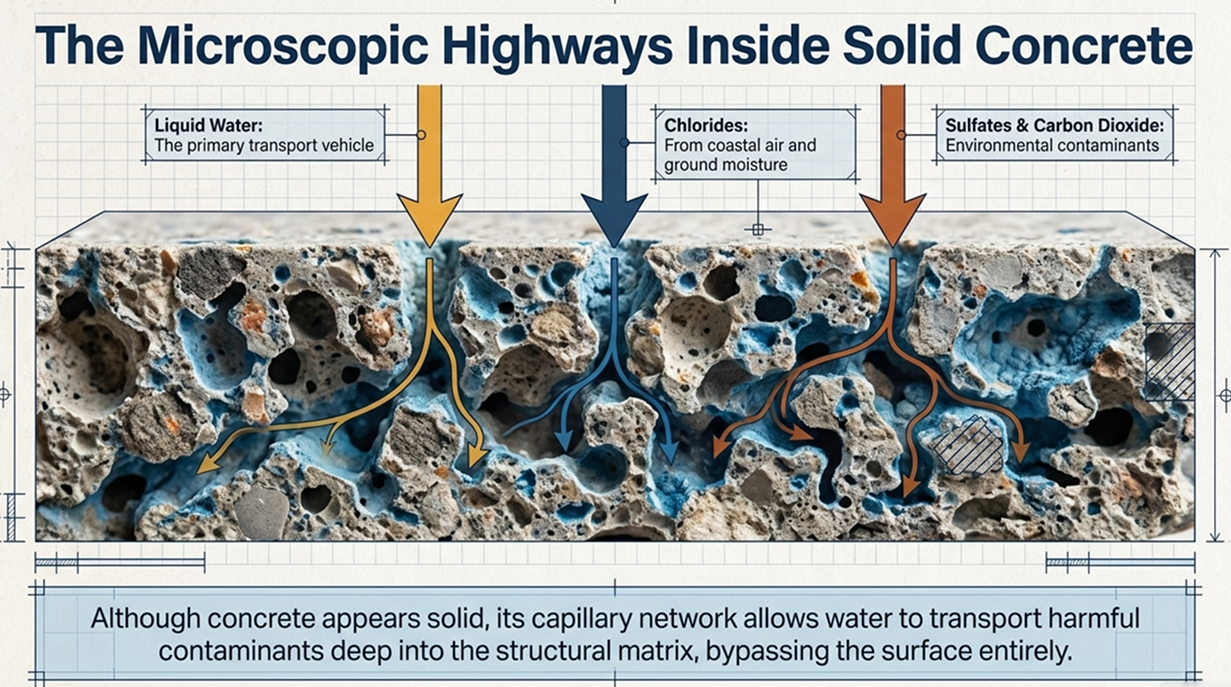
Concrete may look dense, but it is naturally porous. Tiny capillary pores and microscopic cracks allow water to move through the concrete over time. As moisture travels through these pathways, it carries chlorides, sulfates, and other aggressive chemicals that accelerate deterioration.
Crystalline waterproofing is an integral waterproofing technology designed to eliminate these pathways from within the concrete.
Unlike conventional waterproofing membranes that sit on the surface, crystalline waterproofing penetrates into the concrete matrix. When water enters the concrete, proprietary chemicals react with moisture and cement by-products to form insoluble needle-like crystals. These crystals grow deep inside the concrete and permanently block capillary pores and microcracks.
Because the waterproofing becomes part of the concrete, it cannot peel, puncture, delaminate, or wear away like traditional surface coatings.
Key Characteristics
- Waterproofs concrete from within
- Reactivates whenever moisture is present
- Becomes a permanent part of the concrete
- Resists high hydrostatic pressure
- Helps reduce reinforcement corrosion
- Protects against water and chemical ingress
- Suitable for new construction and rehabilitation
How Does Crystalline Waterproofing Work?
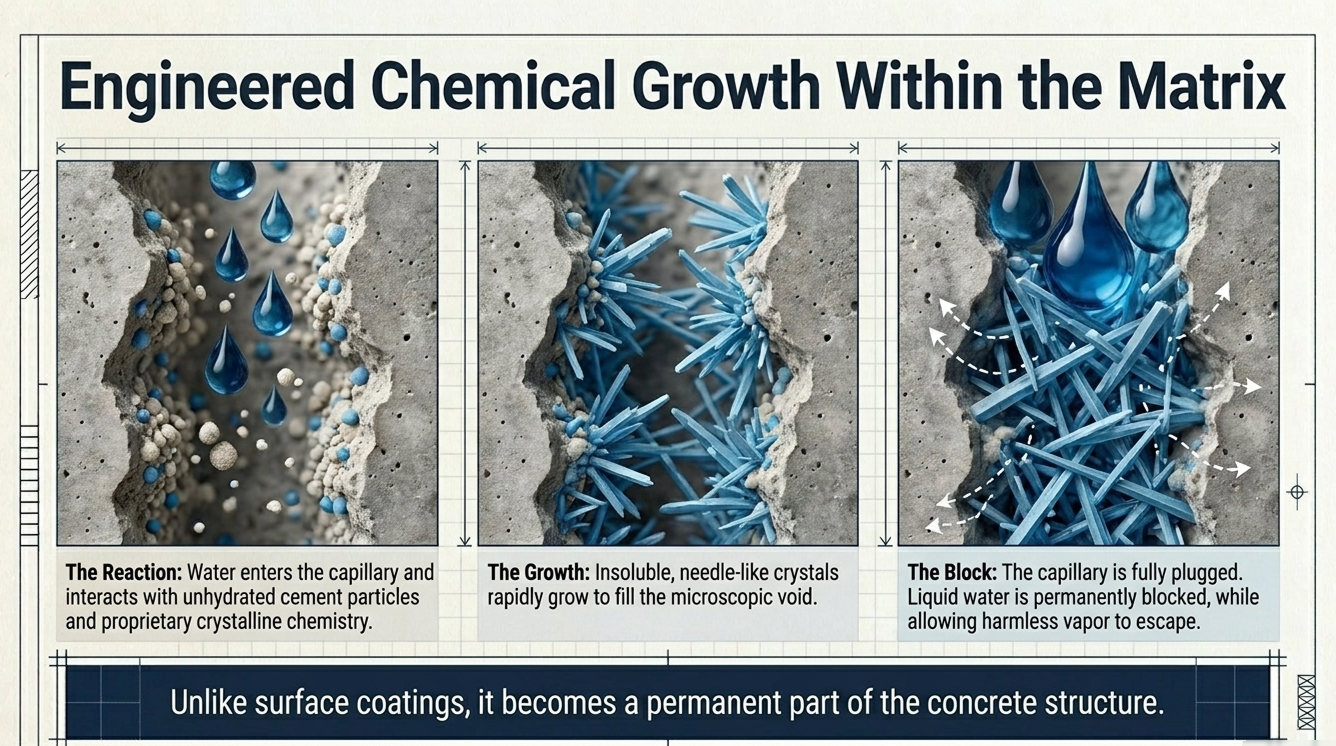
The effectiveness of crystalline waterproofing lies in its chemical reaction inside the concrete.
When the active chemicals come into contact with water and unhydrated cement particles, they begin producing insoluble crystalline formations. These crystals continue growing into the capillary network, gradually filling microscopic voids and pathways that water would normally use to penetrate the structure.
Unlike surface treatments that rely on adhesion, the protection is integrated into the concrete itself.
Even years after construction, dormant chemicals remain inside the concrete. If new moisture enters through a hairline crack, the chemicals reactivate and promote additional crystal growth, helping seal cracks up to the manufacturer’s specified limits.
The Process
- Water enters concrete.
- Active chemicals dissolve.
- Chemical reaction begins.
- Crystals develop inside pores.
- Water pathways become blocked.
- Concrete remains breathable while resisting liquid water.
This process provides long-term protection without creating a fragile surface barrier.
Why Concrete Needs Waterproofing
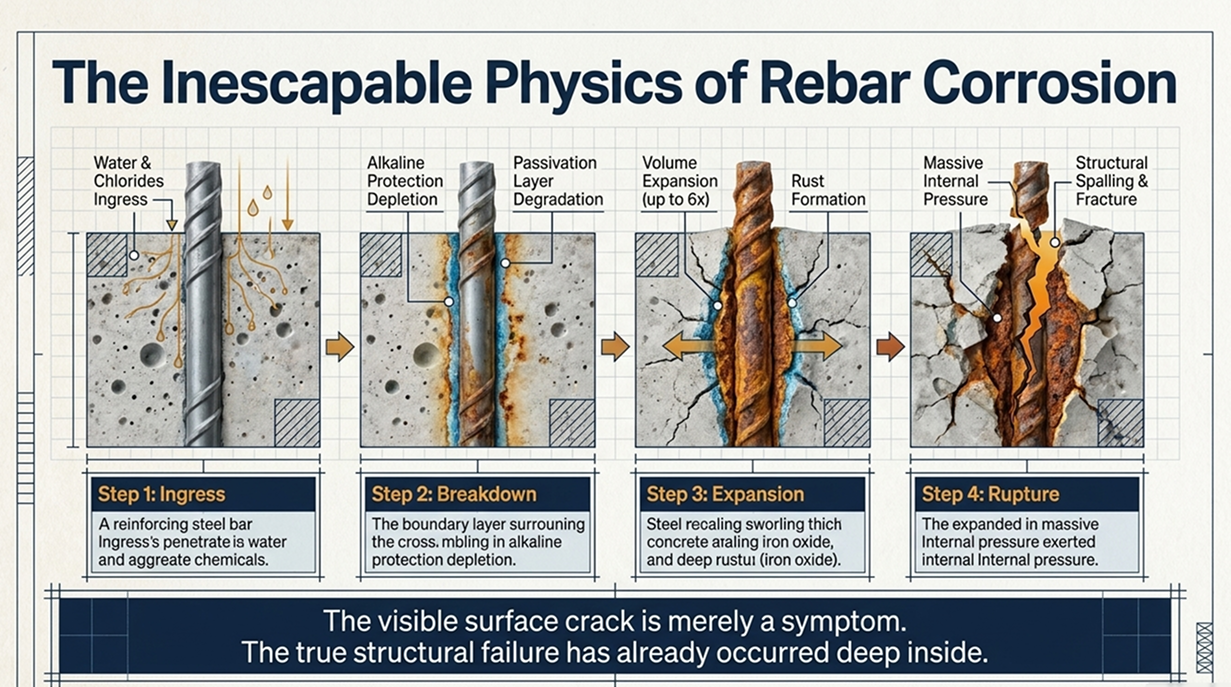
Many people assume concrete is naturally waterproof. In reality, standard concrete is water-resistant but not waterproof.
As concrete cures, it develops an interconnected network of pores. Water can move through these pores under pressure, especially in underground and water-retaining structures.
Without proper waterproofing, moisture penetration can lead to significant structural problems.
Common Risks
- Reinforcement corrosion
- Concrete cracking
- Mold and mildew
- Interior leaks
- Sulfate attack
- Chloride penetration
- Reduced structural lifespan
- Increased maintenance costs
The financial impact extends beyond repairs. Water damage often disrupts operations, delays projects, and increases lifecycle costs.
Investing in permanent waterproofing during construction is usually far more cost-effective than repairing water damage later.
Common Causes of Water Ingress
Water intrusion rarely occurs because of one issue alone. Instead, several factors often combine to create leakage and deterioration.
Poor Concrete Quality
High water-cement ratios produce more capillary pores, making concrete significantly more permeable.
Construction Joints
Every joint represents a potential leakage path if it is not properly detailed and protected.
Honeycombing
Poor vibration or inadequate concrete consolidation creates voids that allow water to travel freely.
Shrinkage Cracks
As concrete cures, drying shrinkage can produce hairline cracks that become water pathways.
Hydrostatic Pressure
Groundwater constantly pushes against underground walls and slabs. Over time, this pressure forces water into even the smallest openings.
Improper Waterproofing
When membranes fail, locating and repairing leaks often becomes expensive and disruptive.
Benefits of Crystalline Waterproofing
One of the primary reasons engineers specify crystalline waterproofing is its ability to provide long-term protection with minimal maintenance.
Instead of relying on a surface barrier that may deteriorate over time, crystalline waterproofing strengthens the concrete from within.
Major Benefits
Permanent Protection
The waterproofing becomes part of the concrete and does not require replacement.
Self-Sealing Capability
Dormant chemicals reactivate in the presence of water, helping seal future microcracks within design limits.
Resists Hydrostatic Pressure
Because the crystals form throughout the concrete matrix, protection works against both positive and negative water pressure.
Reduced Corrosion Risk
Limiting water penetration also reduces the movement of oxygen and chlorides that contribute to reinforcing steel corrosion.
Lower Maintenance Costs
Permanent protection means fewer repairs, reduced downtime, and lower lifecycle costs compared with many traditional waterproofing systems.
Sustainable Construction
By extending the service life of concrete structures, crystalline waterproofing helps reduce repair materials, demolition waste, and long-term environmental impact.
Suitable for New and Existing Structures
Crystalline waterproofing products are available as:
- Integral concrete admixtures
- Surface-applied coatings
- Repair mortars
- Joint treatment systems
This flexibility makes the technology suitable for both new construction and rehabilitation projects.
Crystalline Waterproofing vs Membrane Waterproofing
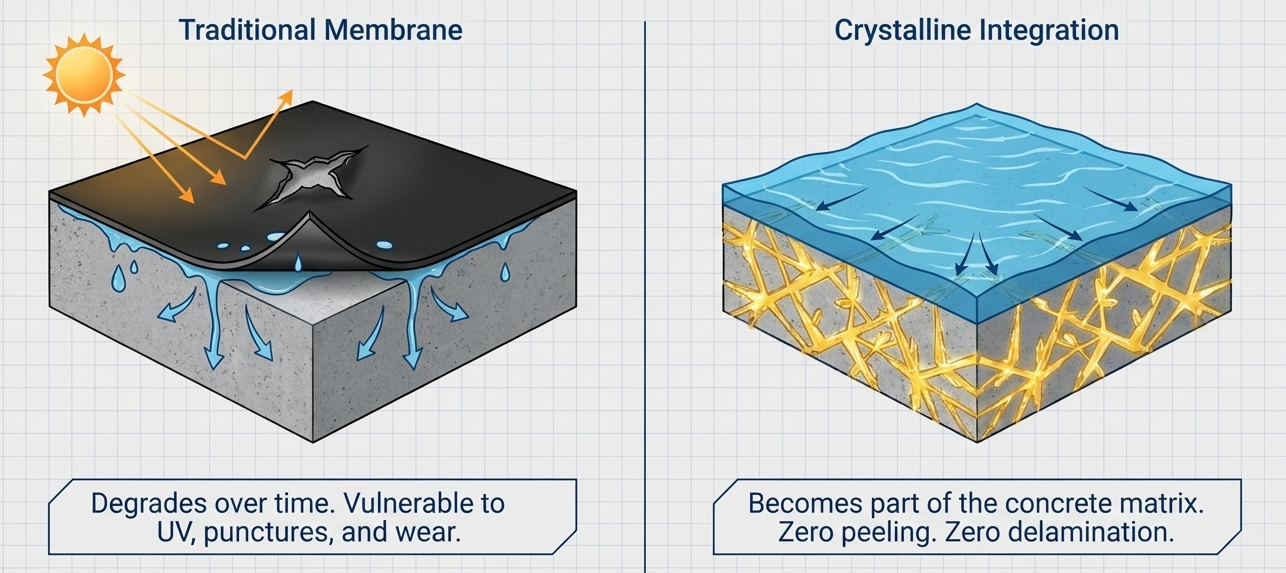
One of the most common questions from engineers and project owners is whether crystalline waterproofing is better than traditional membrane systems. The answer depends on the project, but for concrete structures exposed to continuous moisture or hydrostatic pressure, crystalline waterproofing often offers significant long-term advantages.
Unlike membranes, which protect only the surface, crystalline waterproofing becomes an integral part of the concrete. This means it cannot be punctured during backfilling, peeled away over time, or damaged by construction traffic.
That said, membranes still have an important role in some applications, such as roofing systems, balconies, and non-concrete substrates. In many complex projects, engineers even specify both systems to provide layered protection.
Real-World Applications of Crystalline Waterproofing
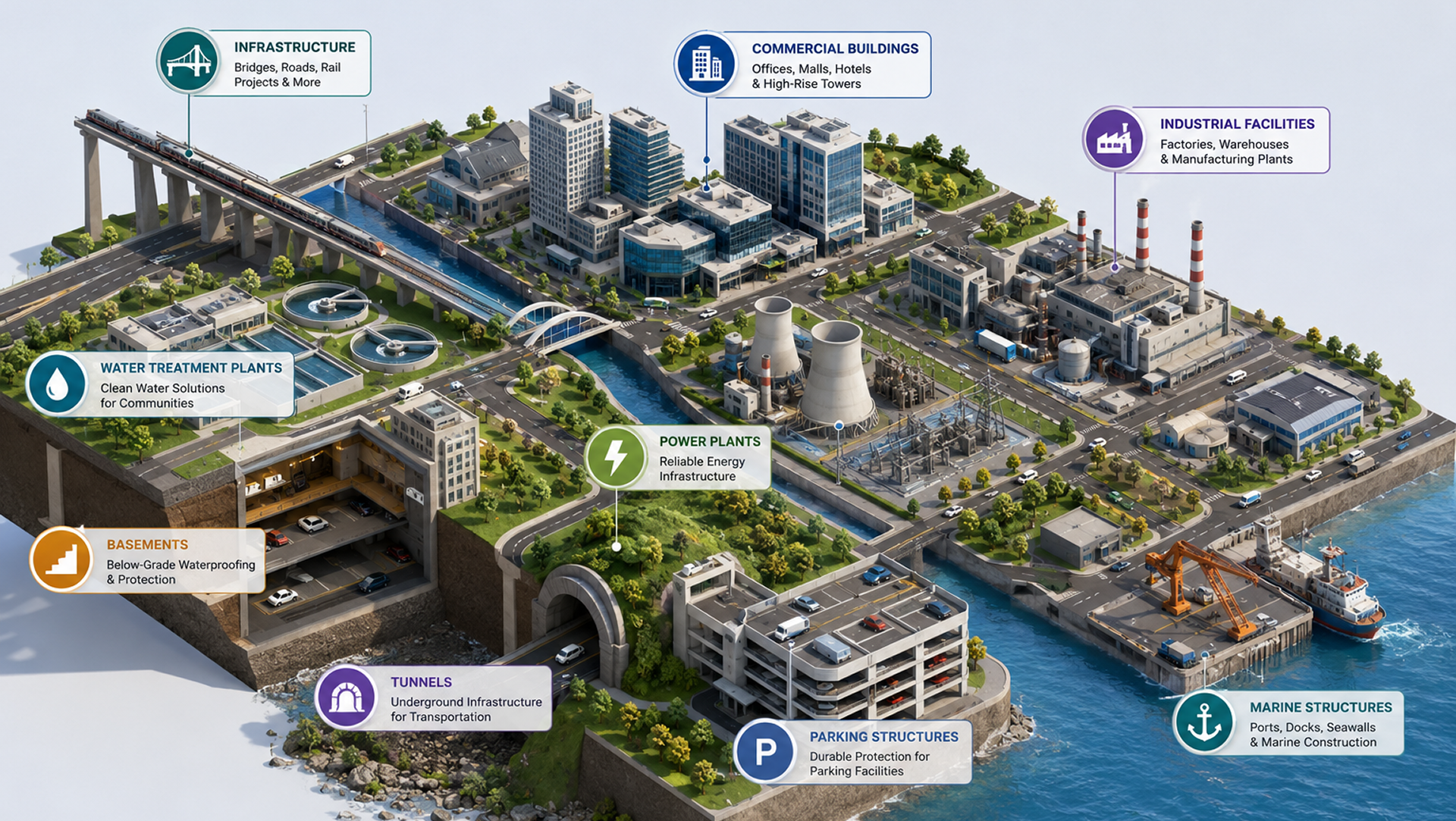
Crystalline waterproofing has been used for decades in projects where durability and watertight performance are critical. Because it protects concrete internally, it performs well in structures that are constantly exposed to water, groundwater, or aggressive chemicals.
Infrastructure Projects
Infrastructure assets often have long design lives and limited opportunities for maintenance. Crystalline waterproofing helps reduce water ingress and protects reinforcement from corrosion.
Common applications include:
- Tunnels
- Bridges
- Dams
- Subway stations
- Culverts
- Retaining walls
- Underground utility vaults
Commercial Buildings
Commercial developments require reliable waterproofing to prevent leaks, protect assets, and reduce maintenance costs.
Typical applications include:
- Basements
- Elevator pits
- Parking structures
- Podium decks
- Foundations
- Concrete roofs
- Service tunnels
Industrial Facilities
Industrial environments expose concrete to moisture, chemicals, and heavy operational demands. Crystalline waterproofing helps extend the service life of critical structures.
Examples include:
- Manufacturing plants
- Warehouses
- Power plants
- Processing facilities
- Chemical containment areas
Water and Wastewater Facilities
Water-retaining structures demand waterproofing systems that can withstand continuous exposure to moisture and pressure.
Typical applications include:
- Potable water tanks
- Reservoirs
- Sewage treatment plants
- Pump stations
- Clarifiers
- Digesters
Marine Structures
Saltwater accelerates corrosion in reinforced concrete. By reducing chloride penetration, crystalline waterproofing helps protect structures in coastal and marine environments.
Applications include:
- Ports
- Harbors
- Wharves
- Piers
- Seawalls
- Offshore platforms
Best Practices for Successful Installation
The performance of crystalline waterproofing depends on proper design, product selection, and installation. Following best practices ensures the technology delivers its full benefits.
During Design
- Specify the correct product for the application.
- Detail construction joints carefully.
- Include crack control measures.
- Coordinate waterproofing with the structural engineer.
During Concrete Placement
- Maintain the specified water-cement ratio.
- Consolidate concrete properly to eliminate honeycombing.
- Cure concrete according to project specifications.
- Use the recommended dosage for admixtures.
Surface Applications
- Prepare the concrete thoroughly.
- Remove laitance and contaminants.
- Pre-wet the substrate as recommended.
- Apply the product uniformly.
Repairs
- Treat active leaks before coating.
- Repair damaged concrete.
- Seal joints and penetrations.
- Verify curing requirements.
Good workmanship remains essential. Even the best waterproofing technology cannot compensate for poor concrete quality or improper installation.
Common Mistakes to Avoid
Although crystalline waterproofing is highly effective, several mistakes can reduce its performance.
Avoid these common issues:
- Assuming concrete is naturally waterproof.
- Using the wrong waterproofing product.
- Ignoring construction joints.
- Skipping proper curing.
- Poor concrete consolidation.
- Applying products to contaminated surfaces.
- Neglecting crack repairs.
- Incorrect admixture dosage.
- Treating waterproofing as an afterthought instead of part of the structural design.
Addressing these issues early can prevent expensive repairs later.
Cost vs. Lifecycle Value
When comparing waterproofing systems, focusing only on initial installation costs can be misleading.
Crystalline waterproofing may have a comparable or slightly higher upfront cost than some conventional methods. However, its value becomes clear over the life of the structure.
Potential long-term savings include:
- Reduced leak repairs
- Lower maintenance costs
- Fewer disruptions to building operations
- Extended concrete service life
- Reduced reinforcement corrosion
- Lower replacement costs compared to damaged membranes
For infrastructure and industrial projects with design lives of 50 years or more, lifecycle cost often outweighs the initial investment.
Frequently Asked Questions
What is crystalline waterproofing?
Crystalline waterproofing is a concrete waterproofing technology that reacts with moisture and cement particles to form insoluble crystals inside the concrete. These crystals block capillary pores and reduce water penetration.
Is crystalline waterproofing permanent?
Yes. When properly installed, the crystalline structure becomes an integral part of the concrete and provides long-term protection throughout the service life of the structure.
Can crystalline waterproofing seal cracks?
It can help seal hairline cracks within the manufacturer’s specified limits by reactivating in the presence of moisture. Larger structural cracks require appropriate repair methods.
Is it better than membrane waterproofing?
For many concrete structures, crystalline waterproofing offers advantages such as permanent protection, resistance to punctures, and lower maintenance. Membranes remain suitable for applications involving non-concrete surfaces or exposed roofs.
Can it be used on existing structures?
Yes. Surface-applied crystalline products are available for existing concrete structures, making them suitable for repair and rehabilitation projects.
Does it protect reinforcing steel?
Yes. By reducing water and chloride penetration, crystalline waterproofing helps lower the risk of reinforcing steel corrosion.
Where is crystalline waterproofing commonly used?
It is widely used in basements, tunnels, water tanks, wastewater treatment plants, parking structures, marine facilities, bridges, foundations, dams, and industrial buildings.
Does crystalline waterproofing require maintenance?
The waterproofing itself requires minimal maintenance because it becomes part of the concrete. However, routine inspections of the structure remain good engineering practice.
Can crystalline waterproofing withstand hydrostatic pressure?
Yes. It is specifically designed to resist both positive and negative hydrostatic pressure when installed according to the manufacturer’s recommendations.
Why do engineers specify crystalline waterproofing?
Engineers choose crystalline waterproofing because it offers permanent protection, improves concrete durability, reduces maintenance costs, and helps extend the service life of reinforced concrete structures.
Still have questions? Check out our FAQ page or send us a message
Conclusion
Concrete is one of the most durable construction materials available, yet it remains vulnerable to water intrusion. Without proper protection, moisture can trigger reinforcement corrosion, chemical attack, cracking, and costly repairs.
Crystalline waterproofing provides a long-term solution by becoming part of the concrete itself. Instead of relying on a surface barrier, it forms insoluble crystals within the concrete matrix, blocking water pathways while preserving the concrete’s structural integrity.
For infrastructure, commercial, industrial, and water-retaining structures, crystalline waterproofing offers lasting protection, reduced maintenance, and improved lifecycle performance. When incorporated into a well-designed waterproofing strategy and installed correctly, it helps owners protect their investment for decades.
Request Project Evaluation