


by
Crystalline waterproofing for foundations can help protect below-grade concrete against water ingress. Foundations and retaining structures face demanding waterproofing conditions. Soil moisture, groundwater, rainfall infiltration, and hydrostatic pressure can all affect these structures.
After backfilling, contractors may find it difficult to access the exterior concrete. Repairs can also become costly. Therefore, a minor waterproofing defect during construction may develop into a much larger problem later.
Crystalline waterproofing for foundations and retaining structures offers a different approach from systems that rely mainly on external waterproofing barriers. Crystalline technology works within the concrete itself. It helps reduce water penetration through pores, capillaries, and other water pathways.
Engineers can consider this approach for foundations, basement walls, retaining walls, footings, pile caps, and other below-grade concrete structures. It can form part of the waterproofing strategy where concrete encounters moisture or groundwater.
However, crystalline waterproofing is only one part of a complete waterproofing system. It does not replace proper structural design, drainage, crack control, or good concrete workmanship. Designers must also address construction joints, penetrations, movement, and waterstops where required.
For foundations and retaining walls, these elements should work together to create a comprehensive below-grade waterproofing strategy.
Quick Answer
Crystalline waterproofing for foundations helps protect reinforced concrete against water penetration. The technology reduces water pathways within the concrete and supports a more watertight structure.
Engineers can use crystalline waterproofing for foundations, basement walls, retaining walls, footings, pile caps, and below-grade slabs.
For new construction, concrete producers can add crystalline waterproofing admixtures directly to the concrete mix. For existing structures, contractors can apply suitable surface-applied crystalline treatments to prepared concrete.
Crystalline technology can reduce concrete permeability and improve resistance to water penetration. It can also support waterproofing where concrete encounters hydrostatic pressure.
However, a complete below-grade waterproofing design requires more than treating the concrete itself. Designers must also address construction joints, penetrations, moving cracks, drainage, groundwater conditions, and structural loads.
What Is Crystalline Waterproofing for Foundations?
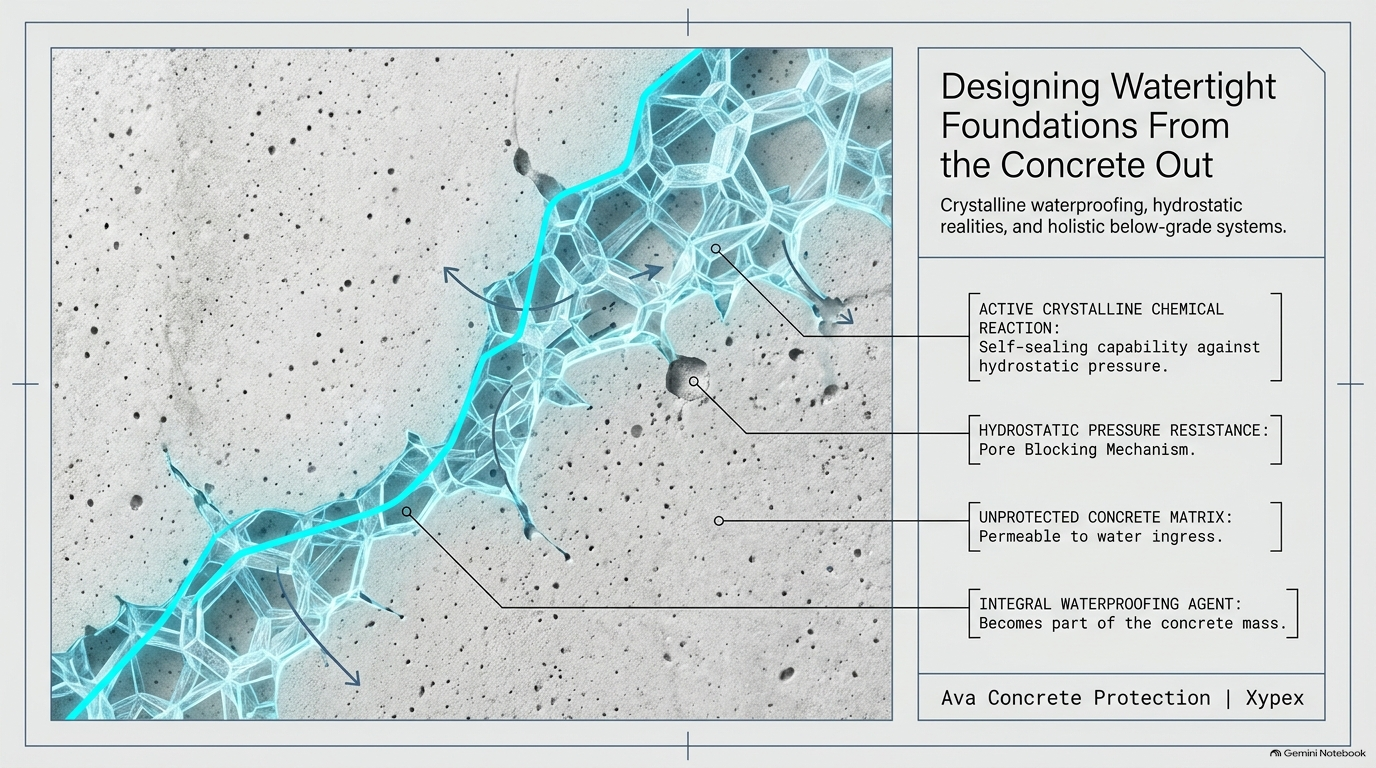
Crystalline waterproofing is a concrete-protection approach that uses reactive constituents to create insoluble formations within concrete’s pores, capillaries, and certain water pathways.
For new concrete foundations, crystalline technology can be introduced through an admixture added during concrete batching.
For existing foundations and retaining structures, certain crystalline products can instead be applied to properly prepared concrete surfaces.
The important distinction is that crystalline waterproofing does not function simply by creating a continuous flexible film over the concrete.
In the case of Xypex Crystalline Technology, Xypex Chemical Corporation states that its proprietary chemicals react with water and cement-hydration by-products to develop a non-soluble crystalline structure within interconnected pores and other voids in the concrete.
This makes the waterproofing mechanism fundamentally different from conventional sheet membranes and many liquid-applied barrier systems.
Delta Fertilizers Plant Rehabilitation
ONE
TWO
THREE
FOUR
FIVE
SIX
SEVEN
EIGHT
NINE
TEN
ELEVEN
TWELVE
What Is Crystalline Waterproofing for Foundations?
Crystalline waterproofing for foundations is a concrete-protection approach that works within the concrete. Reactive constituents form insoluble crystalline structures within pores, capillaries, and certain water pathways. These formations help reduce water penetration through the concrete.
For new concrete foundations, concrete producers can add a crystalline waterproofing admixture during batching. This approach integrates the waterproofing technology directly into the concrete mix.
For existing foundations and retaining structures, contractors can apply suitable crystalline products to properly prepared concrete surfaces. This approach can support waterproofing and rehabilitation where the existing concrete requires treatment.
Unlike many conventional waterproofing systems, crystalline technology does not rely primarily on a continuous flexible barrier over the concrete surface.
For Xypex Crystalline Technology, Xypex Chemical Corporation describes a reaction between its proprietary chemicals, water, and cement hydration by-products. According to Xypex, this reaction develops a non-soluble crystalline structure within interconnected pores and other voids in the concrete.
As a result, Xypex uses a fundamentally different waterproofing mechanism from conventional sheet membranes and many liquid-applied barrier systems.
Why Are Foundations and Retaining Structures Difficult to Waterproof?
Below-grade structures operate in an environment where water exposure can be persistent and difficult to observe.
A foundation or retaining wall may encounter:
The waterproofing challenge therefore involves more than the permeability of the concrete itself.
How Does Crystalline Waterproofing Work in Below-Grade Concrete?
Concrete appears solid, but its microstructure contains pores, capillaries, microcracks, and other pathways through which water may travel.
Crystalline waterproofing targets these pathways.
With Xypex Crystalline Technology, water acts as part of the reaction mechanism. According to Xypex, its active chemicals interact with cement-hydration products and form a non-soluble crystalline structure within the concrete’s interconnected pores and capillary system.
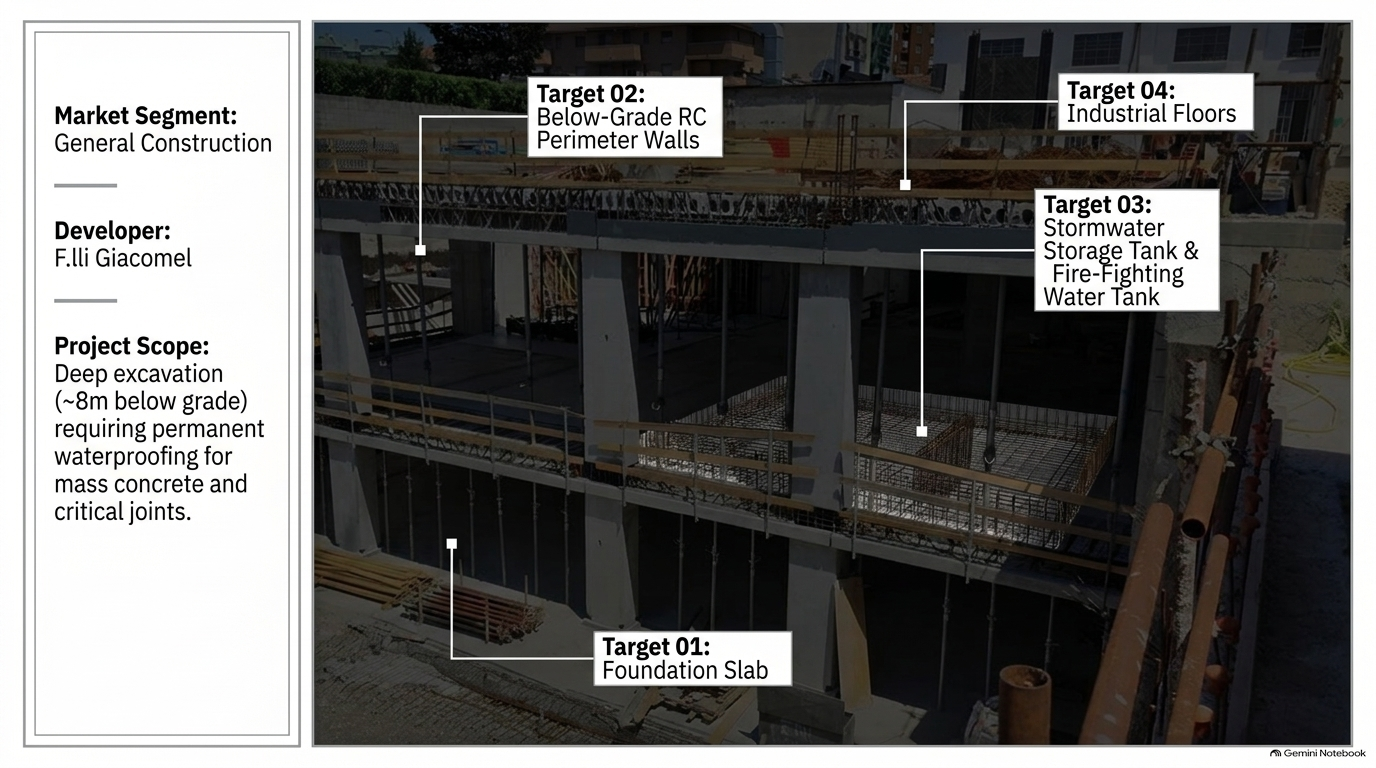
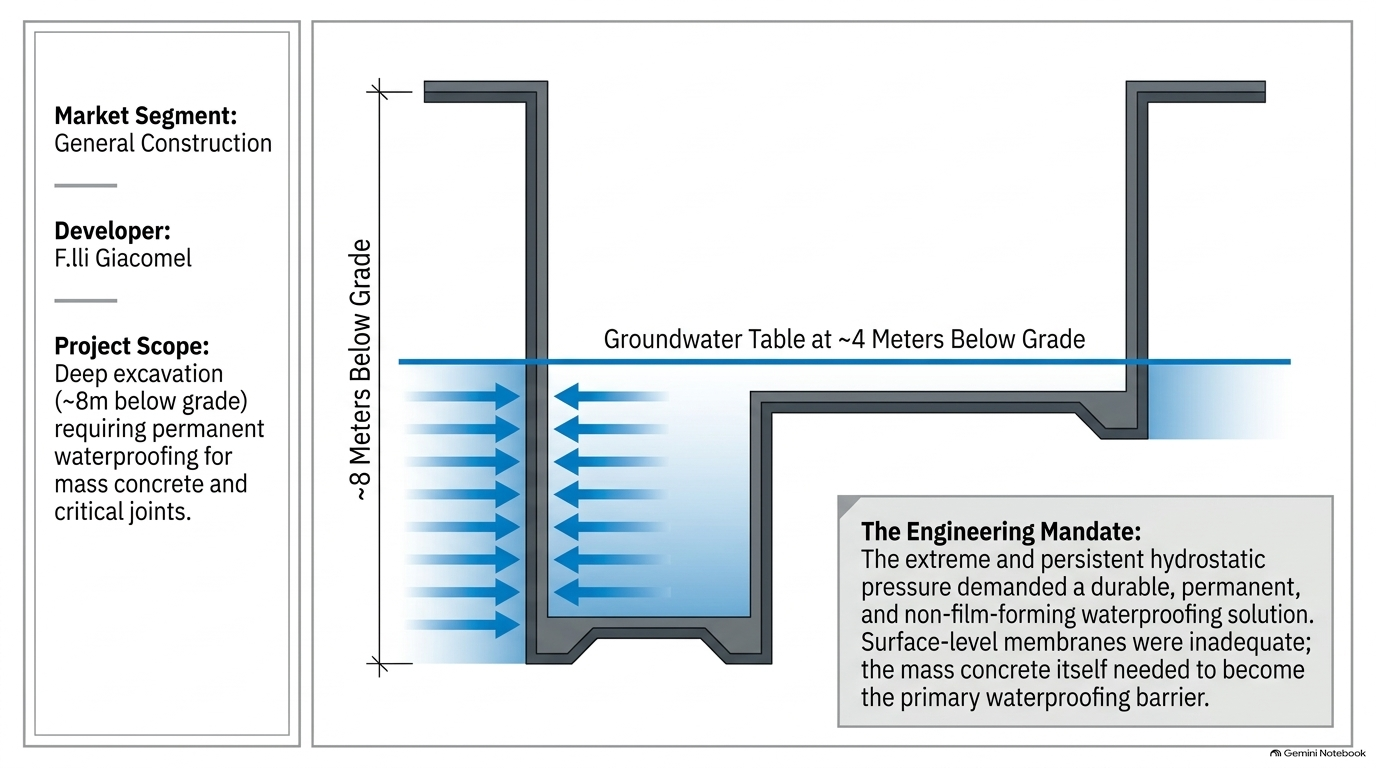
The objective is to reduce pathways available for liquid-water penetration through the concrete matrix.
For a foundation wall, this means waterproofing is not dependent solely on maintaining a separate exposed film at the exterior surface.
That characteristic can be particularly useful where the waterproofing will eventually become inaccessible behind soil, backfill, drainage materials, finishes, or adjoining construction.
Integral Crystalline Waterproofing for New Foundations
For new reinforced-concrete construction, crystalline waterproofing admixtures can be incorporated into the concrete during batching.
This approach can be considered for structures such as:
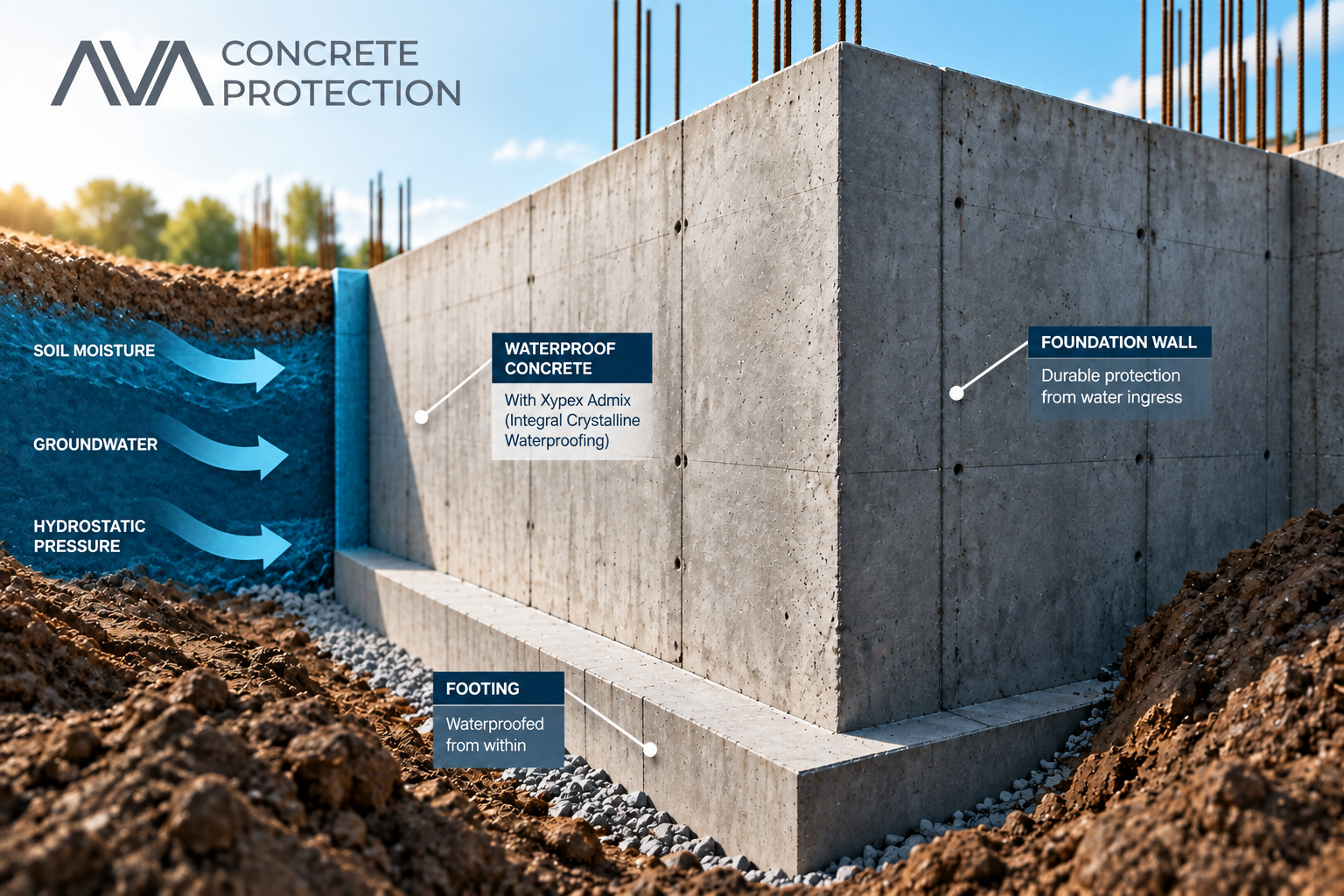
Foundation Walls
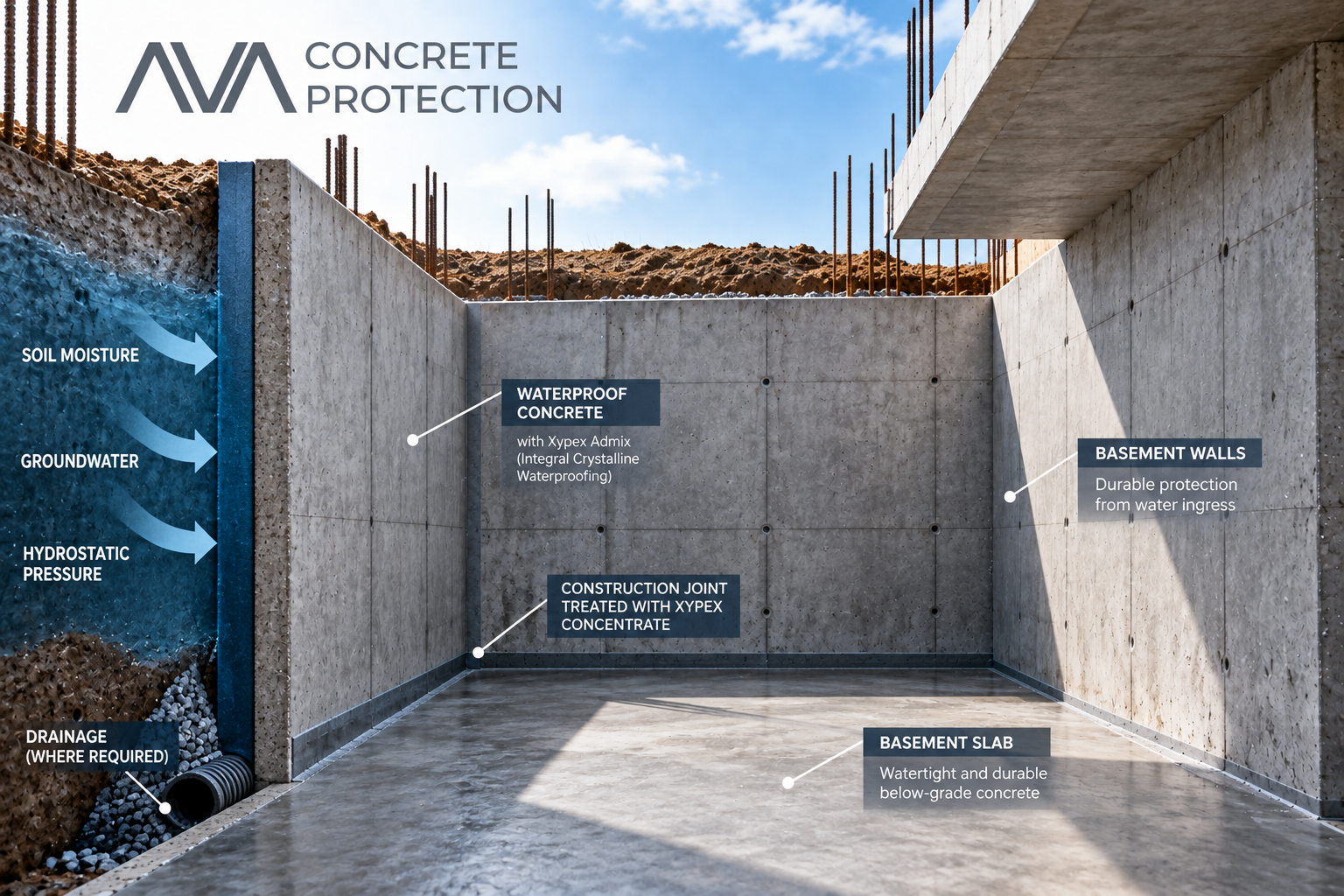
Basement Walls
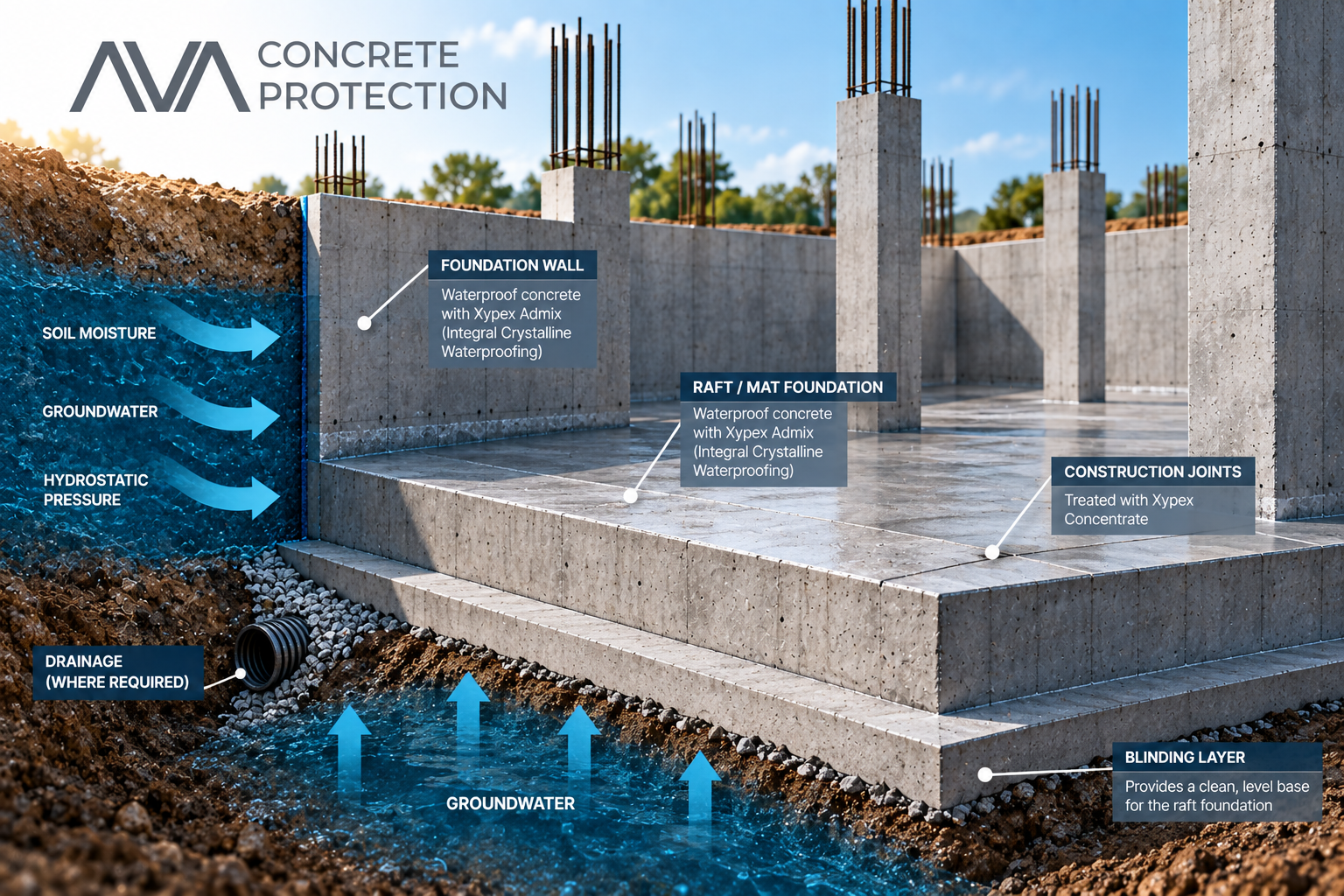
Raft or Mat Foundations
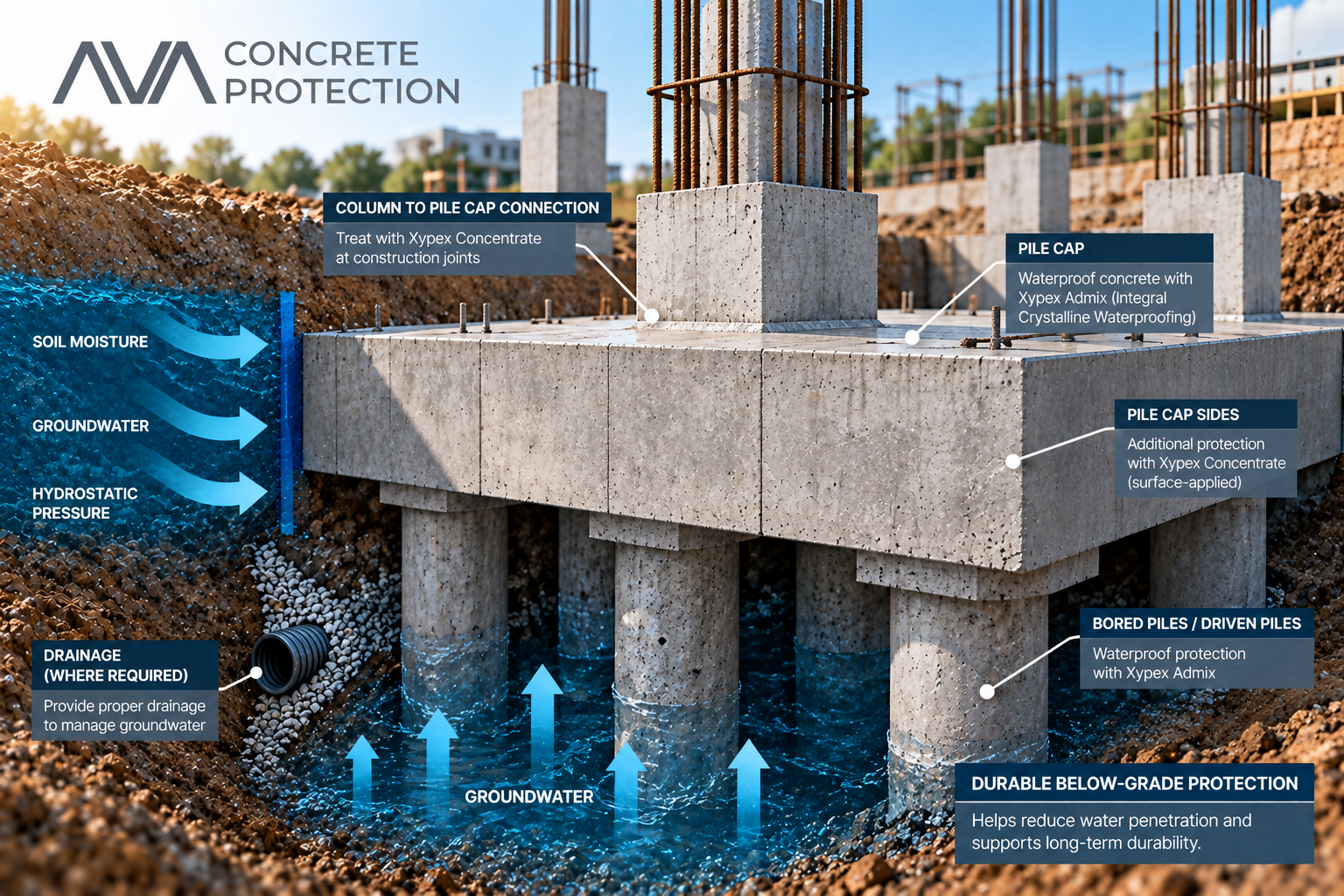
Pile Caps
Foundation Walls
Basement Walls
Raft or Mat Foundations
Pile Caps
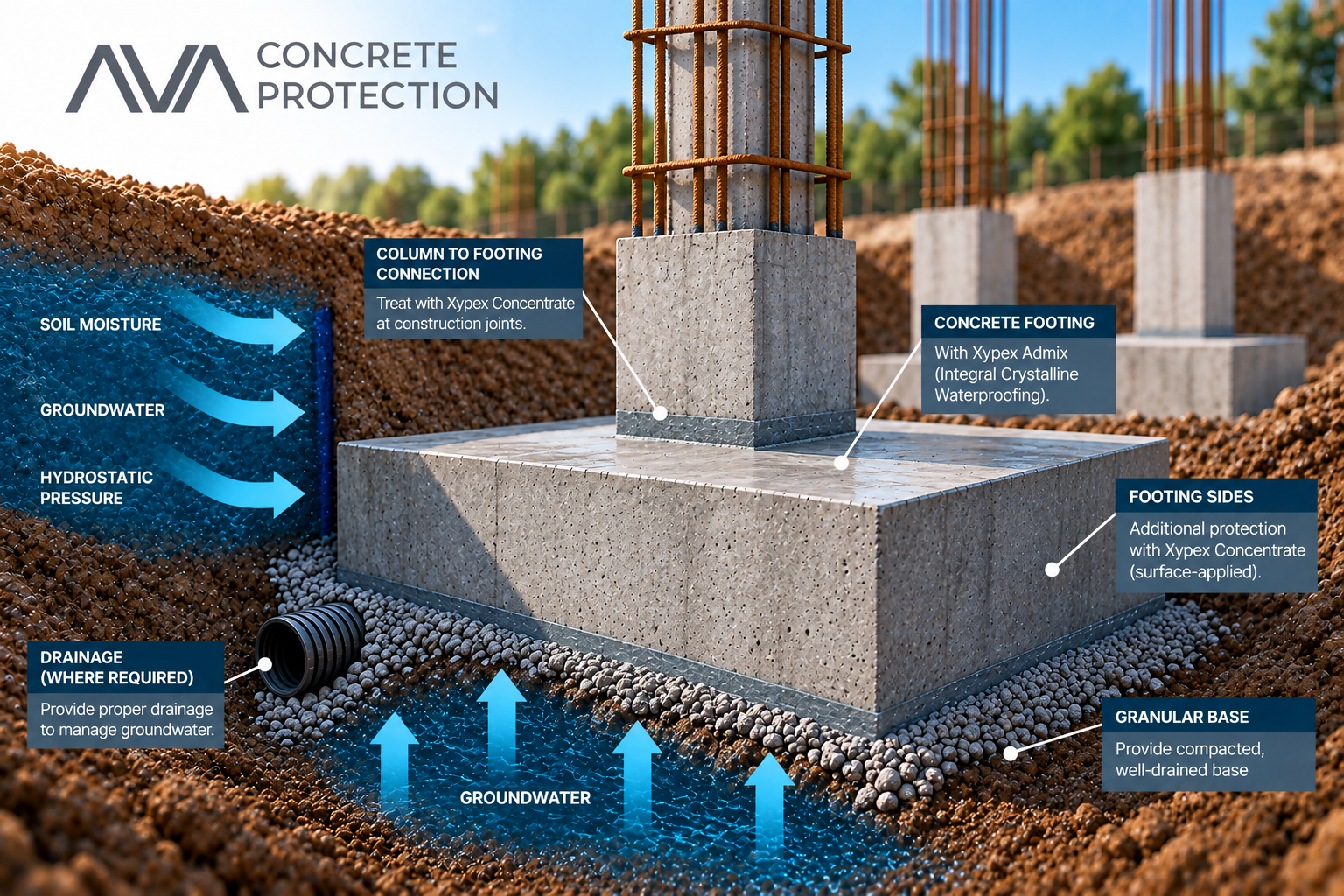
Footings
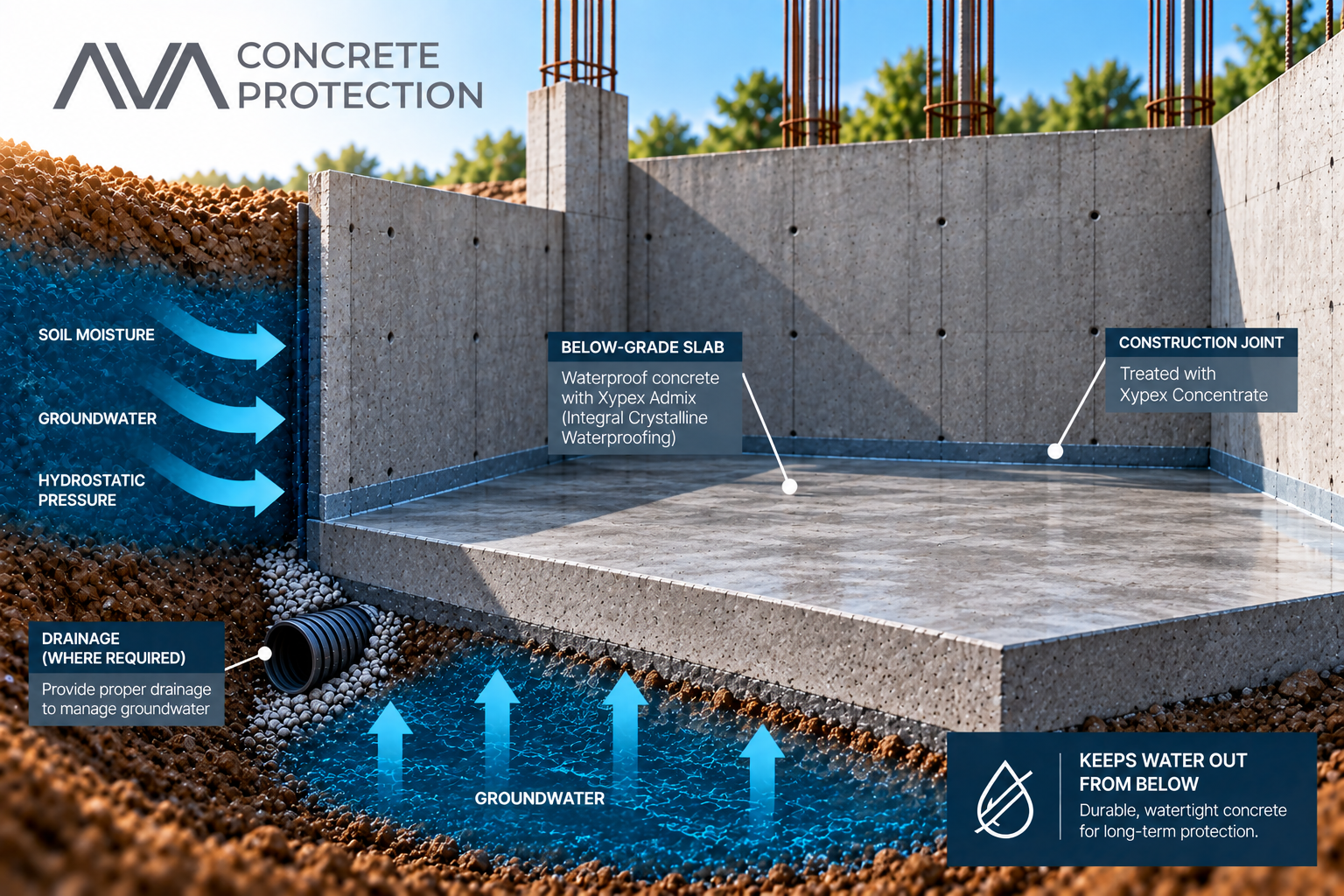
Below-grade Slabs
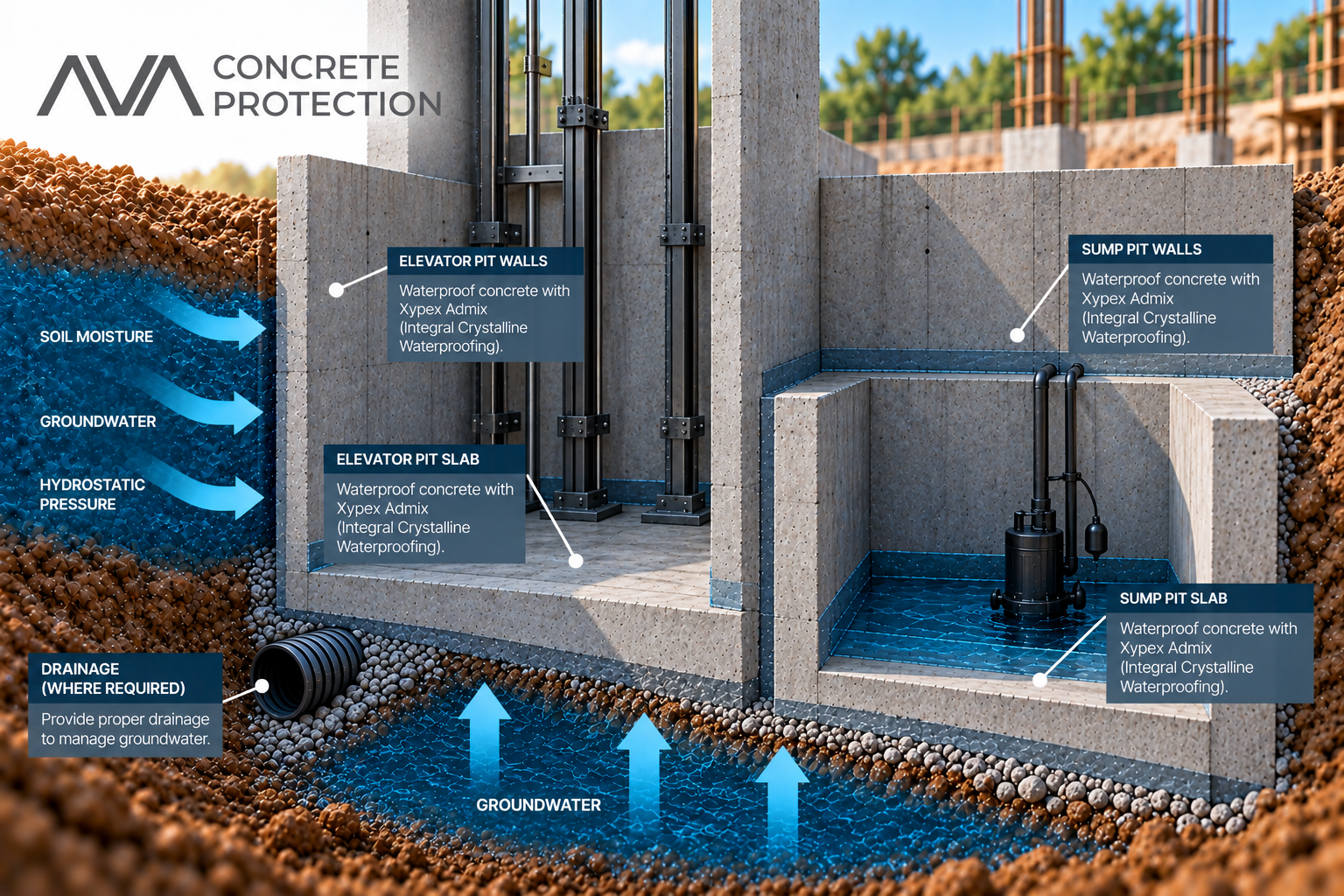
Elevator and Sump Pits
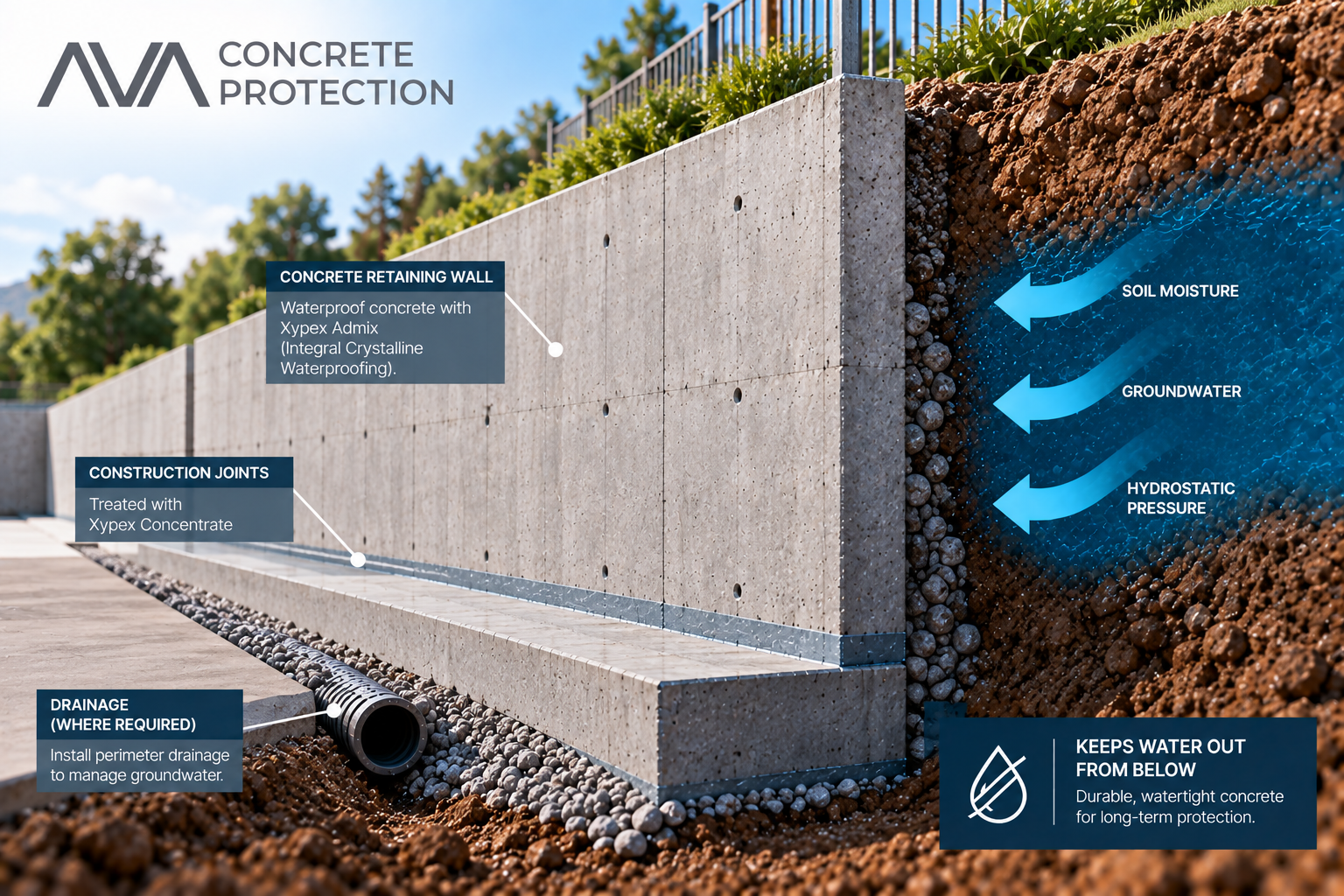
Concrete Retaining Walls
Footings
Below-grade Slabs
Elevator and Sump Pits
Concrete Retaining Walls
Xypex specifically identifies structural walls, raft or mat slabs, pile caps, footings, slab-on-grade construction and related foundation elements among its foundation applications.
What is the advantage of integral treatment?
The primary conceptual advantage is straightforward:
The concrete itself becomes part of the waterproofing strategy.
With an external membrane, the continuity of the waterproofing layer depends heavily on surface preparation, installation, seams, terminations, detailing, protection during subsequent construction, and accessibility.
An integral crystalline admixture is distributed through the concrete during production.
That does not make detailing irrelevant.
Construction joints, penetrations, expansion joints, defective concrete and other discontinuities remain potential water pathways requiring specific attention.
Surface-Applied Crystalline Waterproofing for Existing Foundations
Crystalline technology can protect both new and existing concrete. For existing structures, surface-applied crystalline waterproofing provides an option for waterproofing and concrete rehabilitation.
Contractors can apply suitable crystalline products directly to properly prepared concrete surfaces. This approach allows the crystalline technology to interact with the concrete without adding an admixture during batching.
For example, contractors apply Xypex Concentrate as a cementitious crystalline slurry. Xypex recommends the product for foundations, tunnels, underground vaults, parking structures, reservoirs, and other concrete structures.
Therefore, Xypex Concentrate for existing concrete can provide a useful option for rehabilitation projects. It is particularly relevant when a structure requires waterproofing after the original concrete construction is complete.
In some circumstances, excavation of the exterior side of an existing basement or foundation wall may be impractical because of:
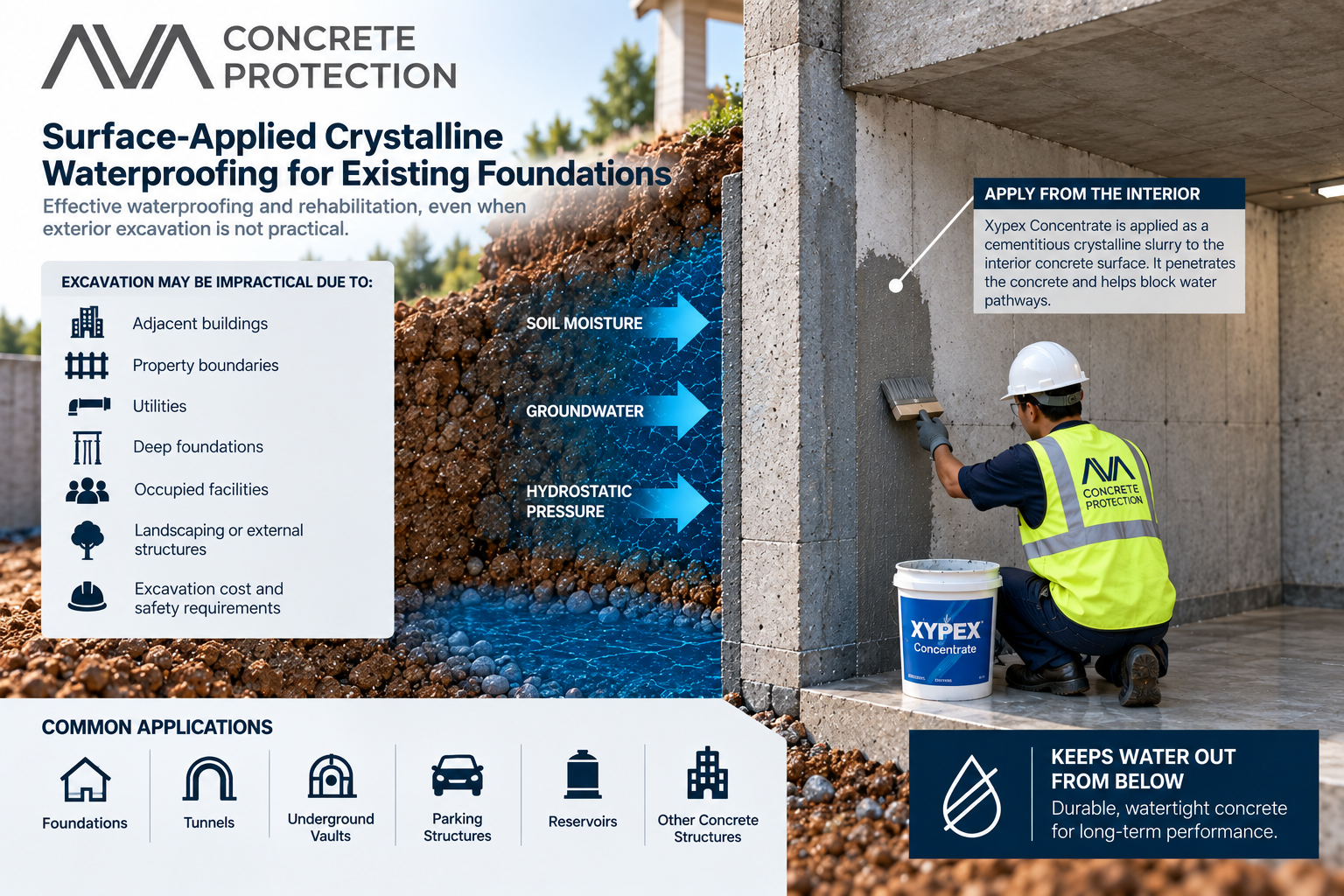
Xypex publishes procedures for negative-side crystalline waterproofing of below-grade concrete. This approach allows contractors to treat the accessible interior concrete surface when they cannot reasonably reach the exterior positive side.
Negative-side treatment can provide an option for existing foundations and basement walls where exterior excavation is difficult or impractical.
However, contractors and designers must evaluate each structure before selecting this approach. They should consider the source of water ingress, groundwater conditions, hydrostatic pressure, cracks, construction joints, penetrations, and the condition of the existing concrete.
The final waterproofing solution should reflect the actual site conditions and the specific causes of water penetration.
Why Does This Matter in the Philippines?
Philippine foundations and retaining structures can experience demanding moisture conditions.
Heavy seasonal rainfall can introduce significant amounts of water into surrounding soils. Site drainage, groundwater elevation, soil permeability, topography and development around the structure can then influence how much water reaches the foundation.
Below-grade structures may consequently experience combinations of:
Rainwater infiltration
Groundwater exposure
Hydrostatic pressure
Coastal exposure
Construction variability
Rainwater infiltration
Rainwater infiltration
Groundwater exposure
Hydrostatic pressure
Coastal exposure
Construction variability
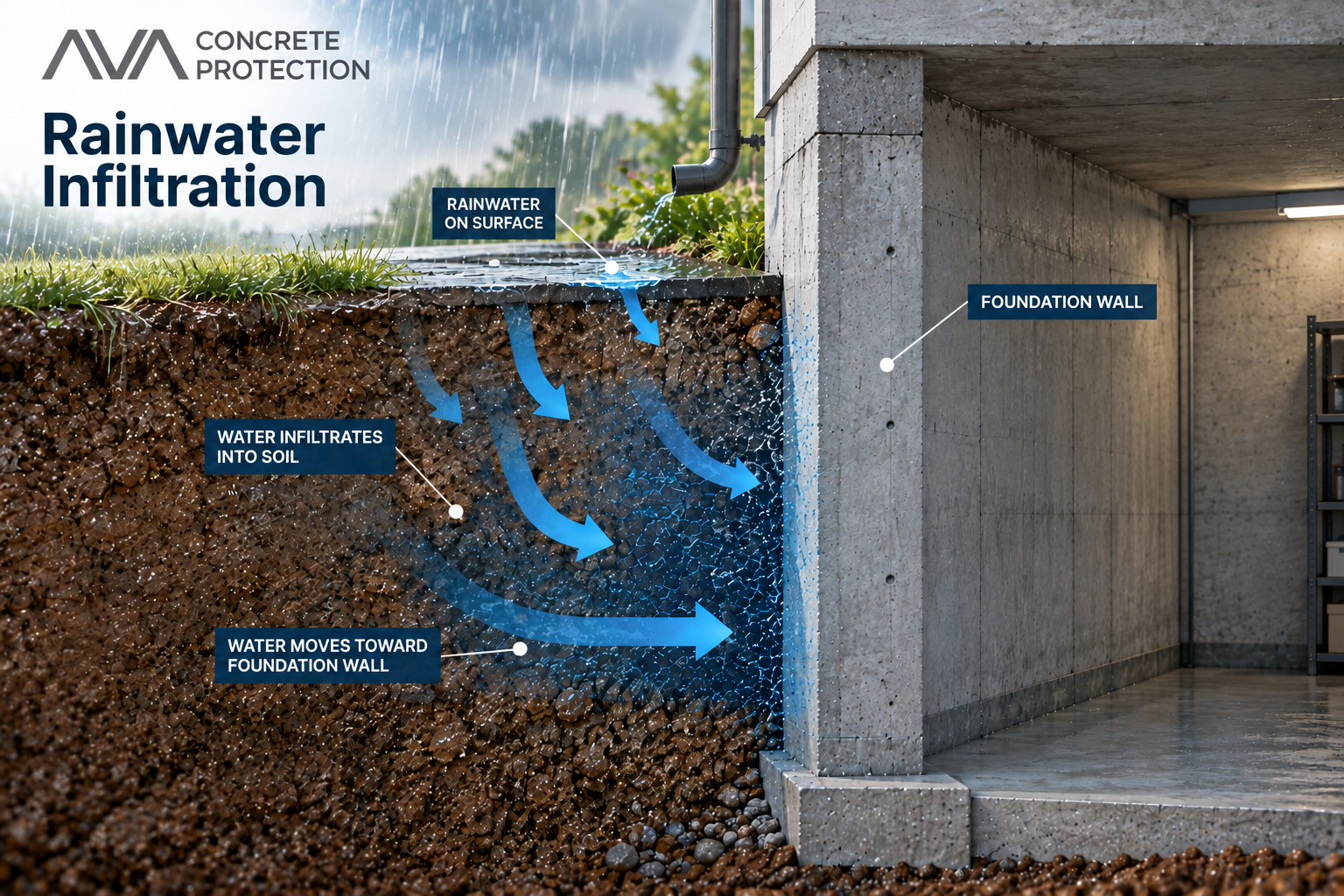
Rainwater infiltration
Surface water can migrate into soil surrounding foundations and retaining structures.
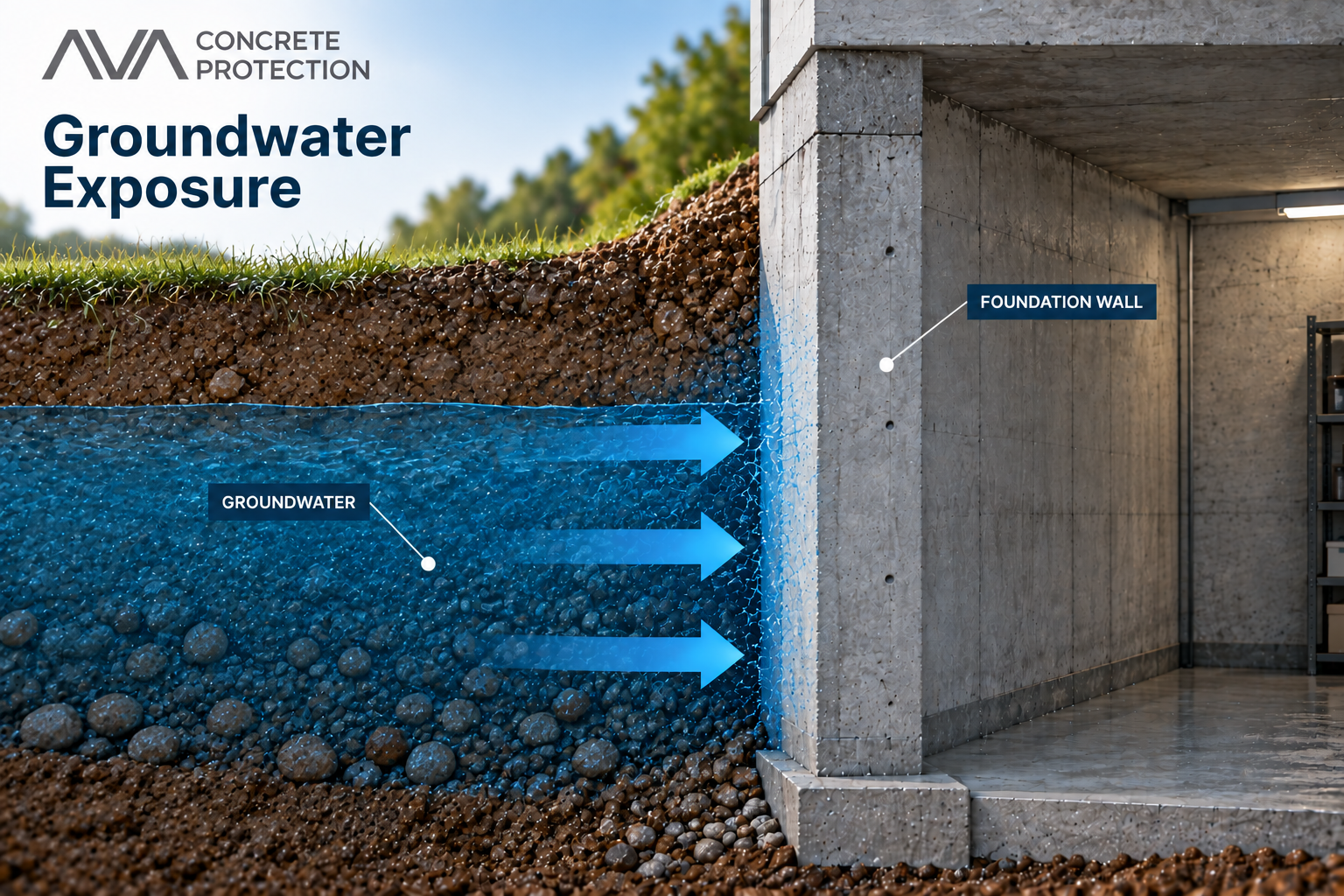
Groundwater exposure
Sites with elevated or fluctuating groundwater may expose concrete to prolonged moisture.
Hydrostatic pressure
Where water cannot drain adequately, pressure can develop against below-grade walls and slabs.
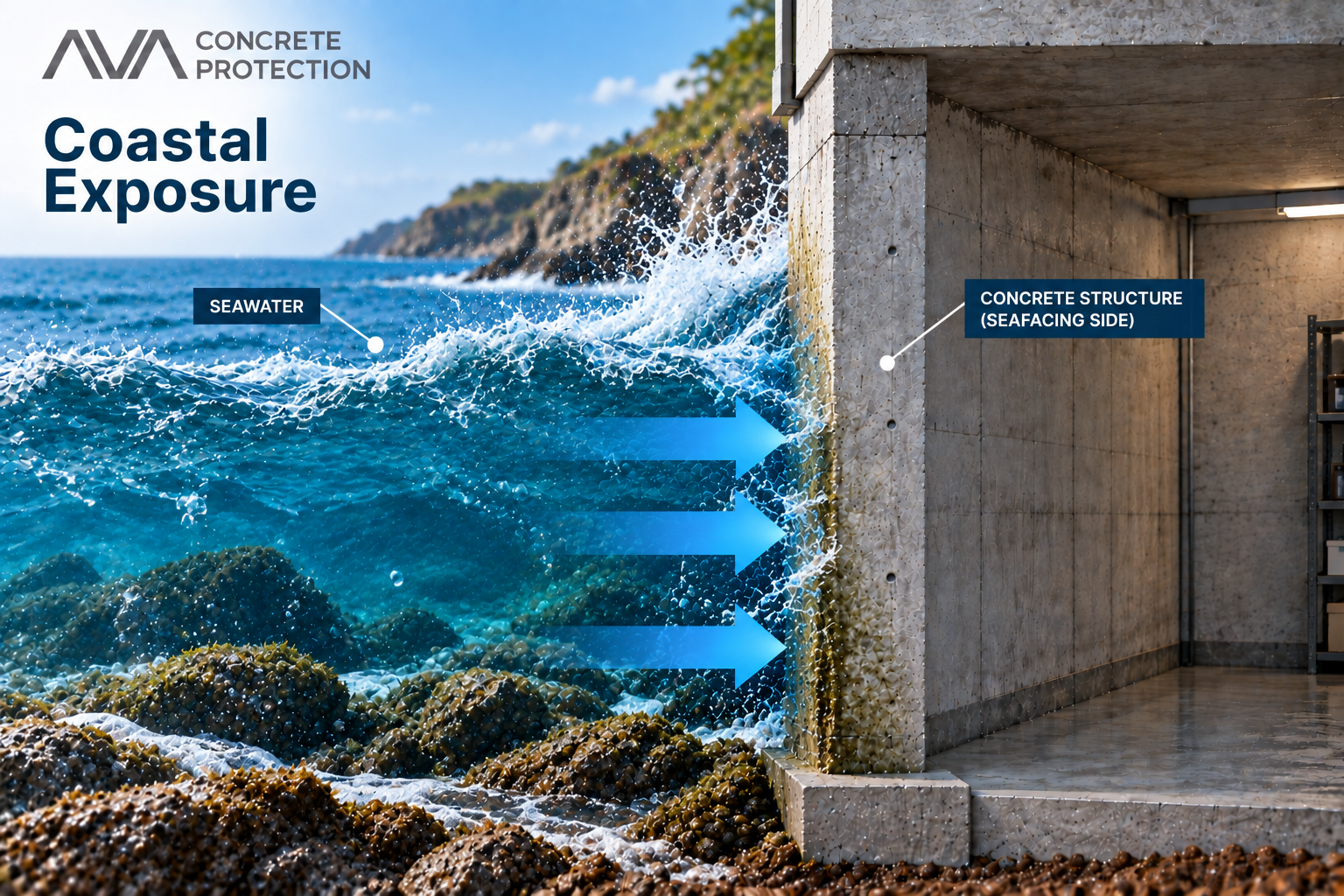
Coastal exposure
Groundwater or soil environments in coastal locations may contain chlorides that increase durability concerns for reinforced concrete.
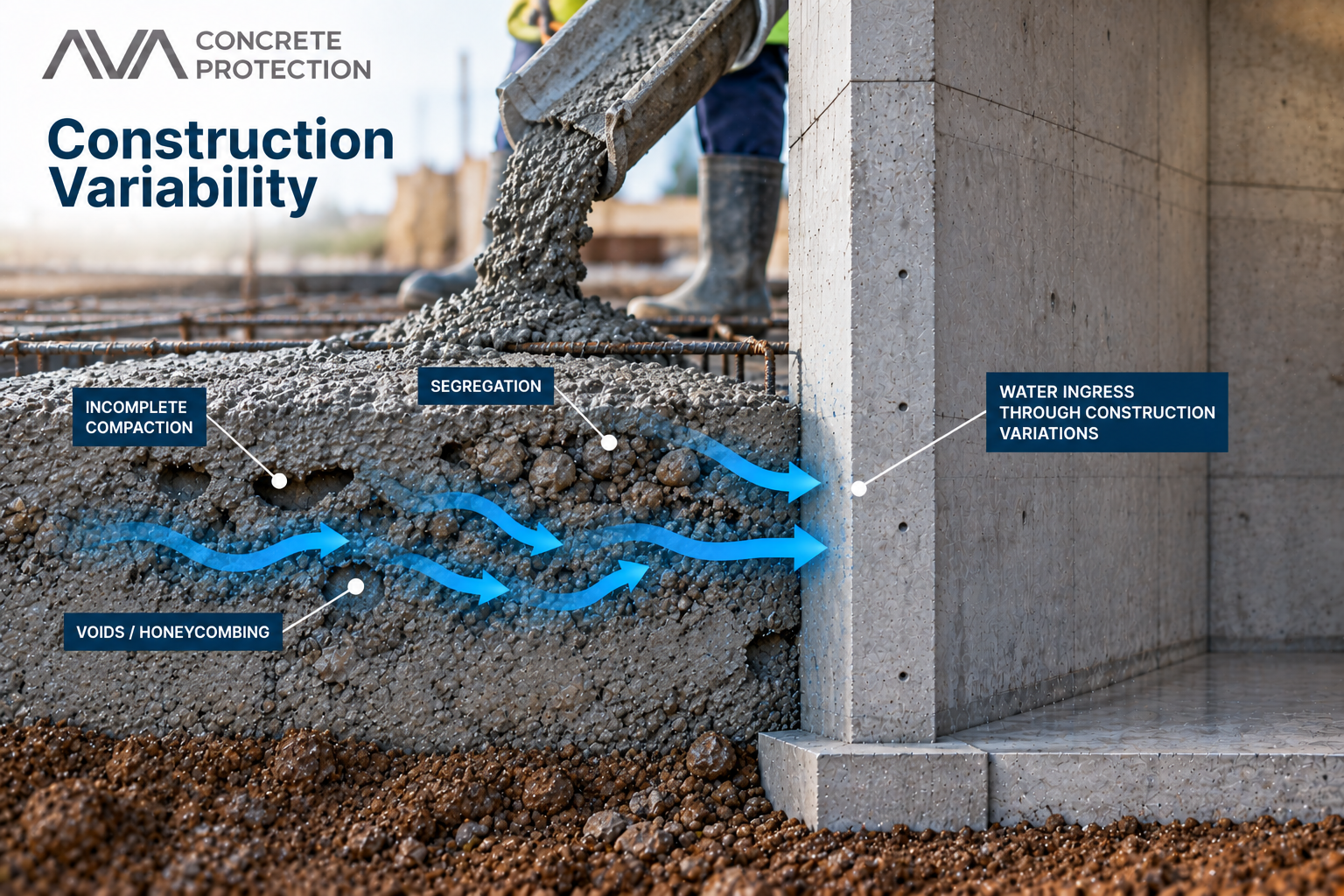
Construction variability
Cold joints, honeycombing, poorly consolidated concrete, tie holes, penetrations and cracking can create preferential leakage pathways even where the main concrete matrix has low permeability.
This is why waterproofing should be considered as part of the overall below-grade concrete design rather than as a single product applied after structural construction is complete.
Crystalline Waterproofing for Retaining Walls
Concrete retaining walls present a special case because waterproofing and structural drainage interact closely.
The wall may need to resist:
- Lateral Earth Pressure
- Surcharge Loads
- Groundwater Pressure
- Surface-water Infiltration
- Other Project-specific loads
Crystalline waterproofing can address water penetration through the concrete, but it does not make hydrostatic loading disappear.
Does crystalline waterproofing eliminate retaining-wall drainage?
No.
This is an important distinction.
Where the engineering design requires drainage behind a retaining wall, crystalline waterproofing should not be presented as a reason to remove it.
FHWA guidance emphasizes the importance of controlling groundwater behind retaining structures. Drainage may involve free-draining backfill, underdrains, gravel drainage zones, perforated drains or other engineered measures depending on the wall design and site.
Waterproofing and drainage therefore perform different functions:
| System | Primary Function |
|---|---|
| Crystalline waterproofing | Controls water penetration through concrete |
| Drainage layer | Provides a path for water to move away |
| Subsoil/perimeter drain | Collects and discharges groundwater |
| Structural wall | Resists earth, surcharge and applicable water loads |
| Waterstop/joint treatment | Controls leakage at discontinuities and joints |
| Crack-control design | Manages cracking through structural and reinforcement design |
A robust retaining-wall design may require several of these measures simultaneously.
What Happens at Construction Joints?
CConstruction joints require special attention in concrete waterproofing. They create a discontinuity where one concrete placement ends and another begins.
Even when both concrete placements contain an integral crystalline waterproofing admixture, the interface between them remains a construction joint. Therefore, designers should not assume that the admixture alone will waterproof every joint.
A complete construction joint waterproofing detail may include:
- Specified waterstops
- Crystalline joint treatments
- Sealants
- Formed grooves or chases
- Injection systems
- Hydrophilic components
- Other engineered joint systems
The correct detail depends on several factors. These include expected movement, hydrostatic pressure, structural conditions, project specifications, and the overall waterproofing design.
Xypex also publishes specific construction-joint details for structures that use crystalline admixtures. These details cover wall-to-slab, slab-to-wall, below-grade, and retaining-wall applications.
This distinction is important. Integral crystalline waterproofing and construction joint waterproofing perform different but complementary roles. The admixture protects the concrete matrix, while proper joint detailing addresses discontinuities between concrete placements.
Therefore, engineers should consider both elements as part of the complete waterproofing system rather than treat them as interchangeable solutions.
What About Expansion and Movement Joints?
Crystalline waterproofing should not be relied upon to bridge intentionally moving joints.
Expansion joints and other movement joints exist specifically to accommodate movement.
They normally require a flexible joint-waterproofing system designed for the expected displacement.
Crystalline technology may protect the adjacent concrete, but the moving joint itself requires appropriate detailing.
The same principle applies to cracks.
Can Crystalline Waterproofing Seal Cracks?
SSome crystalline waterproofing technologies can help seal certain static cracks in concrete. However, the specific performance depends on the manufacturer and product system.
According to Xypex, its crystalline technology can seal static hairline cracks up to 0.5 mm (0.02 in.) under suitable conditions.
However, this capability has important limitations. Xypex does not:
- Prevent concrete from cracking
- Correct structural instability
- Accommodate unrestricted crack movement
- Replace structural crack repair
- Convert an expansion or moving joint into a static joint
Therefore, designers must distinguish between static and moving cracks when selecting a waterproofing or repair method.
A static crack no longer experiences significant movement. In contrast, settlement, thermal changes, structural loading, or joint movement can cause a crack to remain active.
Moving or structurally significant cracks may require an engineering assessment and a different repair method. Engineers should evaluate the cause, width, movement, location, and condition of the crack before selecting the appropriate treatment.
Mount Royal Tunnel Upgrade: Crystalline Waterproofing in Montreal
The Mount Royal Tunnel Upgrade in Montréal, Canada, shows how Xypex crystalline waterproofing can support the rehabilitation of existing underground concrete structures.
The tunnel faced active water leakage and extensive concrete cavities. Therefore, the project required more than a single waterproofing treatment. The repair strategy combined several Xypex products to address active leaks, damaged concrete, and water penetration.
First, the project used Xypex Patch’n Plug to help stop active water ingress. Its rapid-setting properties made it suitable for areas experiencing active leakage.
Next, Xypex Megamix II helped repair extensive cavities in the existing concrete. These repairs restored damaged areas before further waterproofing treatment.
The project then used Xypex Concentrate on more than 2,000 m² of tunnel walls. The application also incorporated Xypex Xycrylic Admix.
Crystalline Waterproofing for Existing Concrete
The Mount Royal Tunnel project provides a practical example of surface-applied crystalline waterproofing for existing concrete. It also shows how crystalline technology can support the rehabilitation of existing structures.
For underground structures, contractors can use suitable Xypex products as part of a concrete rehabilitation and waterproofing system. This approach can help control water ingress in tunnels and other below-grade concrete structures.
However, damaged concrete may require several repair methods. Contractors may need to stop active leaks, repair concrete cavities, and prepare the substrate before they apply the crystalline treatment.
Therefore, a complete rehabilitation strategy may combine active leak stopping, concrete repair, and surface-applied crystalline waterproofing. Each method addresses a specific condition within the concrete structure.
The same principle can apply to foundations, basement walls, tunnels, and other below-grade structures. Engineers should assess the source of water ingress, concrete condition, cracks, construction joints, and groundwater conditions. They can then select a suitable repair and waterproofing system for the structure.
Project: Mount Royal Tunnel Upgrade
Location: Montréal, Quebec, Canada
Application: Underground concrete rehabilitation and waterproofing
Products Used: Xypex Concentrate, Xypex Patch’n Plug, Xypex Megamix II, and Xypex Xycrylic Admix
Frequently Asked Questions
Can crystalline waterproofing be used for concrete foundations?
Yes. Crystalline waterproofing can be incorporated into new concrete through an admixture or, depending on the product and conditions, applied to existing concrete as a surface treatment.
Xypex specifically identifies foundations and multiple below-grade concrete elements among the applications for its crystalline technology.
Can crystalline waterproofing be used on retaining walls?
Yes, crystalline waterproofing can be part of the waterproofing strategy for reinforced-concrete retaining walls.
However, it does not replace structural design or drainage requirements. Groundwater and hydrostatic pressure behind the wall must still be addressed by the project engineer.
Does crystalline waterproofing eliminate the need for drainage?
No.
Drainage and waterproofing perform different functions. Drainage controls the accumulation and movement of water around the structure, while waterproofing controls water penetration through the building or structural envelope.
Where drainage is required by the design, crystalline waterproofing should complement it rather than automatically replace it.
Can Xypex resist hydrostatic pressure?
Xypex states that its crystalline technology is designed to resist water penetration under hydrostatic pressure.
This is a manufacturer-specific performance claim and should not be generalized to every crystalline product.
It also does not mean the structural engineer can disregard hydrostatic loads acting on the foundation or retaining wall.
Can crystalline waterproofing replace a waterstop?
Not as a general rule.
Waterstops address leakage through joints, while integral crystalline waterproofing primarily treats the surrounding concrete matrix.
Joint requirements should be determined from the project specification, joint type, expected movement, hydrostatic conditions and manufacturer’s approved detailing.
Can Xypex seal cracks in a foundation?
Xypex states that its crystalline technology can seal static hairline cracks up to 0.5 mm (0.02 in.) under suitable conditions.
That capability should not be extended to moving cracks, expansion joints or structurally significant cracking without engineering evaluation.
Can crystalline waterproofing be applied from inside a leaking basement?
Certain surface-applied crystalline systems can be used from the negative side of concrete.
Xypex publishes a specific negative-side procedure for below-grade concrete.
However, cracks, active leaks, construction joints, penetrations and defective concrete should be identified and treated as part of the repair strategy.
Is crystalline waterproofing better than a membrane for foundations?
Not universally.
Crystalline and membrane systems work differently and have different advantages, limitations and detailing requirements.
The appropriate system depends on groundwater conditions, structure type, construction sequence, movement, accessibility, concrete quality, risk tolerance and project specifications
Still have questions? Check out our FAQ page or send us a message
Conclusion
Crystalline waterproofing for foundations and retaining structures provides engineers and contractors with an approach that addresses water penetration within the concrete rather than relying exclusively on an external barrier.
That can be particularly valuable below grade, where waterproofing systems become difficult to access after backfilling.
However, watertight construction requires more than treating the concrete matrix.
Drainage, hydrostatic loads, concrete quality, crack control, construction joints, waterstops, movement joints, penetrations and repair details must all be considered as parts of the same system.
For new construction, Xypex Admix can be evaluated as an integral crystalline waterproofing approach for appropriate reinforced-concrete foundation and retaining elements. For existing structures, surface-applied Xypex systems and associated repair products may provide another approach depending on the condition of the concrete and source of water ingress.
Ava Concrete Protection works with Xypex crystalline waterproofing technology in the Philippines and can assist project teams in evaluating concrete waterproofing requirements, product selection and relevant Xypex construction details.
For foundation or retaining-wall projects, the appropriate next step is to review the structural drawings, waterproofing specification, construction joints, penetration details, groundwater conditions and concrete design before determining the proposed crystalline waterproofing system.