


by
Underground concrete structures face a major waterproofing challenge: continuous or intermittent exposure to groundwater and hydrostatic pressure. Basements, tunnels, underground railway stations, retaining structures, foundations and utility vaults may encounter these conditions throughout their service life.
Water can penetrate concrete through interconnected pores and capillaries. Cracks, construction joints, penetrations and concrete defects can also create pathways for water ingress. For this reason, underground concrete waterproofing requires more than simply protecting an exposed surface. Engineers and project teams must consider the concrete, joints and penetrations as part of the overall waterproofing strategy.
Xypex Admix for underground concrete takes a different approach from conventional surface-applied waterproofing membranes. Concrete producers add Xypex Admix during batching, which distributes the crystalline waterproofing technology throughout the concrete mix. In the presence of moisture, its proprietary reactive constituents interact with cement-hydration products and form non-soluble crystalline structures within pores and capillary pathways. This crystalline mechanism helps reduce concrete permeability and limits the pathways available for water penetration.
Because Xypex Admix develops its crystalline waterproofing mechanism within the concrete matrix rather than relying only on an external surface barrier, it is particularly relevant to below-grade structures exposed to groundwater and hydrostatic pressure.
However, integral crystalline waterproofing does not eliminate the need for proper concrete design and waterproofing details. Engineers and project teams must still address crack control, construction joints, waterstops, movement joints and penetrations. Concrete quality, placement, consolidation, curing and workmanship also play important roles in achieving a durable underground waterproofing system.
Quick Answer
Xypex Admix works in underground concrete by introducing proprietary reactive chemicals into the concrete during batching. In the presence of moisture, these chemicals react with constituents and by-products of cement hydration to form a non-soluble crystalline structure within pores and capillary pathways. This reduces concrete permeability and helps the concrete resist water penetration under hydrostatic pressure.
Because the admixture is distributed throughout the concrete mix, the waterproofing mechanism is integral to the concrete rather than being dependent on a membrane bonded to its external surface.
However, Xypex-treated concrete should be considered part of an engineered waterproofing system. Construction joints, expansion joints, penetrations, cracks and other discontinuities still require appropriate evaluation and detailing.
What Is Xypex Admix?
Xypex Admix C-Series is a cementitious crystalline waterproofing admixture for concrete that concrete producers add during batching. The admixture becomes part of the concrete mix and provides an integral approach to waterproofing and concrete protection.
According to Xypex Chemical Corporation, the proprietary reactive chemicals in Xypex Admix interact with moisture and cement-hydration by-products. This reaction creates a non-soluble crystalline structure within the pores and capillary pathways of the concrete, helping reduce the pathways available for water penetration.
This mechanism distinguishes Xypex Admix from conventional surface-applied waterproofing membranes. A membrane creates a waterproofing barrier on the concrete surface. In contrast, Xypex Admix develops its crystalline waterproofing mechanism within the concrete matrix.
The Xypex Admix C-Series includes different formulations designed for various concrete mix designs, project conditions and setting-time requirements. Selecting the appropriate formulation depends on the concrete design and specific project requirements.
For underground concrete waterproofing, this integral approach offers an important advantage: the waterproofing technology becomes part of the concrete during batching. Basements, tunnels, underground stations, foundations and other below-grade structures can therefore incorporate crystalline waterproofing directly into their concrete rather than relying solely on an externally applied barrier.
However, Xypex Admix addresses the concrete matrix itself. Engineers must still properly design and detail construction joints, movement joints, penetrations, waterstops and other potential water-entry points as part of the complete underground waterproofing system.
How Does Xypex Admix Work Inside Underground Concrete?
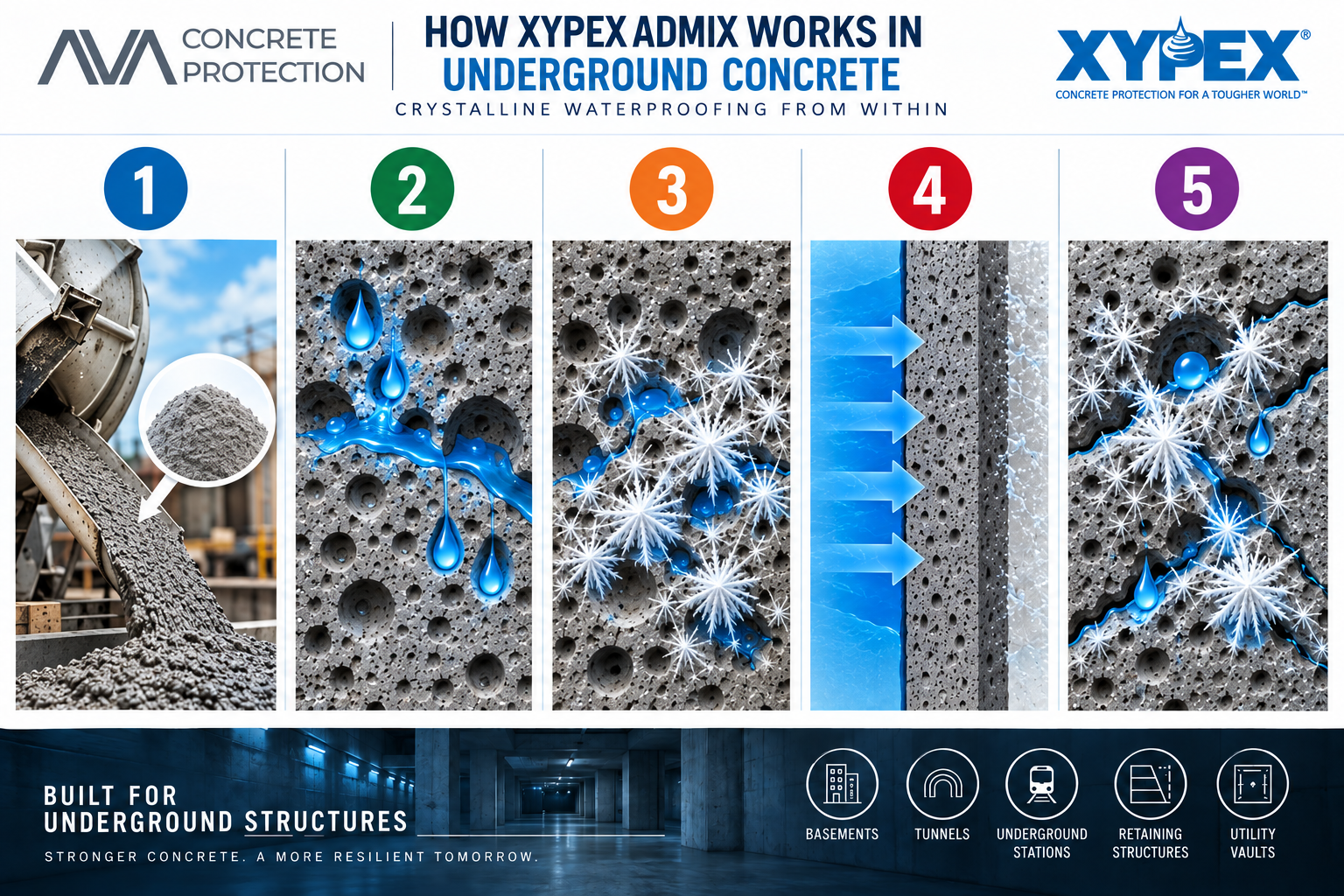
Xypex Admix is added during concrete batching
Xypex Admix is incorporated into the concrete mix rather than installed as a separate external waterproofing layer after the structure has been cast.
Moisture activates the crystalline reaction
Concrete contains a network of microscopic pores and capillary pathways. These pathways are one of the mechanisms through which water can move through concrete.
Non-soluble crystalline formations develop
The reaction produces a non-soluble crystalline structure within pores and capillary pathways. Rather than creating a film over the outside of the concrete, the mechanism occurs inside the concrete matrix.
Concrete permeability is reduced
Reducing interconnected pathways can substantially reduce water permeability. This matters underground because waterproofing performance is not simply about exposure to rain or surface moisture.
Moisture can reactivate the crystalline mechanism
Xypex states that its crystalline technology can reactivate when water becomes present again.
Project Example: Tunnel 45, Alexandria, Egypt
Tunnel 45 in Alexandria, Egypt, is a documented example of Xypex Admix used for underground concrete waterproofing. The tunnel is located near the Mediterranean. According to Xypex, the project faced chemicals in the surrounding water and extreme hydrostatic pressure.
The project used Xypex Admix C-1000 NF, according to Xypex Chemical Corporation’s project documentation. The concrete producer added the crystalline waterproofing admixture during batching. This process distributed the technology throughout the concrete mix.
As a result, the crystalline waterproofing mechanism became part of the concrete matrix. The project therefore did not rely solely on an externally applied waterproofing barrier.
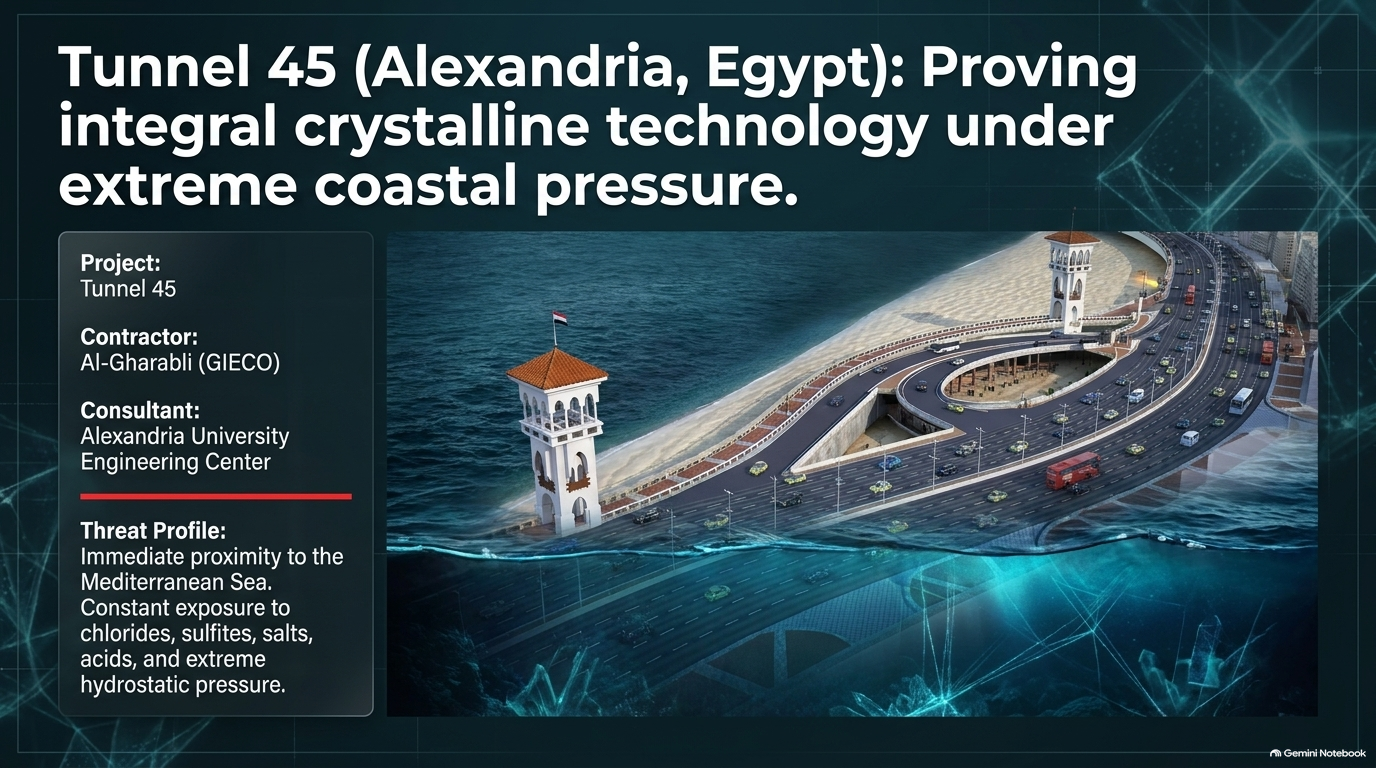
Tunnel 45 also demonstrates why underground tunnel waterproofing involves more than controlling visible water leakage. Xypex identifies several important objectives for the tunnel concrete. These include limiting water penetration under hydrostatic pressure and protecting the tunnel interior from water damage. Another objective involves helping protect reinforcing steel against corrosion.
For engineers evaluating Xypex Admix for underground concrete, Tunnel 45 provides a useful real-world project reference. The project demonstrates the application of integral crystalline waterproofing in demanding underground conditions.
It also shows how crystalline technology can form part of a broader concrete waterproofing and protection strategy. This approach can apply to tunnels and other underground structures exposed to challenging groundwater conditions.
Why Does This Matter for Underground Concrete in the Philippines?
Water exposure is particularly important in Philippine underground construction.
Heavy seasonal rainfall, elevated groundwater conditions, flooding, tropical moisture and coastal exposure can place significant demands on below-grade concrete structures.
Potential applications include:
- underground railway stations
- tunnels and subway structures
- basements
- retaining structures
- deep foundations
- elevator pits
- underground parking
- utility chambers
- water-retaining structures
- underground infrastructure
Once an underground wall or foundation slab has been completed and backfilled, access to its external face can become difficult or expensive.
This makes waterproofing strategy, concrete quality and detailing particularly important during initial construction.
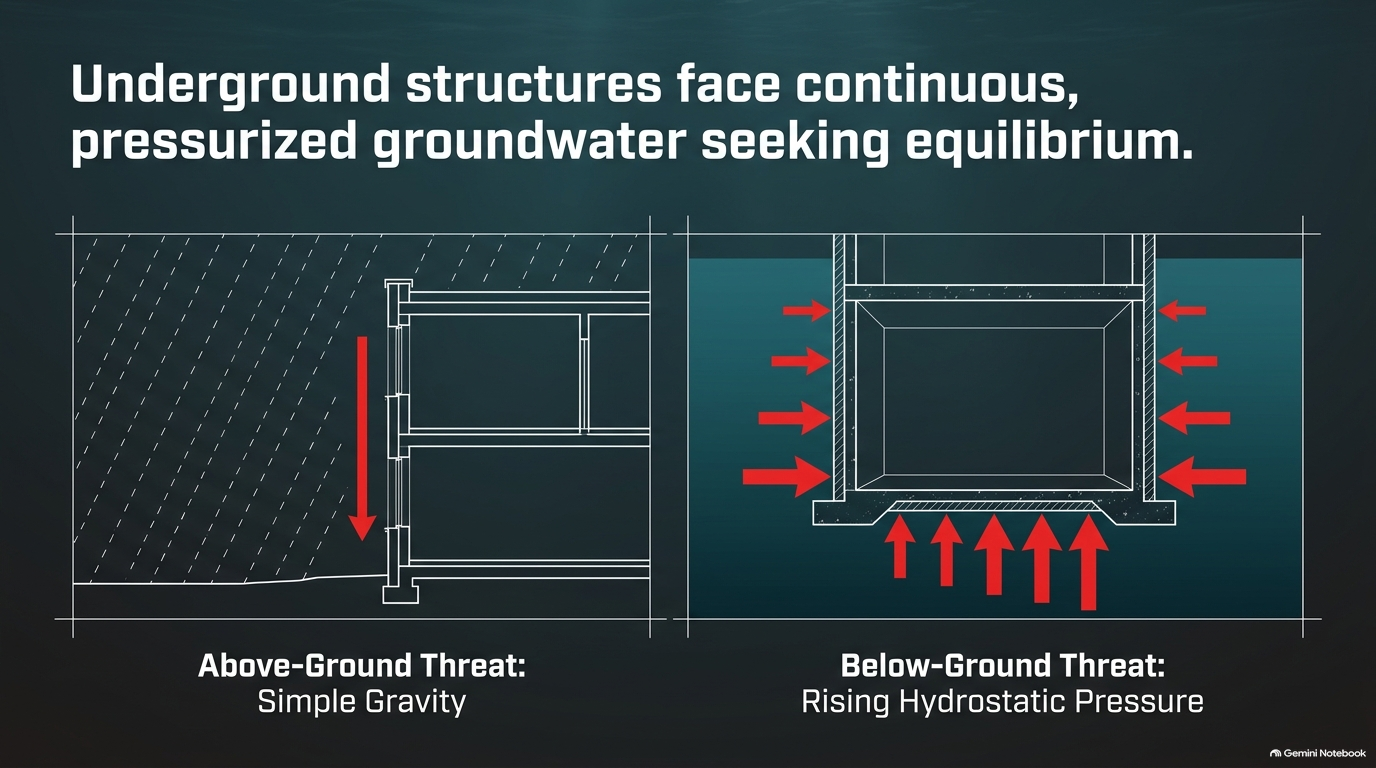
Hydrostatic pressure changes the waterproofing problem
Consider a basement constructed below the groundwater table.
Groundwater creates pressure against the external concrete wall.
If pathways exist through the concrete, water may migrate toward the lower-pressure interior side.
The deeper the structure extends below groundwater level, the greater the potential hydrostatic head.
This is one reason underground waterproofing should be evaluated differently from simple rainwater resistance.
What Does the Evidence Show About Water Permeability?
Xypex publishes independent laboratory test summaries that evaluate the water permeability of concrete containing Xypex Admix. These tests provide evidence of performance under controlled hydrostatic-pressure conditions.
In one test, Aviles Engineering Corporation evaluated Xypex Admix concrete using the U.S. Army Corps of Engineers CRD C48, “Permeability of Concrete” method. The test compared concrete containing Xypex Admix with an untreated control.
The specimens faced approximately 1.04 MPa (150 psi) of water pressure. This pressure represents about 106.7 m (350 ft) of water head. According to Xypex’s published test summary, the untreated concrete showed moisture and permeated water after 24 hours. In comparison, the Xypex Admix specimens showed no leakage and only 1.5 mm (0.06 in.) of water penetration after 120 hours.
Another test examined Xypex Admix NF concrete at the Australia Centre for Construction Innovation, University of New South Wales. Researchers tested concrete containing Xypex Admix NF at dosage rates of 0.8% and 1.2%.
The specimens faced 10 bar of pressure for two weeks, equivalent to approximately 100 m (328 ft) of water head. According to Xypex, the treated concrete achieved a reduction in calculated water permeability of up to 93% at the tested 1.2% dosage rate compared with the control concrete.
These results provide useful evidence for evaluating Xypex Admix under hydrostatic pressure. However, they represent performance under specific laboratory conditions. Engineers should not interpret them as a guarantee that every underground structure will achieve identical results.
Actual performance depends on the complete concrete and waterproofing design. Important factors include mix design, placement, consolidation, curing, crack control, construction joints, penetrations and overall workmanship.
What Happens When Underground Concrete Develops a Crack?
- drying shrinkage
- thermal effects
- restraint
- settlement
- loading
- construction sequence
- structural movement
- inadequate crack-control detailing
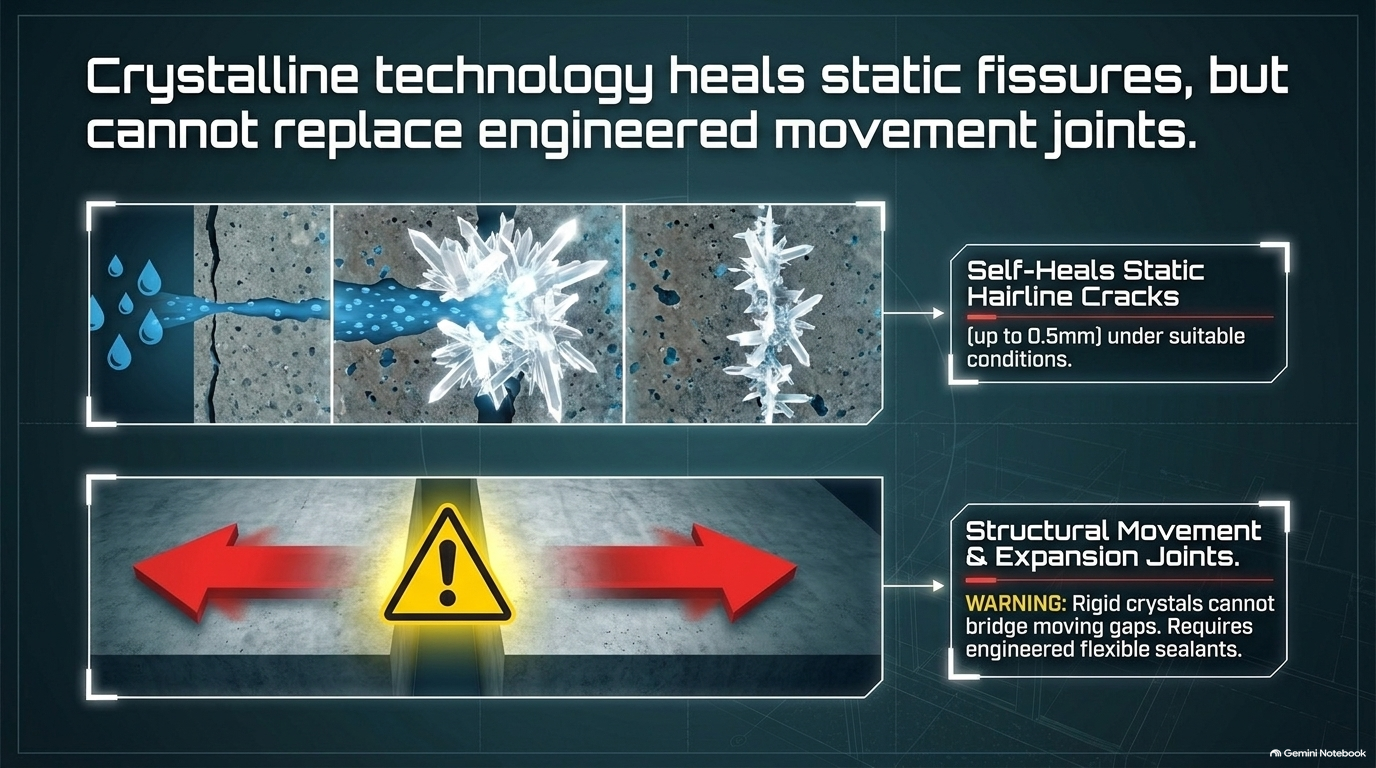
Xypex states that its crystalline technology can seal static hairline cracks up to 0.5 mm (0.02 in.) under suitable conditions.
The distinction between static and moving cracks is critical.
Cracking cannot simply be ignored because a crystalline admixture is present.
Does Xypex Admix Waterproof Construction Joints?
Not by assumption.
This is one of the most important distinctions when designing underground waterproofing.
Xypex Admix treats the concrete matrix, while a construction joint is a discontinuity between separate concrete placements.
For example:
Xypex Admix concrete → Construction joint → Xypex Admix concrete
Both concrete placements may contain crystalline admixture, but the interface remains a construction joint.
Xypex itself publishes schematic details showing Admix-treated concrete used together with Xypex Concentrate joint treatment and specified waterstops.
That provides an important design lesson:
Integral concrete waterproofing and joint waterproofing should be designed together rather than treated as interchangeable measures.
Depending on the project, joint detailing may involve:
- Specified waterstops
- Xypex Concentrate slurry
- Xypex Concentrate Dry-Pac
- Hydrophilic systems
- Sealants
- Injection systems
- Formed grooves or chases
- Other engineered joint treatments
The correct system depends on the joint type, movement, water pressure, structural design and project specification.
Construction Joints and Expansion Joints Are Not the Same
This distinction becomes especially important underground.
A construction joint is created where one concrete placement stops and another begins.
An expansion or movement joint, by contrast, is intentionally designed to accommodate movement between structural elements.
Because an expansion joint is expected to move, it generally requires a flexible joint system capable of accommodating that movement.
Xypex Admix should therefore not be presented as a universal replacement for expansion-joint waterproofing.
The crystalline technology works within the concrete. It does not eliminate the structural function of a movement joint.
What About Pipe Penetrations and Other Openings?
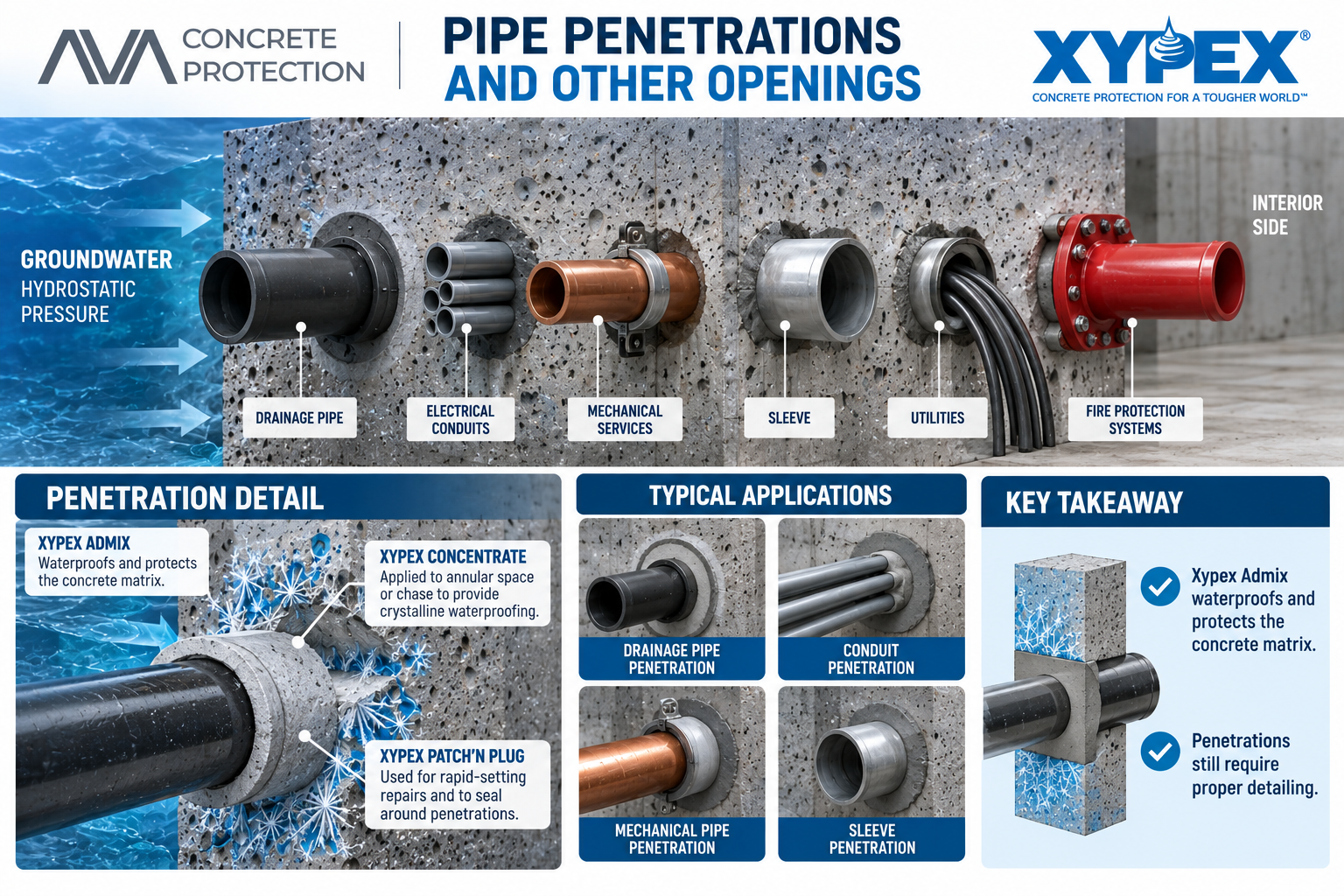
These locations create discontinuities through the concrete.
Even where the surrounding concrete contains Xypex Admix, the annular space around a pipe or sleeve may require a separate engineered waterproofing detail.
Xypex publishes specific repair and penetration procedures using products such as Xypex Concentrate and Patch’n Plug.
Therefore:
Xypex Admix waterproofs and protects the concrete matrix, but penetrations still require proper detailing.
How Does Xypex Admix Compare With an External Waterproofing Membrane?
The two approaches work differently.
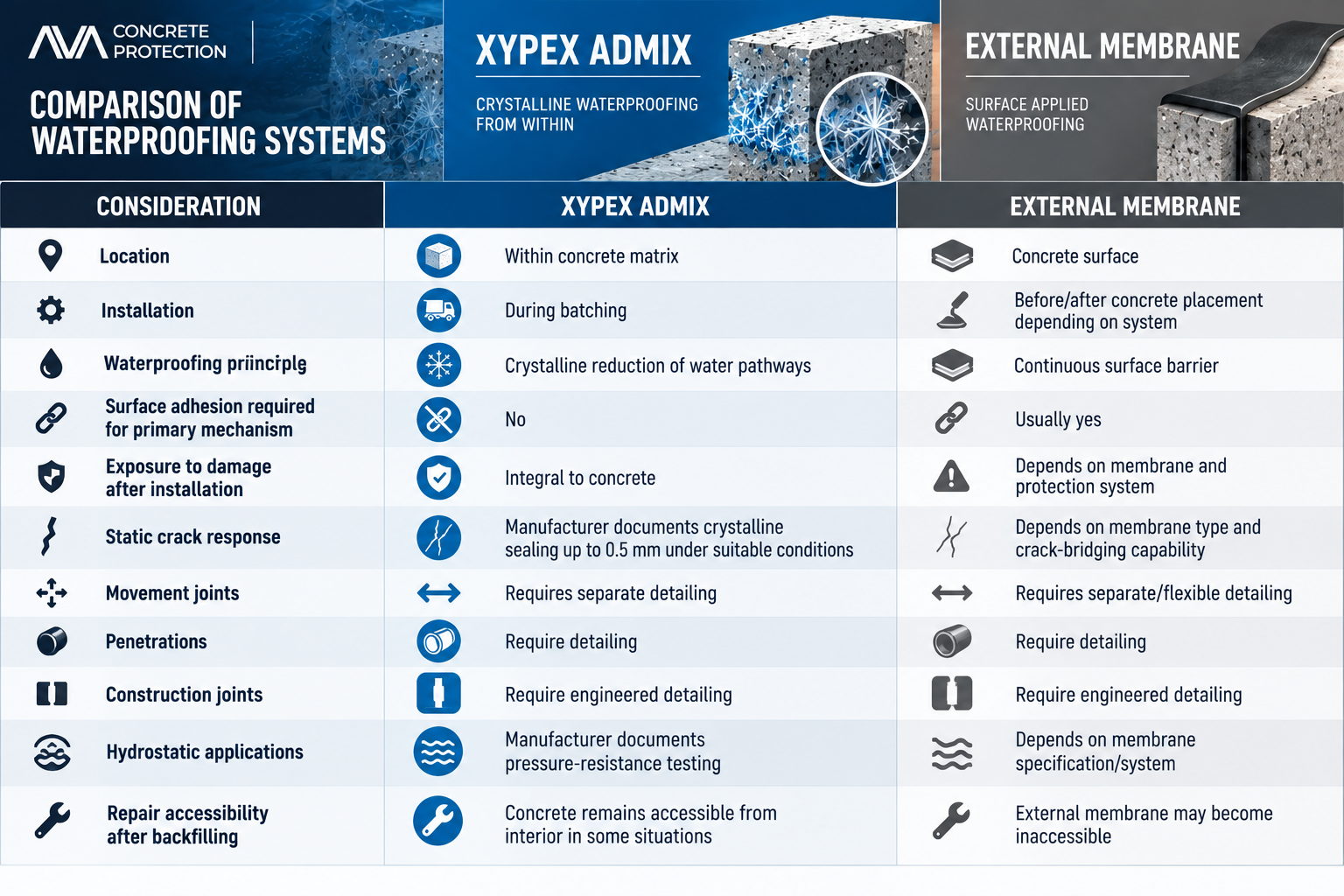
Neither approach should automatically be declared universally superior.
The correct waterproofing strategy depends on factors including:
- groundwater condition
- hydrostatic pressure
- structural configuration
- crack-control requirements
- joint arrangement
- accessibility
- construction sequence
- maintainability
- design life
- concrete quality
- specification requirements
- project risk
Some projects may use integral crystalline waterproofing as the principal concrete-waterproofing approach.
Other projects may combine crystalline technology with membranes or other systems in selected locations.
Where Can Xypex Admix Be Used Underground?
Potential underground applications include:
Basements
Underground railway stations
Tunnels
Precast tunnel segments
Underground utility vaults
Retaining walls
Elevator pits
Basements
Basements
Underground railway stations
Tunnels
Precast tunnel segments
Underground utility vaults
Retaining walls
Elevator pits
Basements
Xypex Admix can be incorporated into basement foundation slabs and reinforced-concrete walls where resistance to groundwater penetration is required.
Underground railway stations
Station boxes can involve large reinforced-concrete slabs and walls exposed to groundwater and difficult external access after construction.
Tunnels
Xypex identifies tunnels and subway systems among the recommended applications for its Admix C-Series.The technology has also been used in cast-in-place and precast tunnel applications.
Underground utility vaults
Electrical, communications, drainage and utility chambers may experience persistent groundwater exposure.
Precast tunnel segments
Because Admix is incorporated during batching, it can be introduced during precast production before tunnel segments leave the manufacturing facility.
Retaining walls
Below-grade retaining walls can experience moisture and hydrostatic pressure from the retained soil side.
Elevator pits
Elevator pits are often among the lowest points of a building and can therefore be particularly vulnerable to groundwater ingress when waterproofing or joint detailing is inadequate.
Why Concrete Quality Still Matters
Xypex Admix does not make poor concrete construction irrelevant.
Xypex itself identifies factors affecting optimum performance, including concrete thickness, cement content, reinforcing steel for strength and crack control, placement and finishing practices, and construction-joint sealing.
Therefore, an integral crystalline admixture should accompany—not replace—good concrete practice.
Important considerations include:
- appropriate concrete mix design
- controlled water-cementitious-material ratio
- proper batching and admixture dosage
- adequate mixing
- correct placement
- thorough consolidation
- appropriate curing
- crack-control reinforcement
- correctly designed construction joints
- waterstops where specified
- properly treated penetrations
- repair of defects such as honeycombing or significant cracks
Waterproofing cannot compensate for every structural or workmanship defect.
Frequently Asked Questions
Can Xypex Admix withstand groundwater pressure?
Xypex publishes independent permeability testing demonstrating treated concrete subjected to substantial hydrostatic pressure.
However, laboratory pressure resistance should not be interpreted as a guarantee for an entire underground structure. Joints, cracks, penetrations, concrete quality and workmanship remain critical to overall watertightness.
Can Xypex Admix replace a waterproofing membrane underground?
Potentially, in some engineered designs, but not automatically.
A project-specific engineering assessment should determine whether Xypex Admix can replace a waterproofing membrane. The assessment should consider project specifications, groundwater exposure, hydrostatic pressure, structural design, joints, penetrations, construction sequence and required waterproofing performance.
Can Xypex Admix seal cracks?
Xypex states that its crystalline technology can seal static hairline cracks up to 0.5 mm (0.02 in.) under suitable conditions.
This manufacturer-specific capability should not be generalized to moving, expanding or structurally significant cracks.
Does Xypex Admix eliminate waterstops?
Not as a general rule.
Waterstops and integral crystalline waterproofing perform different functions. Xypex’s own published construction details show Admix-treated concrete used together with waterstops and crystalline joint treatments in certain configurations.
Waterstop requirements should follow the project waterproofing design, structural details and approved specifications.
Can Xypex Admix waterproof expansion joints?
Xypex Admix treats the surrounding concrete but should not be considered a universal replacement for a movement-capable expansion-joint waterproofing system.
Expansion joints require detailing appropriate to their expected movement and hydrostatic exposure.
Can Xypex Admix be used in tunnels and subway systems?
Yes. Xypex specifically lists tunnels and subway systems among applications for its Admix products and publishes numerous underground infrastructure project references.
The appropriate product, dosage, concrete design and joint system should still be determined for the particular project.
Does Xypex Admix work only on the positive side of water pressure?
Unlike a surface barrier whose performance depends on its location and adhesion to the substrate, Xypex’s crystalline mechanism occurs within the concrete matrix.
Xypex therefore describes its technology as capable of resisting water penetration from either direction under hydrostatic pressure.
Is Xypex Admix enough to guarantee a leak-free basement?
No waterproofing admixture should be presented that way.
Successful underground waterproofing depends on the complete system: concrete quality, mix design, crack control, joints, waterstops, penetrations, workmanship, curing, defect repair and project-specific detailing all matter.
Still have questions? Check out our FAQ page or send us a message
Conclusion
Xypex Admix works in underground concrete by incorporating crystalline waterproofing technology directly into the concrete during batching. In the presence of moisture, its proprietary reactive constituents interact with cement-hydration products and develop non-soluble crystalline formations within pores and capillary pathways, reducing the pathways through which water can penetrate.
That mechanism is particularly relevant to underground structures exposed to groundwater and hydrostatic pressure because the waterproofing function exists within the concrete rather than solely as a surface barrier.
However, integral crystalline waterproofing should not be confused with a complete solution to every potential leakage pathway.
Construction joints, expansion joints, penetrations, structural cracks, concrete defects and workmanship still require proper engineering and detailing.
For Philippine underground projects, the strongest approach is therefore to evaluate Xypex Admix as part of a complete concrete waterproofing and durability strategy.
Ava Concrete Protection works with Xypex crystalline waterproofing technology in the Philippines and can assist project teams in reviewing concrete waterproofing requirements, structural drawings, joint configurations and relevant Xypex technical documentation before developing a project-specific recommendation.