


by
Although concrete looks solid, its internal structure contains pores, capillaries, and microcracks. These pathways can allow water to enter and move through the concrete.
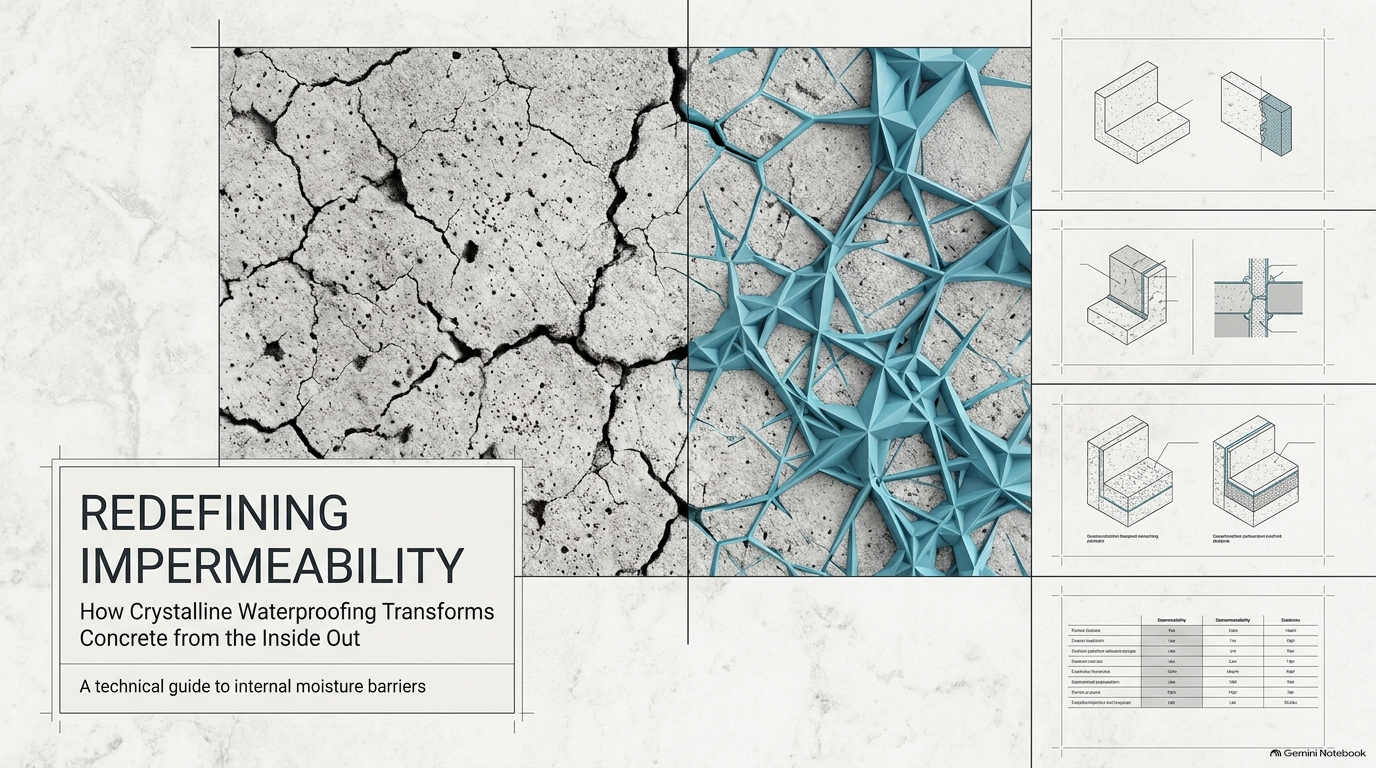
Crystalline waterproofing uses reactive chemicals that interact with moisture and the cementitious environment. This reaction forms insoluble crystalline deposits within the concrete. These deposits help restrict the movement of liquid water through pores, capillaries, and certain small cracks.
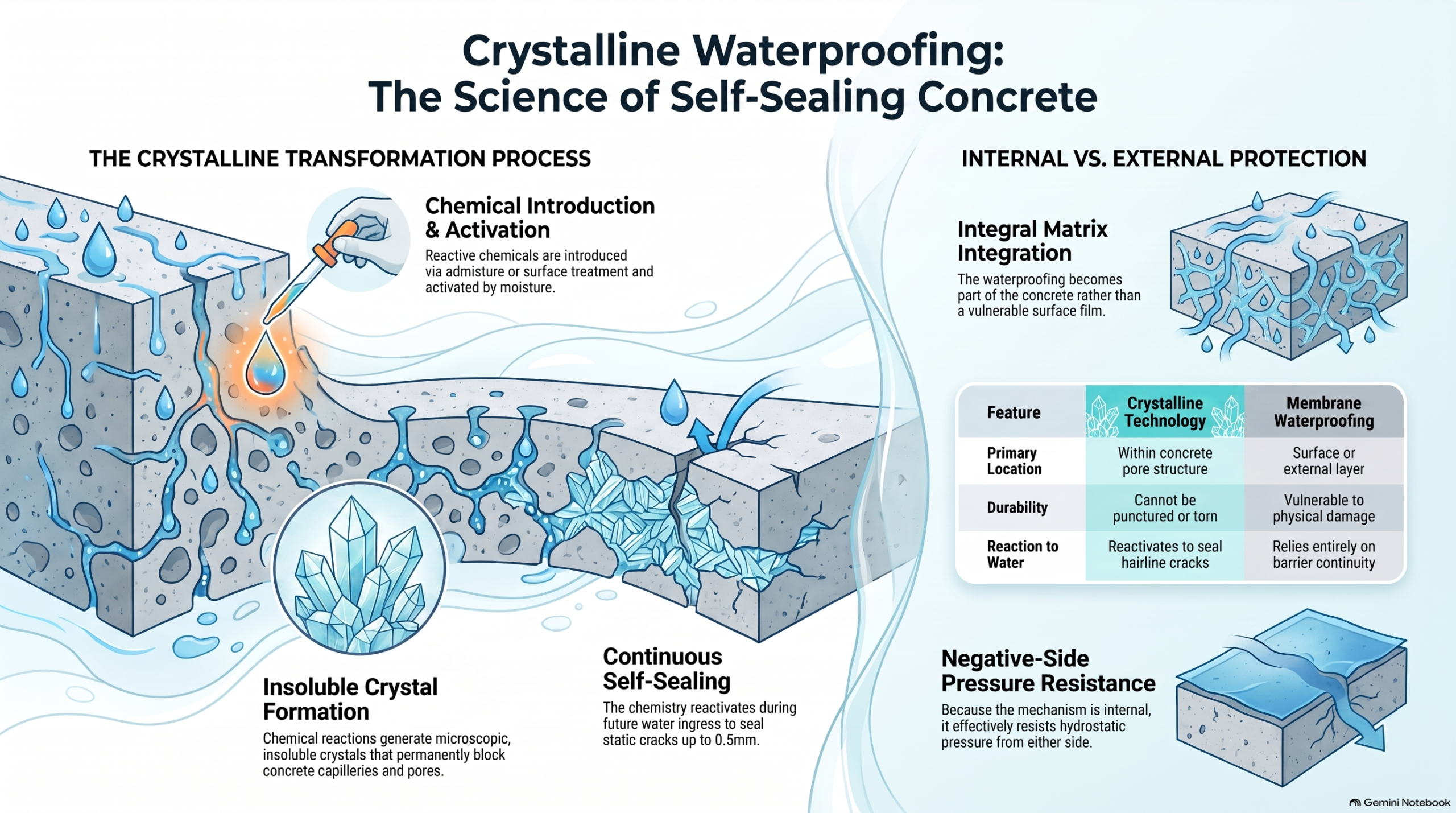
In contrast to conventional membrane waterproofing, crystalline technology works within the concrete itself. Membranes, by comparison, primarily create a barrier on the concrete surface.
How Does Crystalline Waterproofing Work?
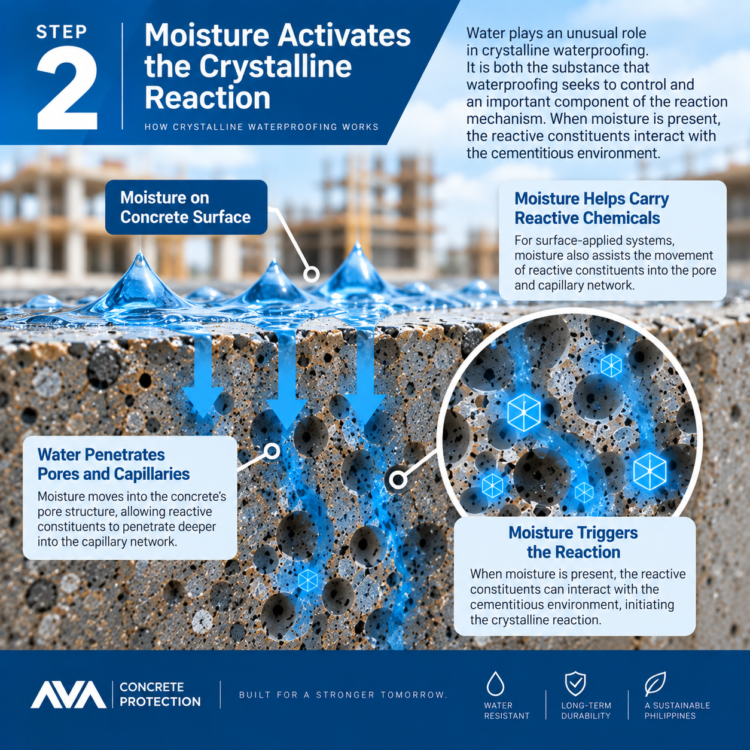
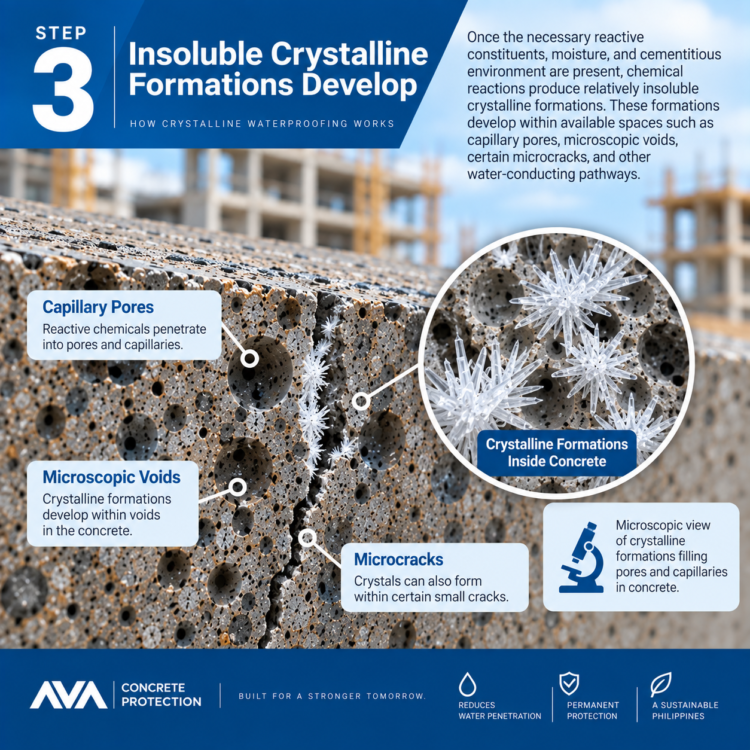
Moisture activates the reactive chemicals within the concrete. These chemicals interact with the cementitious environment and form insoluble crystalline deposits inside pores, capillaries, and certain small cracks. As these formations develop, they obstruct pathways through which liquid water can penetrate the concrete.
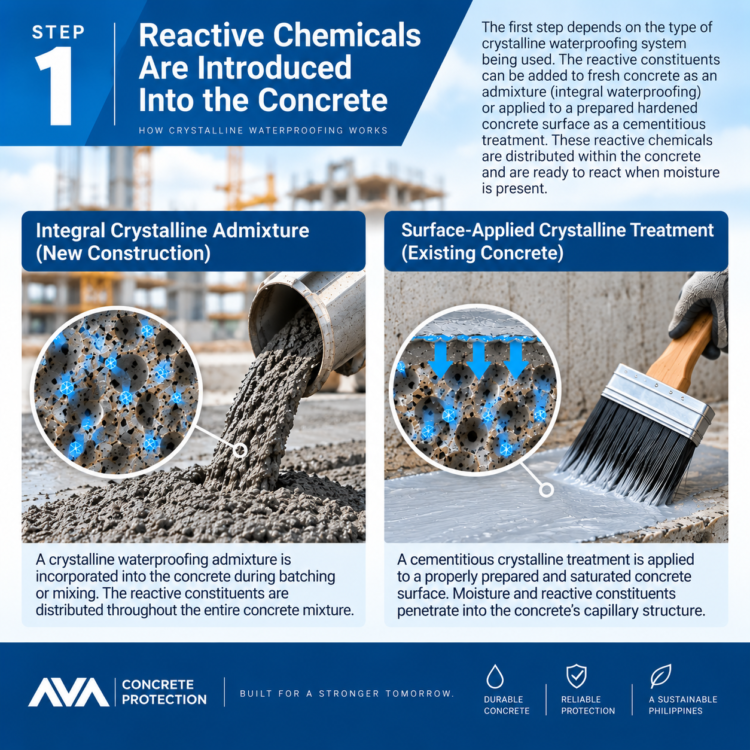
Depending on the system, manufacturers can introduce the reactive chemicals into fresh concrete as an admixture, or applicators can apply a crystalline treatment to the surface of hardened concrete.
Crystalline technology can reduce water penetration, but it does not eliminate the need for proper concrete design, crack control, joint detailing, penetration treatment, curing, and good workmanship.
Why Can Water Pass Through Concrete?
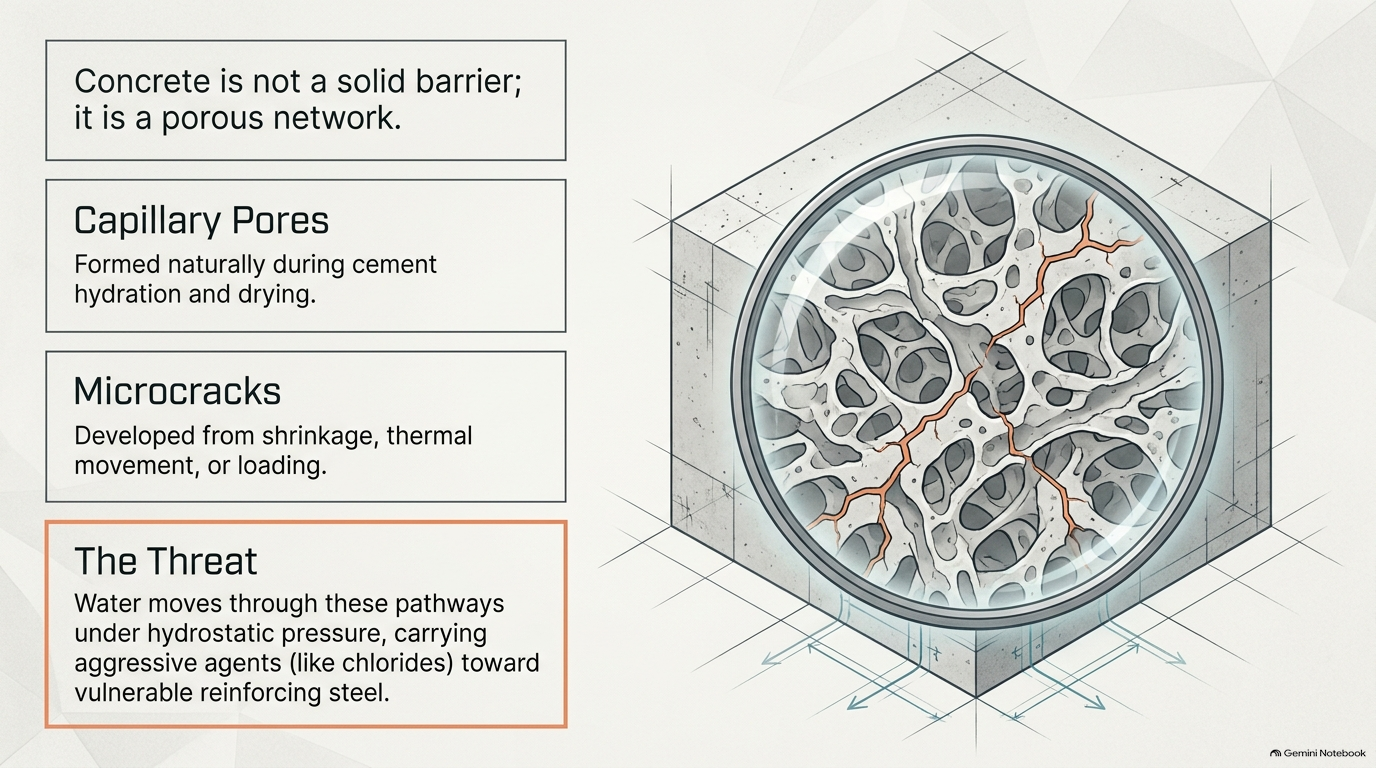
Concrete is not a completely solid or impermeable material.
As cement hydrates and concrete hardens, a complex internal pore structure develops. Its characteristics depend on factors such as:
water-to-cementitious-material ratio
cementitious materials
concrete mixture proportions
placement and consolidation
curing
cracking
overall workmanship
Some pores and capillaries can form interconnected pathways through the hardened cement paste.
When concrete is exposed to rain, groundwater, stored water, or hydrostatic pressure, these pathways can allow moisture and liquid water to penetrate.
Cracks, poorly treated construction joints, honeycombing, and penetrations can create even larger pathways.
This is the environment in which crystalline waterproofing operates.
How Crystalline Waterproofing Works: Step by Step
The crystalline waterproofing mechanism can be understood through five main stages.
Reactive Chemicals Are Introduced Into the Concrete
Water plays an important role in the crystalline waterproofing process.
Insoluble Crystalline Formations Develop
Crystalline systems can introduce reactive chemicals into concrete in different ways.
Moisture Activates the Crystalline Reaction
The chemical reaction produces insoluble crystalline formations within available spaces in the concrete.
How Crystalline Deposits Block Water Pathways
Before crystalline treatment, interconnected capillaries may provide pathways for water movement.
New Moisture Triggers Further Crystalline Activity
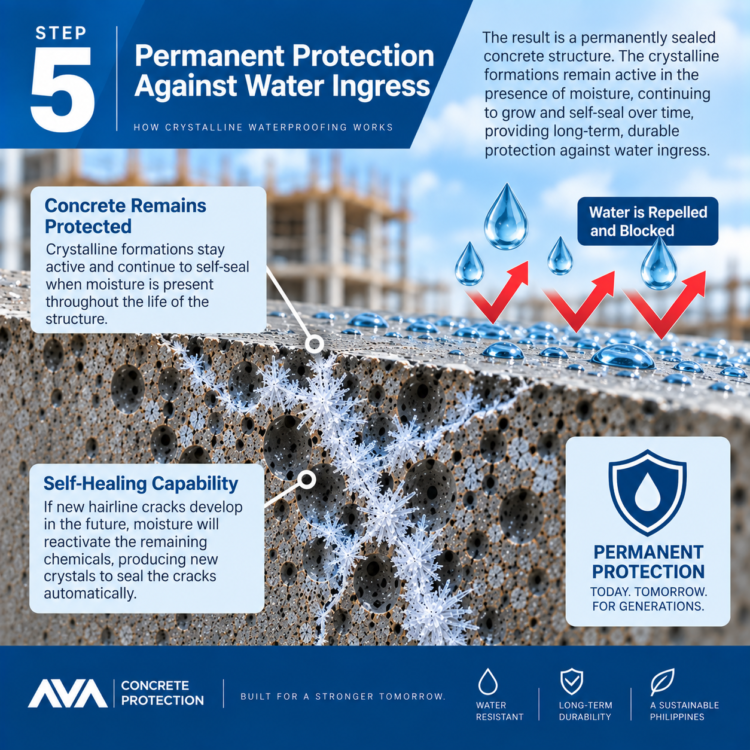
Certain crystalline systems can respond when moisture later enters the concrete.
How Does Crystalline Waterproofing Seal Small Cracks?
Concrete can develop small cracks due to drying shrinkage, thermal changes, restrained movement, loading, settlement, and other conditions. These cracks can create pathways for water to enter the concrete.
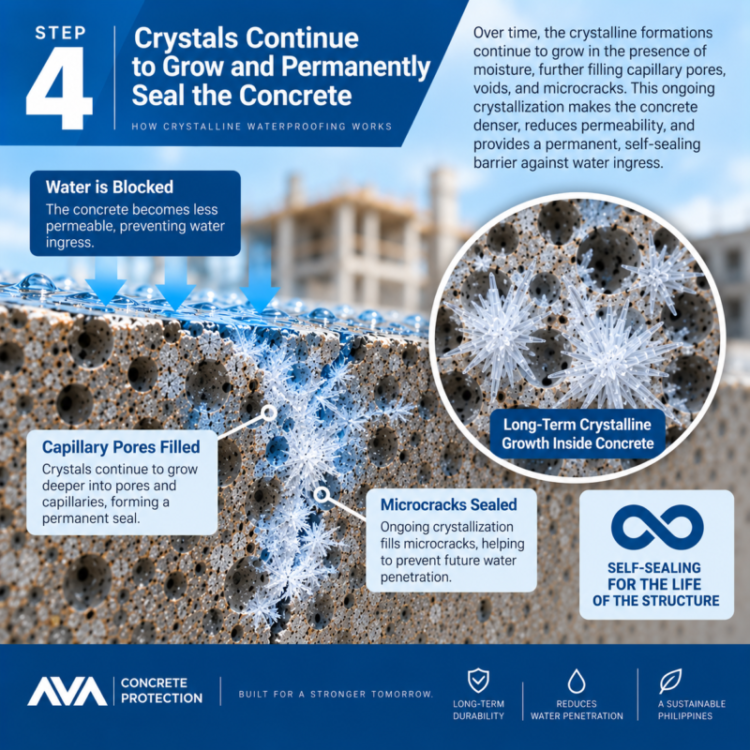
Crystalline waterproofing can help seal certain small cracks through a moisture-responsive chemical reaction. When water enters a crack, moisture can reactivate available crystalline constituents within the concrete.
This reaction can produce additional insoluble crystalline formations inside the crack. As these formations develop, they can obstruct the pathway available for liquid water.
As a result, crystalline waterproofing can reduce water penetration through certain small cracks over time. This process is often described as self-healing waterproofing or self-sealing concrete waterproofing.
However, self-healing requires an important engineering qualification. Crystalline waterproofing does not automatically repair every concrete crack. Crack width, movement, cause, exposure conditions, and the specific crystalline system can affect performance.
Engineers should evaluate structural cracks, active cracks, movement joints, and larger defects separately. These conditions may require dedicated concrete repair or joint-treatment systems.
Self-Sealing Is Not the Same as Structural Repair
Crystalline waterproofing can help certain small cracks become watertight under suitable conditions. However, sealing a crack against water does not restore the concrete’s original structural capacity.
This distinction is important. Terms such as self-sealing or chemically assisted crack sealing can describe the waterproofing mechanism more precisely than structural repair.
Crystalline waterproofing can reduce water movement through certain small cracks. However, engineers should not use it as a substitute for structural concrete repair.
Crystalline waterproofing alone cannot address:
- large structural cracks
- actively moving cracks
- expansion joints
- significant settlement cracks
- major honeycombing
- structurally defective concrete
Engineers should evaluate these conditions separately. The assessment should consider the crack’s cause, width, movement, and structural significance. Depending on the findings, the concrete may require a dedicated crack repair, structural repair, or joint-treatment system.
What Role Does Xypex Play in Crystalline Waterproofing?
Xypex Crystalline Technology is a commercial implementation of crystalline concrete waterproofing. According to Xypex Chemical Corporation, its proprietary reactive chemicals use moisture as a migrating medium within the concrete.
The chemicals react with water and products associated with cement hydration. As a result, the reaction forms non-soluble crystalline structures within pores, capillaries, cracks, and other voids in the concrete.
In addition, Xypex states that renewed moisture can reactivate the crystalline process. This moisture-responsive mechanism can promote further crystalline activity when water becomes present again.
Can Xypex Seal Small Concrete Cracks?
For certain Xypex systems, the manufacturer reports the capability to seal static hairline cracks up to 0.5 mm.
However, the 0.5 mm figure requires an important qualification. It is a manufacturer-specific performance claim for the applicable Xypex technology. Therefore, engineers should not automatically apply this capability to every crystalline waterproofing product.
For this reason, engineers and specifiers should review product-specific technical documentation and testing when selecting a crystalline waterproofing system.
Does Crystalline Waterproofing Reduce Water Penetration?
Laboratory research and manufacturer-published testing indicate that crystalline waterproofing can reduce water penetration in concrete under appropriate conditions.
However, engineers should look beyond the simple question, “Does crystalline waterproofing work?” Instead, they should evaluate how a specific crystalline waterproofing product performed under recognized test conditions.
Important factors include the concrete mixture, product dosage, curing conditions, water pressure, test duration, and specimen configuration. Therefore, waterproofing performance depends on both the crystalline technology and the concrete in which it operates.
What Factors Affect Crystalline Waterproofing Performance?
Several variables can influence the performance of a crystalline waterproofing system. For example, engineers should consider:
- concrete mixture design
- water-cementitious ratio
- crystalline product formulation
- dosage or application rate
- curing conditions
- concrete age
- cracking
- workmanship
- exposure conditions
- test methodology
For this reason, engineers should evaluate crystalline waterproofing as part of the overall concrete system rather than as an isolated material.
What Does Independent Research Show?
Peer-reviewed research has reported reduced water penetration in concrete containing crystalline waterproofing admixtures compared with control concrete.
In addition, research has observed improved crack-healing behavior in concrete containing crystalline admixtures. However, crack width can significantly influence the effectiveness of this process.
Therefore, crystalline waterproofing performance should be considered together with concrete quality, crack characteristics, curing, and exposure conditions.
What Is the Difference Between Integral and Surface-Applied Crystalline Waterproofing?
Crystalline waterproofing can be incorporated into concrete in different ways. The two common approaches are integral crystalline waterproofing admixtures and surface-applied crystalline treatments.
For new construction, manufacturers can add an integral crystalline admixture during concrete batching. By comparison, applicators apply surface treatments to prepared hardened concrete.
Integral vs Surface-Applied Crystalline Waterproofing
| Consideration | Integral Crystalline Admixture | Surface-Applied Crystalline Treatment |
|---|---|---|
| Installation | During concrete production | After concrete has hardened |
| Application method | Added during batching or mixing | Applied to prepared concrete surfaces |
| Distribution | Distributed throughout the concrete mixture | Introduced from the treated surface |
| Common use | Primarily new construction | New or existing concrete |
| Surface preparation | Not the primary application mechanism | Critical to proper application |
| Moisture | Present during mixing and hydration | Saturation and curing are typically important |
| Typical structures | Slabs, walls, tanks, foundations | Walls, slabs, tanks, and remedial works |
Do Both Methods Require Joint and Crack Treatment?
Yes. Both integral and surface-applied crystalline waterproofing require proper treatment of concrete discontinuities.
For example, construction joints, movement joints, penetrations, cracks, and honeycombing may require dedicated detailing or repair.
Therefore, engineers should select the appropriate crystalline waterproofing method based on the project stage, concrete condition, exposure, detailing requirements, and product-specific recommendations.
Crystalline Waterproofing for Philippine Concrete Structures
Understanding how crystalline waterproofing works is especially important when designing concrete structures for Philippine environmental conditions.
Concrete structures in the Philippines can face frequent moisture exposure. For example, heavy rainfall, high humidity, groundwater, and hydrostatic pressure can increase the risk of water penetration.
In addition, coastal and industrial environments may expose concrete to conditions that can affect long-term durability.
Common Water and Environmental Exposure Conditions
Depending on the project location and use, concrete structures may encounter:
- intense rainfall
- high humidity
- groundwater
- hydrostatic pressure
- repeated wetting
- coastal conditions
- chloride exposure
- water-retaining conditions
- aggressive industrial environments
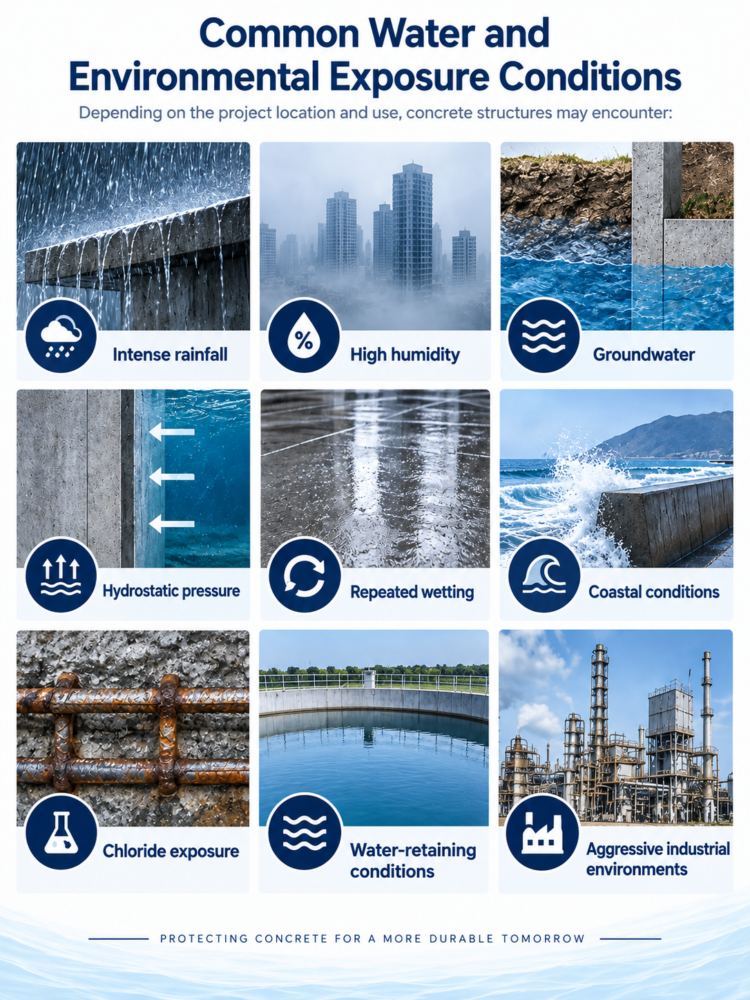
As a result, controlling water penetration can be important for both concrete watertightness and long-term durability.
Therefore, engineers should consider the specific exposure conditions, concrete design, crack control, joint detailing, and waterproofing requirements when selecting a crystalline waterproofing system.
Water Ingress Is Also a Concrete Durability Issue
Water leakage is often treated purely as a waterproofing problem.
For reinforced concrete, however, controlling the transport of moisture and dissolved aggressive substances can also contribute to durability.
Chlorides, for example, can migrate through concrete and contribute to reinforcement corrosion when sufficient concentrations reach the reinforcing steel and the necessary electrochemical conditions exist.
Reducing concrete permeability can therefore form part of a broader durability strategy.
But crystalline waterproofing should not replace good durability design.
Appropriate concrete quality, reinforcement cover, curing, crack control, drainage, joint design, material selection, and exposure-specific engineering requirements remain essential.
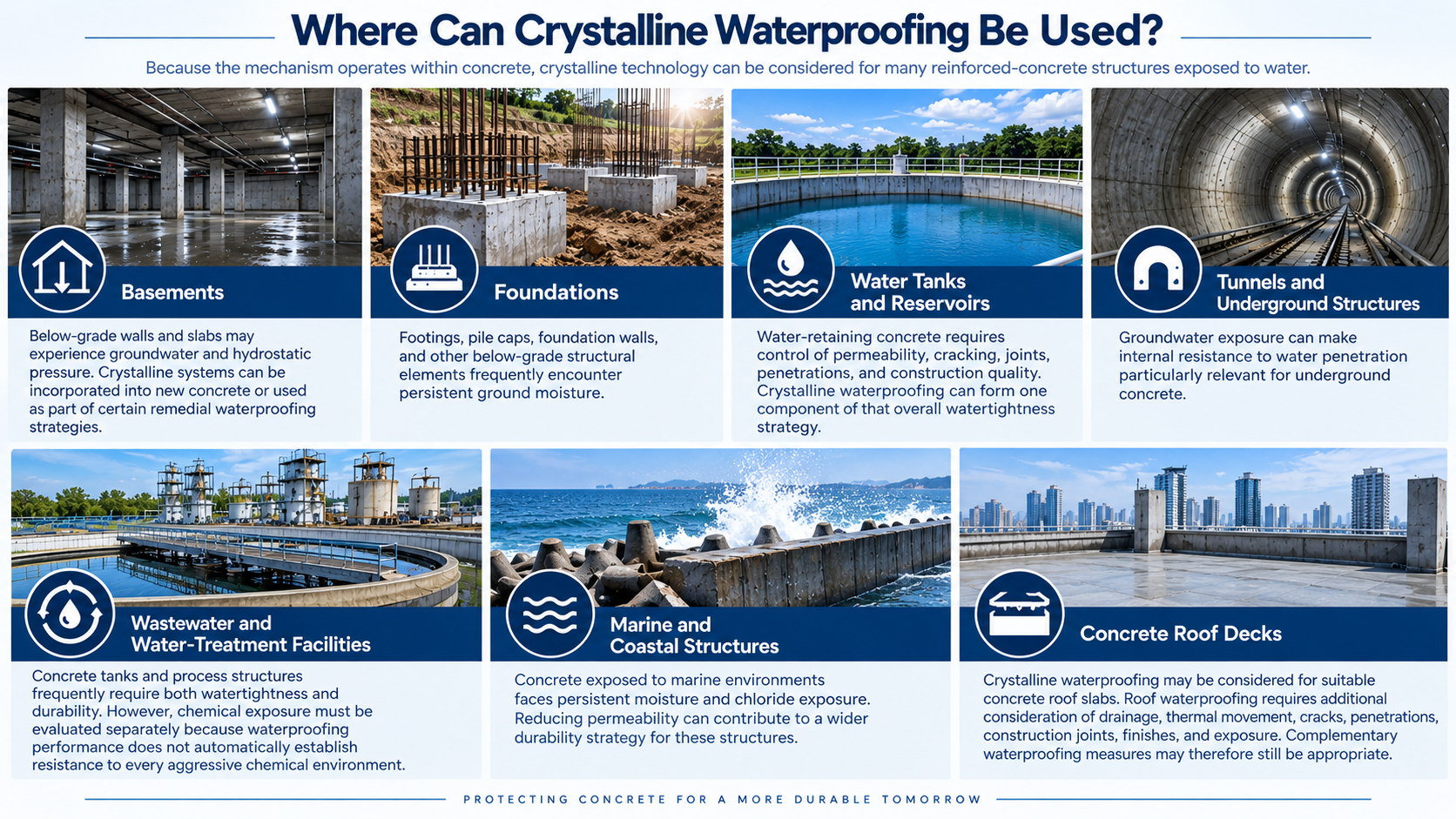
Where Can Crystalline Waterproofing Be Used?
Because the mechanism operates within concrete, crystalline technology can be considered for many reinforced-concrete structures exposed to water.
How Is Crystalline Waterproofing Different From Membrane Waterproofing?
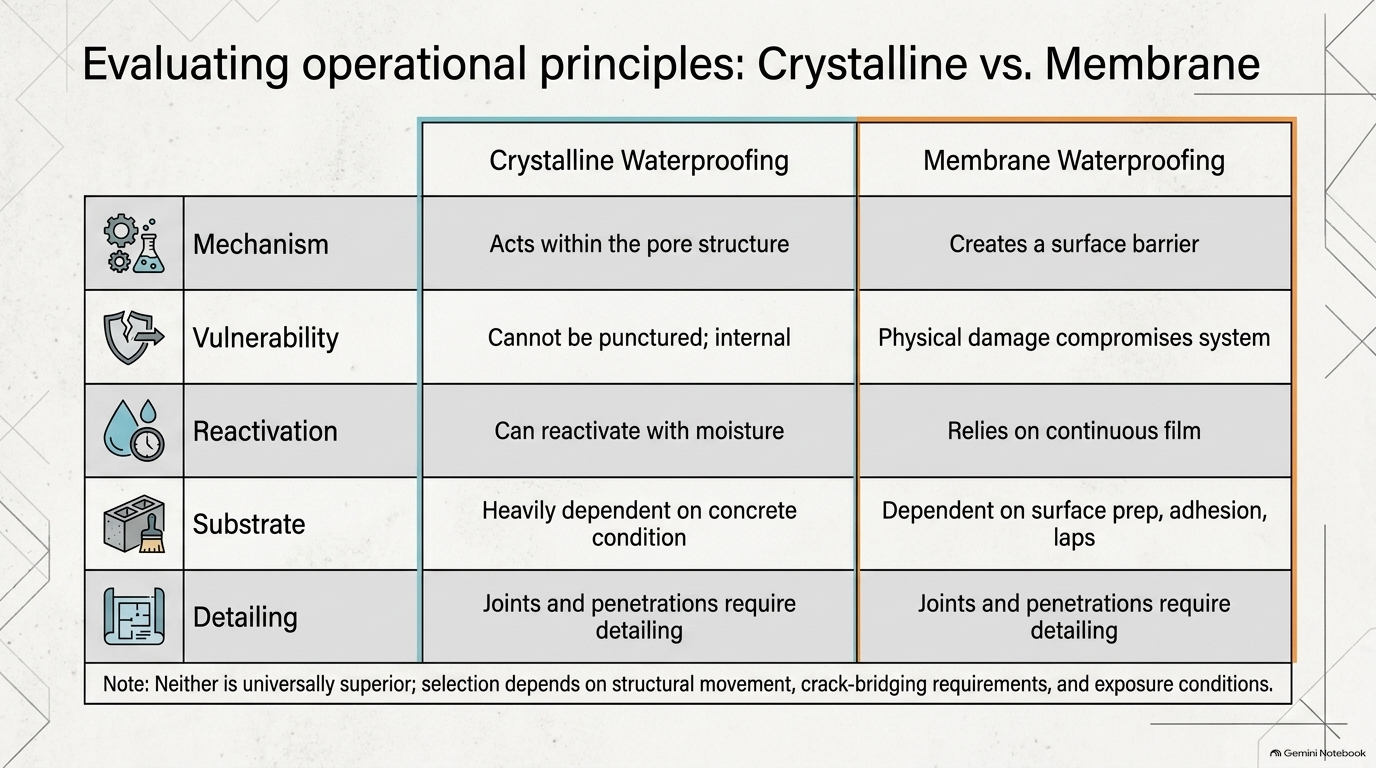
The main difference between crystalline waterproofing and membrane waterproofing is where the waterproofing mechanism operates.
Membrane waterproofing creates a barrier on or adjacent to the concrete surface. By comparison, crystalline waterproofing works within the concrete by reacting with moisture and the cementitious environment.
Therefore, the two systems approach water penetration differently.
How Does Membrane Waterproofing Work?
A waterproofing membrane primarily creates a continuous barrier between water and the concrete.
Depending on the project requirements, membrane systems may include:
- liquid-applied membranes
- sheet membranes
- cementitious coatings
- polyurethane membranes
- bituminous membranes
- other barrier-forming systems
In general, membrane performance depends on maintaining continuity across the waterproofed area. Joints, penetrations, terminations, substrate preparation, and installation quality can therefore affect overall performance.
How Does Crystalline Waterproofing Work Differently?
Crystalline waterproofing works within the pores and capillaries of concrete. Reactive chemicals interact with moisture and the cementitious environment to form insoluble crystalline deposits.
As a result, these formations can obstruct pathways through which liquid water could otherwise penetrate.
Unlike a membrane, crystalline waterproofing does not depend exclusively on maintaining an external film over the concrete surface.
Is Crystalline Waterproofing Better Than Membrane Waterproofing?
Not automatically. Crystalline and membrane waterproofing systems have different characteristics. Therefore, engineers should select the system according to the specific waterproofing requirements of the structure.
For example, membrane waterproofing may be appropriate when the design requires:
- crack-bridging capability;
- accommodation of movement;
- waterproofing of non-concrete substrates;
- separation from specific external exposures; or
- a continuous external waterproofing barrier.
By comparison, crystalline waterproofing may be considered when the project requires:
- waterproofing within the concrete;
- integral waterproofing for new concrete;
- resistance to water penetration under hydrostatic conditions;
- treatment where future access to the waterproofed surface may be difficult; or
- a moisture-responsive waterproofing mechanism within concrete.
In some projects, engineers may specify both technologies as complementary components of the waterproofing strategy.
Therefore, system selection should consider water exposure, structural movement, substrate type, construction sequence, joints, penetrations, accessibility, maintainability, and project-specific performance requirements.
What Crystalline Waterproofing Cannot Do
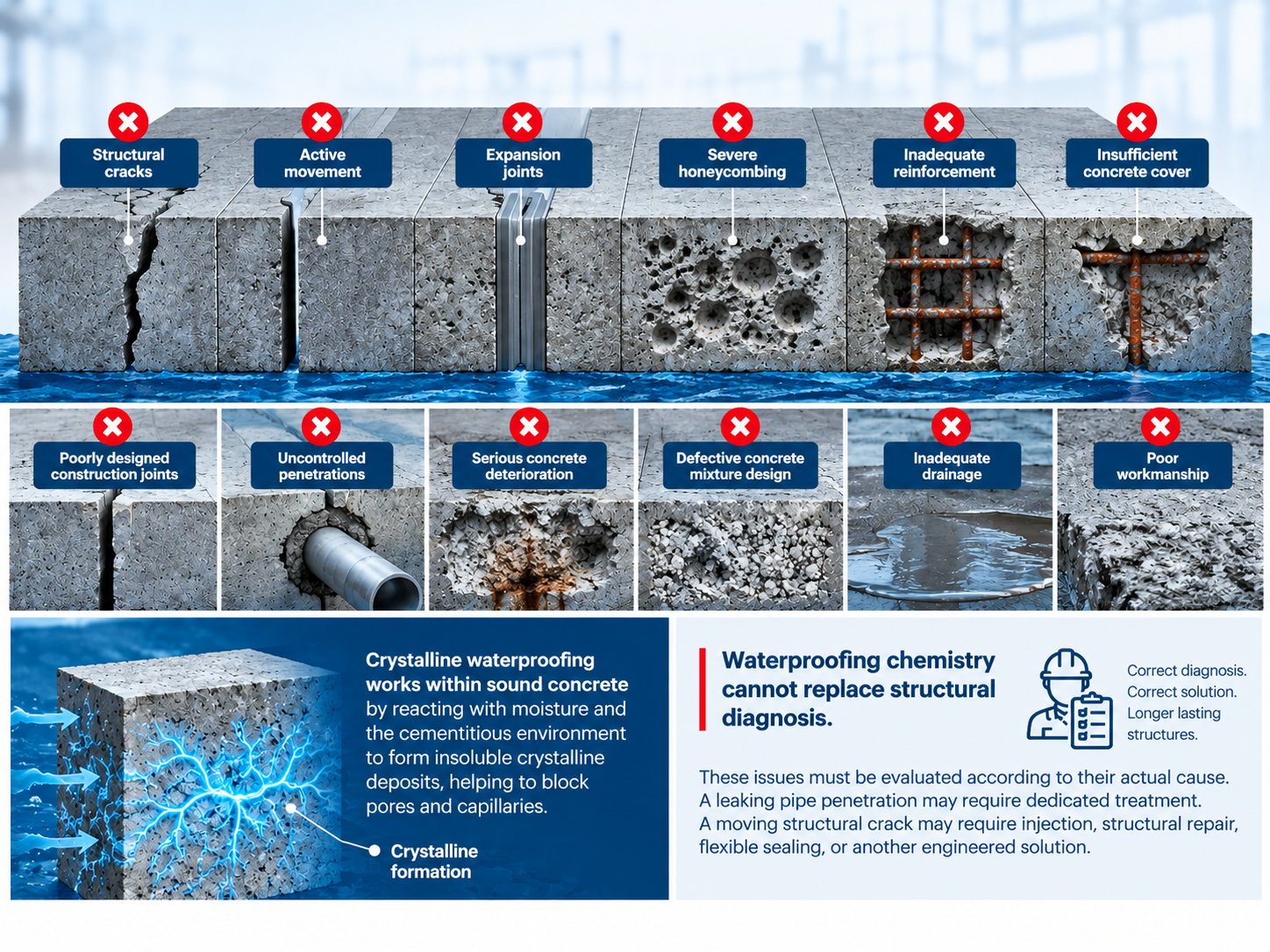
These problems must be evaluated according to their actual cause.
A leaking pipe penetration, for example, normally requires dedicated treatment around the penetration.
A moving structural crack may require injection, structural repair, flexible sealing, or another engineered solution.
Waterproofing chemistry cannot replace structural diagnosis.
What Should Engineers Look for When Evaluating Crystalline Waterproofing?
Engineers and specifiers should evaluate the specific product and evidence, rather than specifying crystalline technology only as a generic category.
Important considerations include:
Concrete mixture design
Evaluate water-cementitious ratio, strength, cementitious materials, expected permeability, and exposure.
Crystalline dosage
Verify the manufacturer’s specified dosage for integral admixtures.
Application rate
For surface treatments, verify substrate preparation, coverage, saturation, and curing requirements.
Permeability testing
Review the actual test method, pressure, duration, concrete mixture, and results.
Crack-sealing evidence
Determine the crack width and conditions under which performance claims were established.
Hydrostatic pressure
Consider expected water pressure and whether exposure is positive-side or negative-side.
Construction joints
Specify dedicated joint treatment rather than assuming crystalline chemistry alone will waterproof every joint.
Penetrations
Develop details for pipes, conduits, sleeves, anchors, and embedded elements.
Concrete workmanship
Maintain proper placement, consolidation, finishing, and curing.
Compatibility
Verify compatibility with coatings, repair materials, sealants, membranes, and other project systems.
Frequently Asked Questions
Does crystalline waterproofing permanently stay inside concrete?
Crystalline reaction products are formed within the concrete matrix rather than existing solely as a removable surface film.
However, claims concerning permanence and service life should be evaluated against the documentation for the specific product.
The durability of the concrete itself also remains important.
Why does crystalline waterproofing need moisture?
Moisture participates in activating and transporting the reactive chemistry.
For surface-applied treatments, appropriate saturation and curing can therefore be important to developing the intended crystalline reaction.
Does crystalline waterproofing completely fill concrete pores?
No.
A more technically accurate explanation is that crystalline formations reduce the continuity and water-conducting capacity of available pores, capillaries, and certain cracks.
The objective is reduced water penetration, not literally eliminating every pore in hardened concrete.
Can crystalline waterproofing seal cracks?
Certain crystalline technologies can promote sealing of small cracks when moisture becomes available.
The result depends on factors such as crack width, movement, concrete condition, product formulation, and exposure.
This should not be confused with structural crack repair.
Can crystalline waterproofing work against hydrostatic pressure?
Certain crystalline systems have been tested under hydrostatic-pressure conditions.
Performance should be evaluated using product-specific test documentation, including pressure, test duration, specimen characteristics, and test method.
Can crystalline waterproofing be applied from the inside of a leaking basement?
Certain surface-applied crystalline systems can be used from the negative side because the intended reaction develops within the concrete.
However, active leaks, joints, cracks, honeycombing, and penetrations may require repair before or together with the crystalline treatment.
Does crystalline waterproofing replace membranes?
Not universally.
Crystalline technology and membranes operate differently. Selection should depend on structural movement, exposure, substrate, drainage, construction sequence, accessibility, detailing, and required performance.
In some situations, complementary use can be appropriate.
Is crystalline waterproofing suitable for old concrete?
Certain surface-applied crystalline products are specifically intended for existing concrete.
Proper preparation is essential. Paint, coatings, laitance, contamination, and other materials that prevent interaction with the concrete may need to be removed before treatment.
Still have questions? Check out our FAQ page or send us a message
Conclusion
Crystalline waterproofing works within concrete, using moisture-responsive chemistry to form insoluble crystalline deposits that help block water pathways in pores, capillaries, and certain small cracks.
However, effective waterproofing still depends on good concrete design, proper joint and penetration detailing, crack control, drainage, and workmanship.
For Philippine projects, Ava Concrete Protection provides crystalline waterproofing solutions designed to support long-term watertightness and concrete durability.