


by
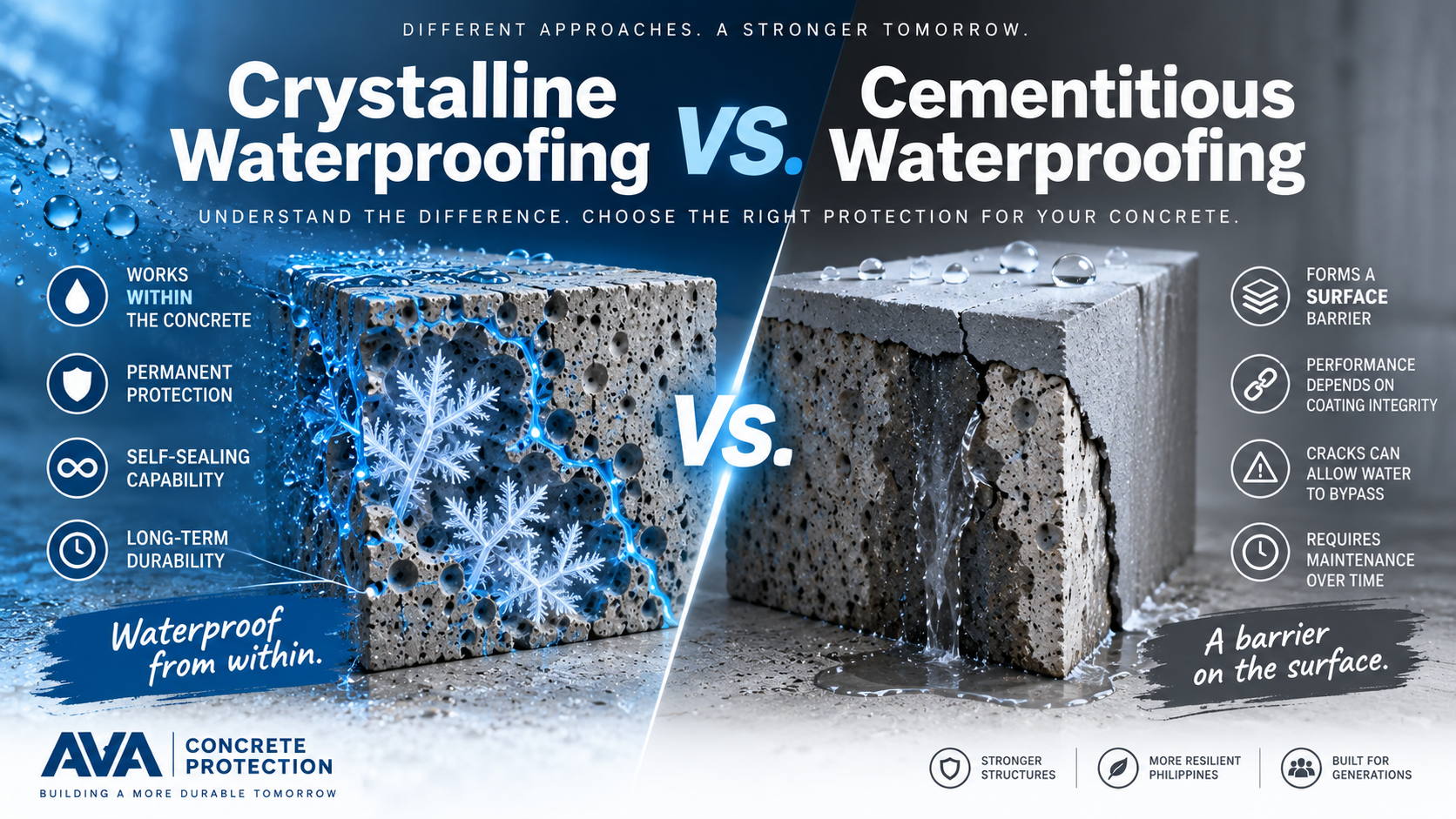
Crystalline waterproofing vs Cementitious waterproofing differs mainly in how each system controls water penetration through concrete. Crystalline waterproofing uses reactive chemistry to form insoluble crystalline structures within concrete pores, capillaries, and certain water pathways. Conventional cementitious waterproofing, by comparison, generally relies on a bonded, water-resistant coating applied to the surface of the substrate.
However, there is an important technical distinction: crystalline waterproofing can itself be cementitious. Some surface-applied crystalline products are cement-based coatings, but their intended waterproofing action extends beyond the surface. The active constituents interact with moisture and the concrete to develop crystalline formations within its pore structure.
Conventional cementitious waterproofing systems—including rigid and polymer-modified flexible coatings—depend more heavily on the adhesion, continuity, thickness, and performance of the applied waterproofing layer. Flexible formulations may also provide specified crack-bridging capability.
For Philippine construction projects, understanding these differences is important when selecting waterproofing for basements, water tanks, foundations, retaining walls, wet areas, infrastructure, and other reinforced-concrete structures exposed to moisture or hydrostatic conditions.
Neither technology is automatically the better choice. The appropriate waterproofing system depends on the concrete substrate, water exposure, hydrostatic pressure, anticipated cracks and movement, joints and penetrations, construction sequence, accessibility, and required service performance.
Quick Answer
Crystalline waterproofing works by promoting insoluble crystalline formations within concrete’s pores, capillaries, and certain water pathways, while conventional cementitious waterproofing generally creates a water-resistant cement-based layer over the substrate.
However, the categories overlap: a surface-applied crystalline treatment may itself be a cementitious coating.
The appropriate system depends on the substrate, expected movement, water pressure, crack conditions, exposure, accessibility, construction sequence, detailing, and required service performance.
What Is Crystalline Waterproofing?
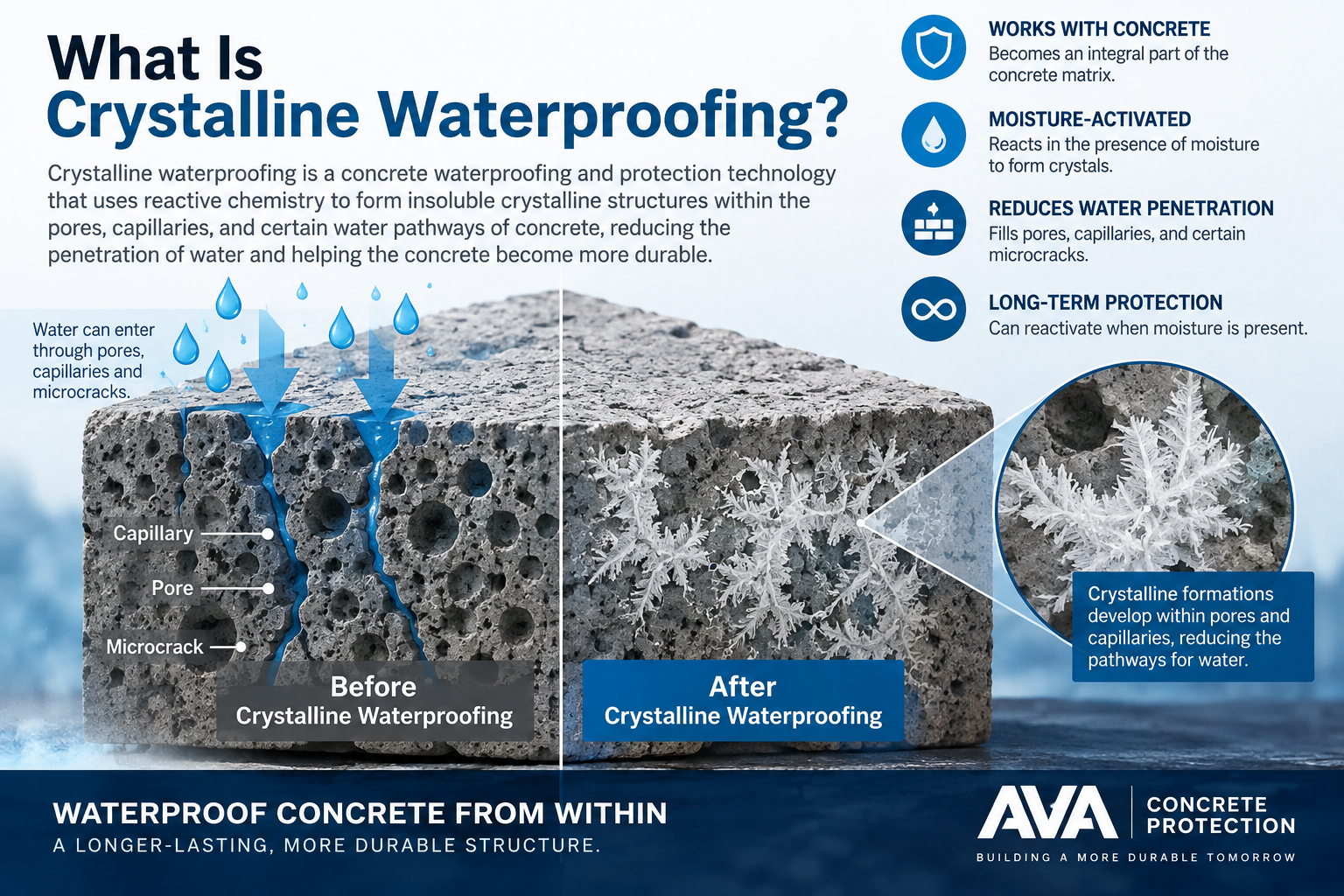
Crystalline waterproofing is a concrete waterproofing technology that uses reactive chemistry to reduce water penetration. It works within the concrete’s pores and capillary network. Therefore, it does not rely only on a waterproof barrier at the surface.
How Is Crystalline Waterproofing Applied?
Project teams can use crystalline waterproofing in two main ways.
For new concrete, they can add an integral crystalline waterproofing admixture during batching. This method incorporates the crystalline technology directly into the concrete mix.
For existing concrete, contractors can apply certain crystalline products as cementitious surface treatments. Proper surface preparation remains essential for effective application.
How Does Crystalline Waterproofing Work?
Crystalline waterproofing uses moisture-responsive chemical reactions within concrete.
For Xypex crystalline technology, the manufacturer describes a reaction involving its proprietary active chemicals, moisture, and components associated with cement hydration.
This reaction develops insoluble crystalline formations within the concrete. These formations develop in interconnected pores, capillaries, and certain water pathways.
As a result, the formations restrict pathways that could otherwise allow liquid water to penetrate the concrete.
How Is Crystalline Waterproofing Different From a Surface Coating?
A surface-applied crystalline product may initially resemble a conventional cementitious coating. However, its intended mechanism does not depend solely on a continuous surface film.
Instead, the reactive treatment interacts with the concrete itself. The reaction develops crystalline formations within the concrete’s pore and capillary structure.
In simple terms, crystalline waterproofing works with the concrete itself to reduce water penetration from within.
Surface-Applied vs Integral Crystalline Waterproofing
Crystalline waterproofing generally comes in two forms: surface-applied treatments and integral crystalline admixtures. Both aim to reduce water movement through concrete, but their application methods differ.
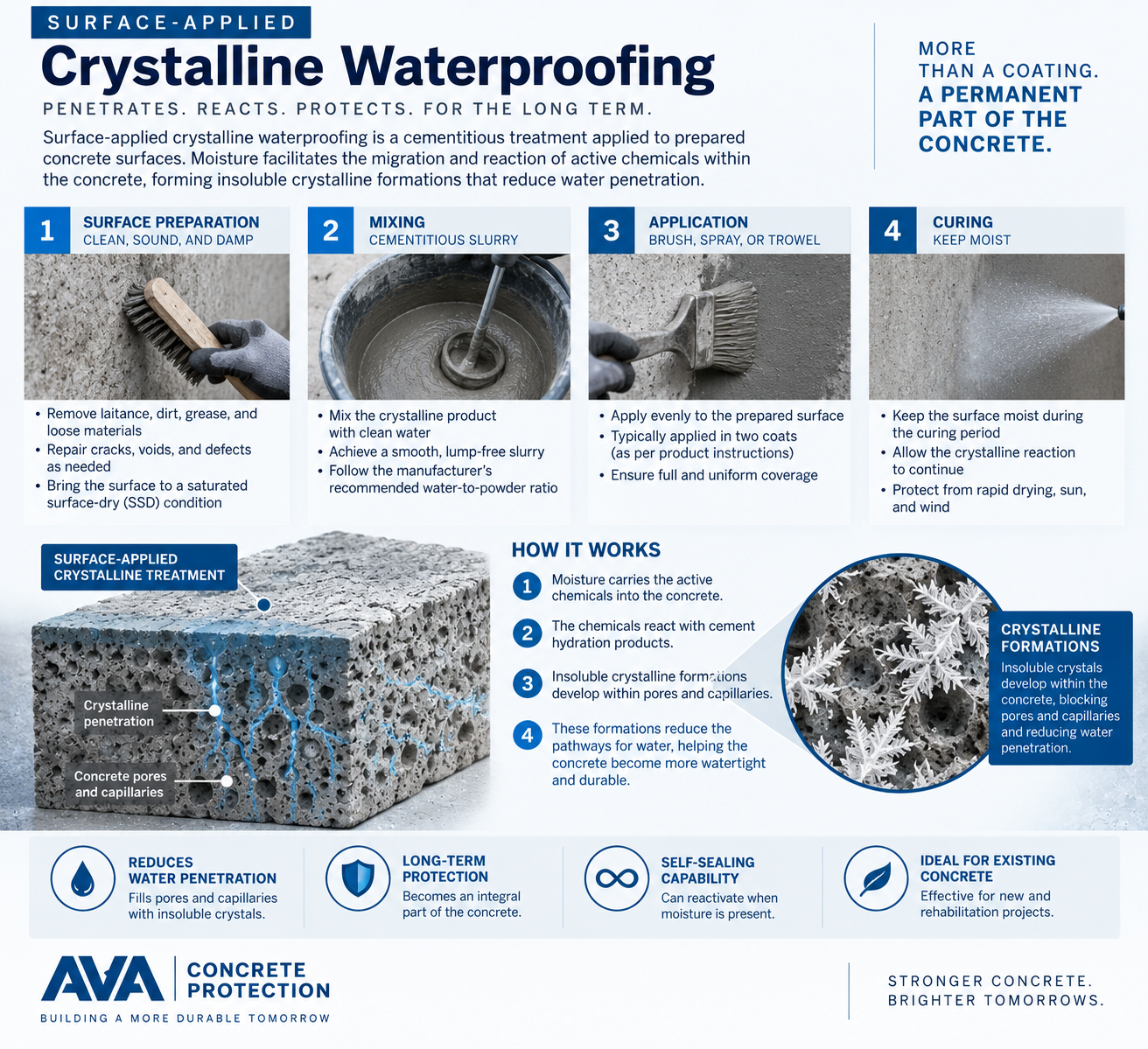
Surface-applied crystalline
waterproofing
Is applied to prepared concrete surfaces, typically as a cementitious slurry. Moisture facilitates migration and reaction of the active constituents within the concrete.
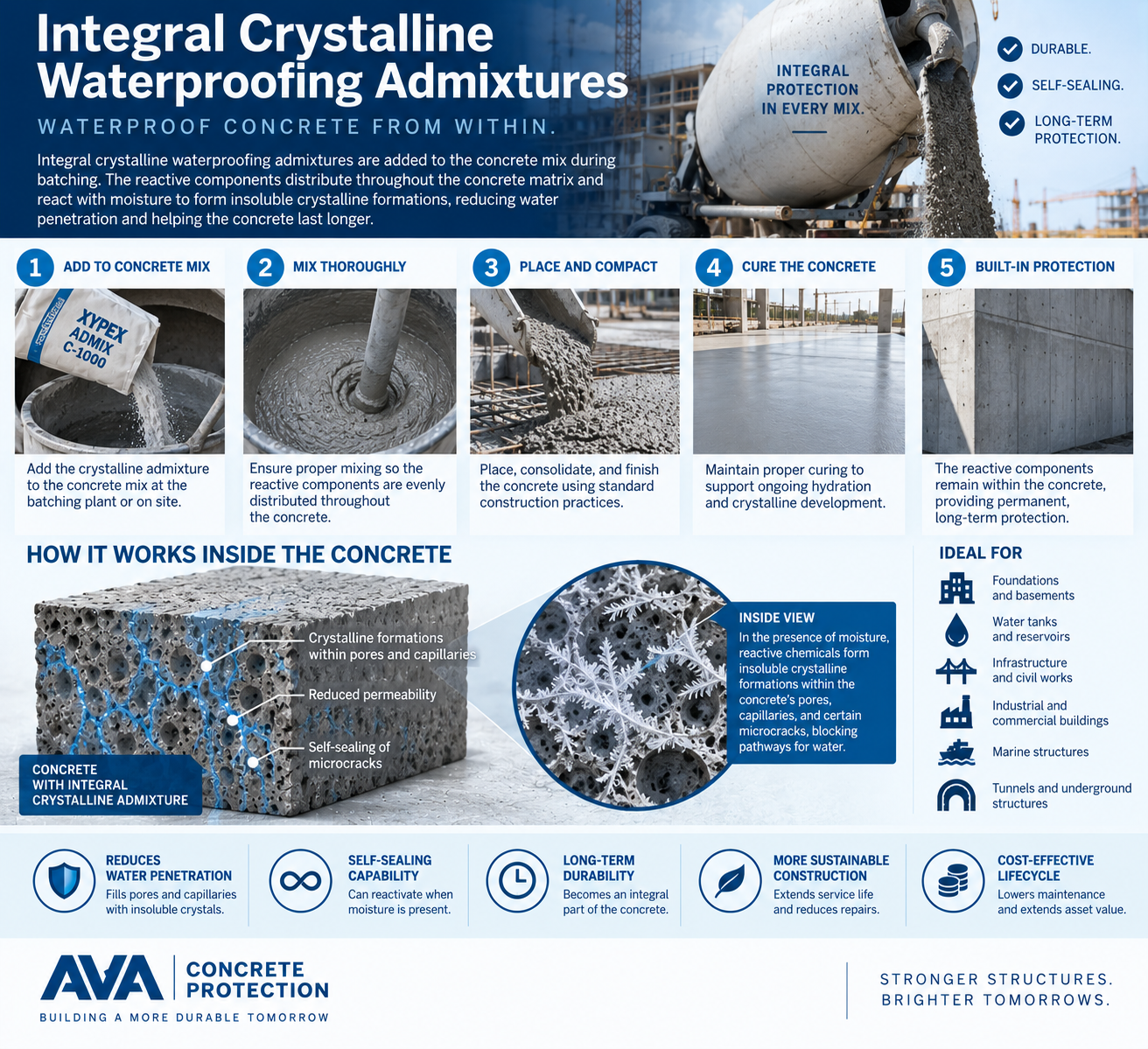
Integral crystalline waterproofing admixtures
Are introduced during concrete batching so the reactive components are distributed through the concrete matrix.
What Is Cementitious Waterproofing?
Cementitious Waterproofing
refers to cement-based mortars, slurries, or coatings applied to a substrate to resist water penetration.
These systems can be one-component or multi-component and may be rigid, semi-flexible, polymer-modified, fibre-reinforced, or flexible depending on their formulation.
For example, conventional polymer-modified cementitious systems available in the Philippine market are applied in coats over prepared concrete or cementitious substrates. Their applications can include bathrooms, balconies, terraces, tanks, reservoirs, and basements.
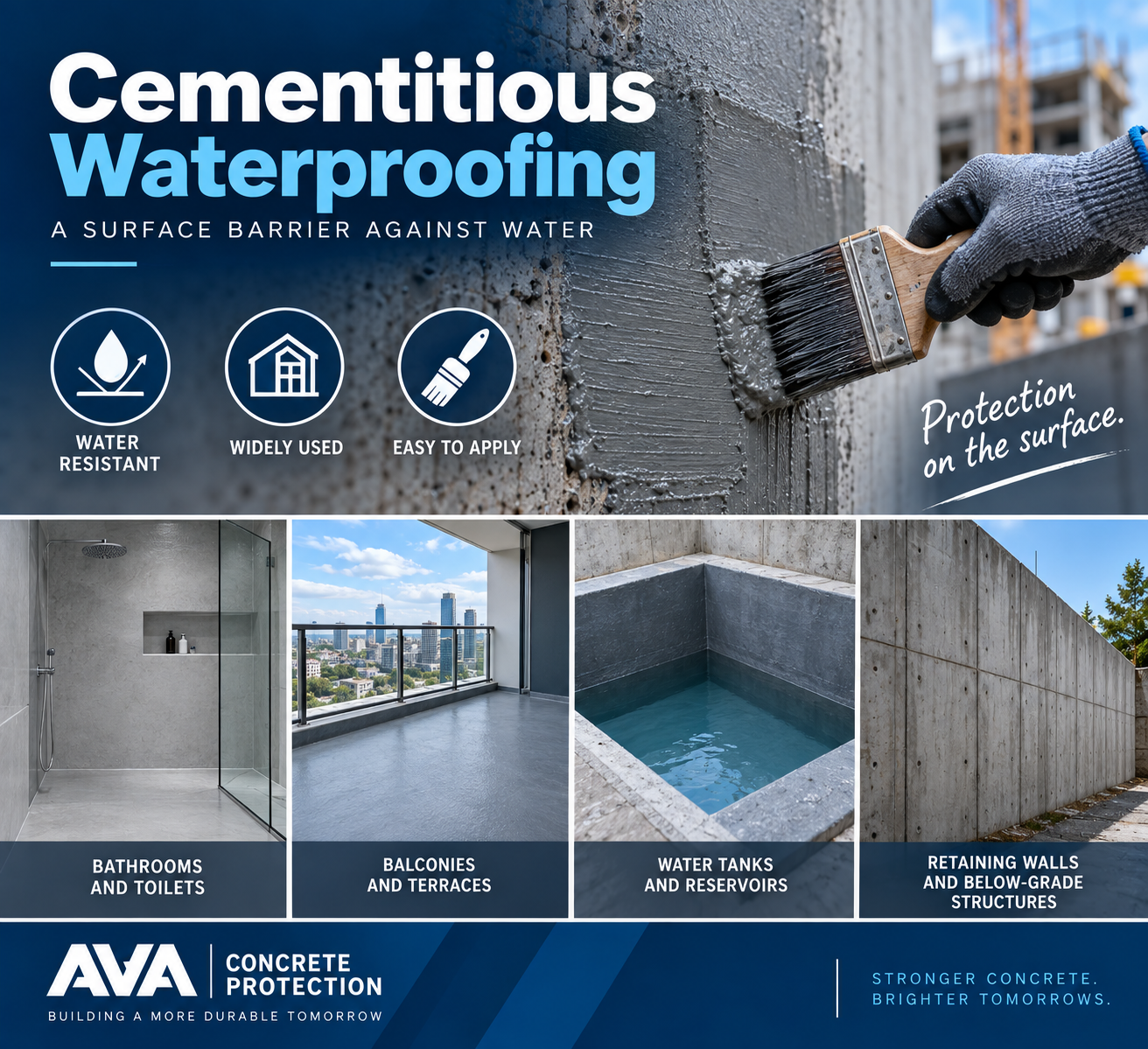
The applied waterproofing layer must therefore be correctly mixed, bonded, detailed, cured, and maintained according to the selected product’s requirements.
Importantly, not all cementitious waterproofing behaves identically.
A rigid cementitious coating and a polymer-modified flexible cementitious coating can have significantly different abilities to accommodate substrate movement or bridge cracks. Project specifications should therefore identify the actual product type and required performance rather than treating “cementitious waterproofing” as one uniform technology.
How Does Crystalline Waterproofing Work?
Concrete appears solid, but its microstructure contains pores, capillaries, interfaces, and potentially cracks through which moisture can migrate.
Crystalline waterproofing uses this internal pore structure as part of its mechanism.
In Xypex’s documented technology, water acts as a catalyst for reactions involving the proprietary chemicals and products of cement hydration. These reactions produce insoluble crystalline structures within the concrete’s pores and capillary tracts.
The practical objective is to obstruct pathways through which liquid water could otherwise penetrate the concrete.
This mechanism is particularly significant because the waterproofing effect is intended to develop within the concrete rather than relying exclusively on a surface barrier.
For surface-applied crystalline treatments, proper substrate preparation, saturation, application, curing, and detailing remain important. Calling a technology “crystalline” does not eliminate normal requirements for good waterproofing workmanship.
How Does Conventional Cementitious Waterproofing Work?
Conventional cementitious waterproofing creates a continuous, water-resistant layer over a compatible substrate. Contractors commonly apply these systems to concrete, masonry, render, and screed.
A typical polymer-modified cementitious waterproofing system may contain:
- cementitious binders
- graded fillers or aggregates
- polymers
- chemical additives
- reinforcing fibres
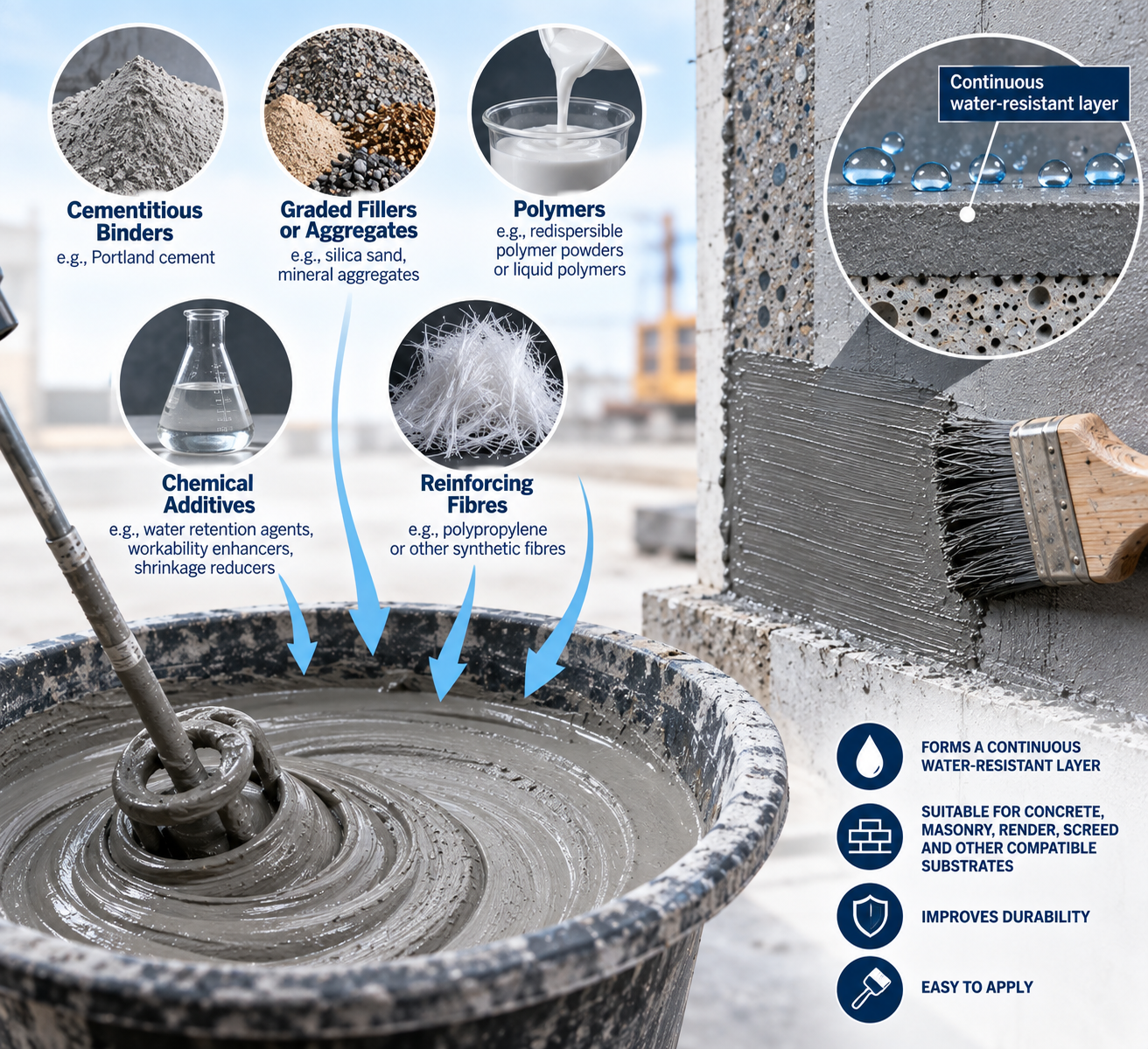
When mixed with water or a liquid polymer component, these materials form a cementitious waterproofing slurry. Contractors then apply the slurry directly to the prepared substrate.
The cementitious binders provide strength and help the system bond to the substrate. Graded fillers help create a dense and uniform matrix. Meanwhile, polymers can improve adhesion, flexibility, and overall performance.
After curing, the system forms a continuous water-resistant layer at the surface. This layer helps limit water penetration through the protected substrate.
Unlike crystalline waterproofing, conventional cementitious waterproofing relies primarily on the integrity of the applied surface layer. Therefore, proper surface preparation, application, curing, and detailing remain important to its performance.
Crystalline Waterproofing vs Cementitious Waterproofing: Key Differences
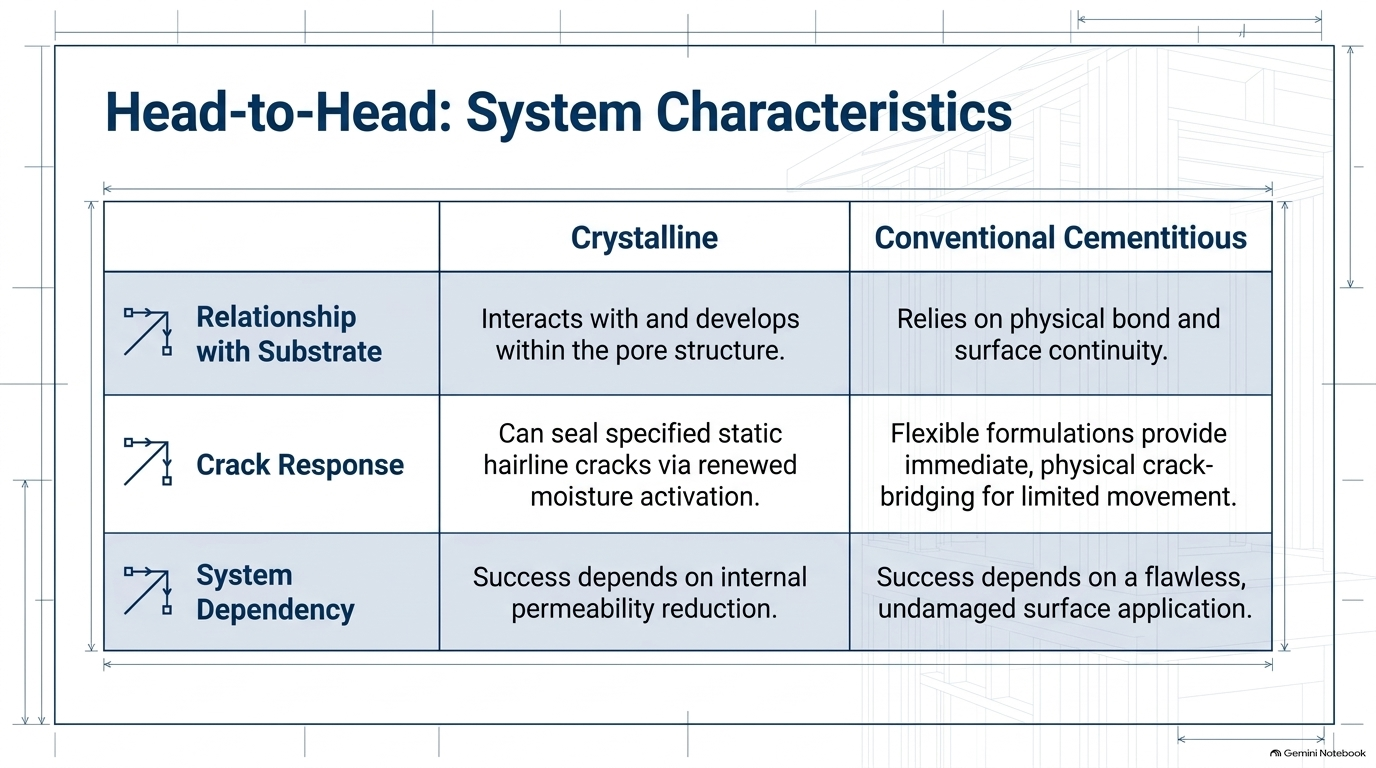
Crystalline and conventional cementitious waterproofing can both protect cement-based structures from water ingress. However, they use different mechanisms to achieve this objective. Crystalline technology focuses on reducing water pathways within the concrete. In contrast, conventional cementitious waterproofing primarily creates a water-resistant layer at or near the substrate surface.
Therefore, project teams should compare more than the application method. They should also consider crack response, movement, substrate conditions, detailing, and the required waterproofing performance.
| Consideration | Crystalline Waterproofing | Conventional Cementitious Waterproofing |
| Primary mechanism | Reactive process intended to form insoluble products within concrete pores and capillaries | Applied cement-based layer primarily intended to resist water penetration at or near the substrate surface |
| Relationship with concrete | Intended to interact with and develop within concrete’s pore structure | Primarily relies on the applied waterproofing layer and its bond to the substrate |
| Application | Surface-applied treatment or integral admixture, depending on system | Usually surface-applied slurry, mortar, or coating |
| Substrates | Principally associated with cementitious concrete systems | Can often be used on concrete, render, masonry, screeds, and other compatible cementitious substrates |
| Crack response | Certain crystalline systems claim sealing capability for specified static cracks under suitable conditions | Depends strongly on formulation; flexible products may provide specified crack-bridging performance |
| Movement accommodation | Not a substitute for movement-joint design or highly dynamic crack accommodation | Flexible formulations may accommodate limited movement within their tested capability |
| Waterproofing dependency | Intended to reduce water pathways within concrete | Depends substantially on continuity and performance of the applied layer |
| Repairs/detailing | Cracks, joints and penetrations may require dedicated crystalline repair/detailing systems | Joints, penetrations and transitions typically require compatible detailing products |
| Best selection basis | Concrete structures where internal permeability reduction and crystalline action are technically appropriate | Projects where a bonded surface waterproofing layer and/or flexible cementitious performance is required |
This comparison is intentionally general. Actual performance must be determined from the selected manufacturer’s technical data, test reports, project conditions, and specification requirements.
Why Does This Difference Matter in Philippine Construction?
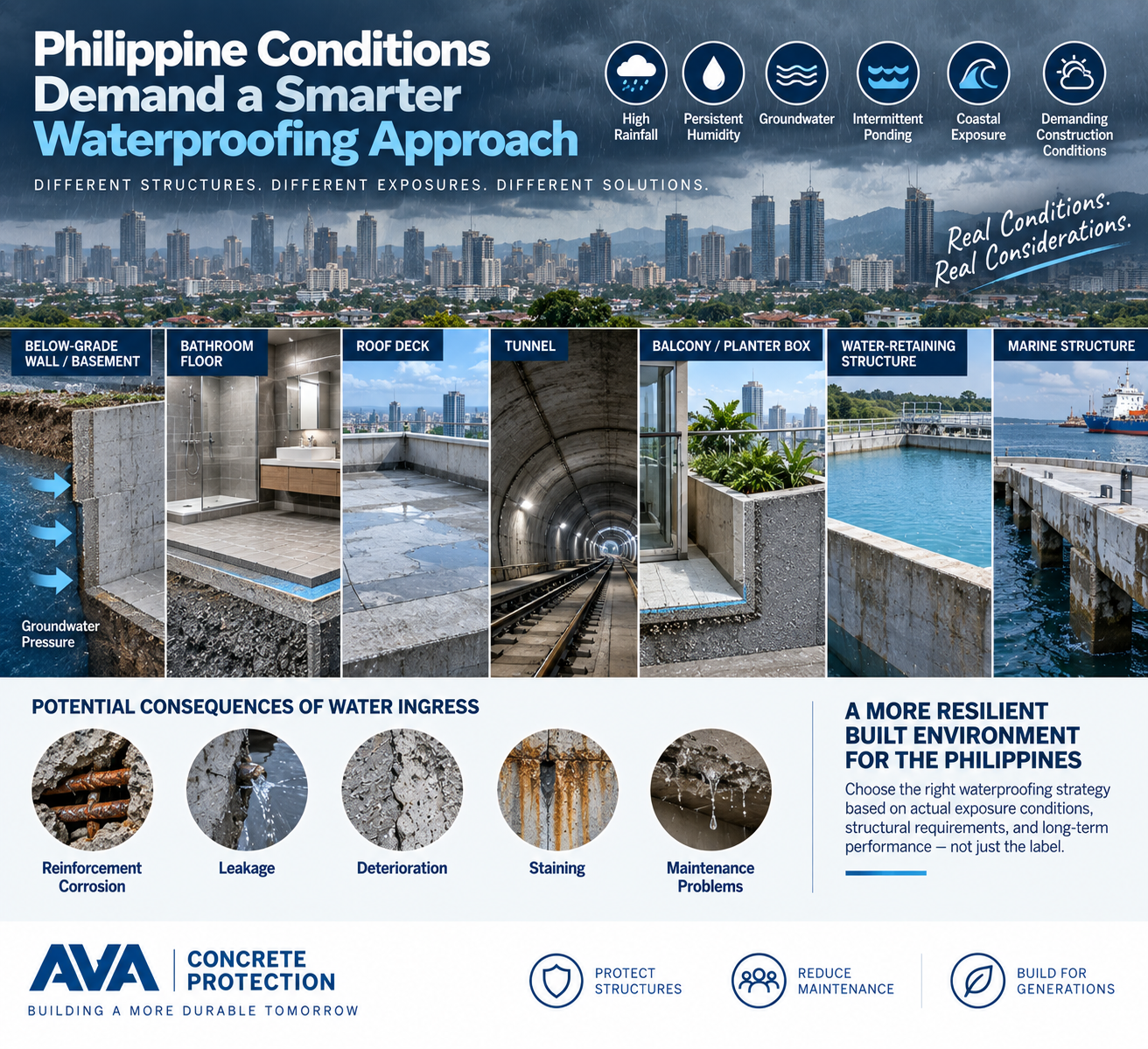
The distinction becomes important under Philippine exposure conditions.
Many reinforced-concrete structures experience combinations of high rainfall, persistent humidity, groundwater, intermittent ponding, coastal exposure, and demanding construction conditions.
Water ingress is not merely an inconvenience.
Once moisture can move through cracks, joints, penetrations, pores, or defects in concrete, it can contribute to conditions associated with reinforcement corrosion, leakage, deterioration, staining, and maintenance problems.
The appropriate waterproofing strategy should therefore consider how water is expected to reach and move through the structure, rather than selecting a product solely because it carries the word “waterproofing.”
For a below-grade wall exposed to groundwater, for example, the engineering considerations differ considerably from those for a bathroom floor that will subsequently receive ceramic tiles.
Likewise, a water-retaining structure, roof deck, tunnel, balcony, planter box, basement, and marine structure may require different combinations of waterproofing, joint treatment, crack control, drainage, protective systems, and concrete design.
What Should Engineers and Specifiers Evaluate?
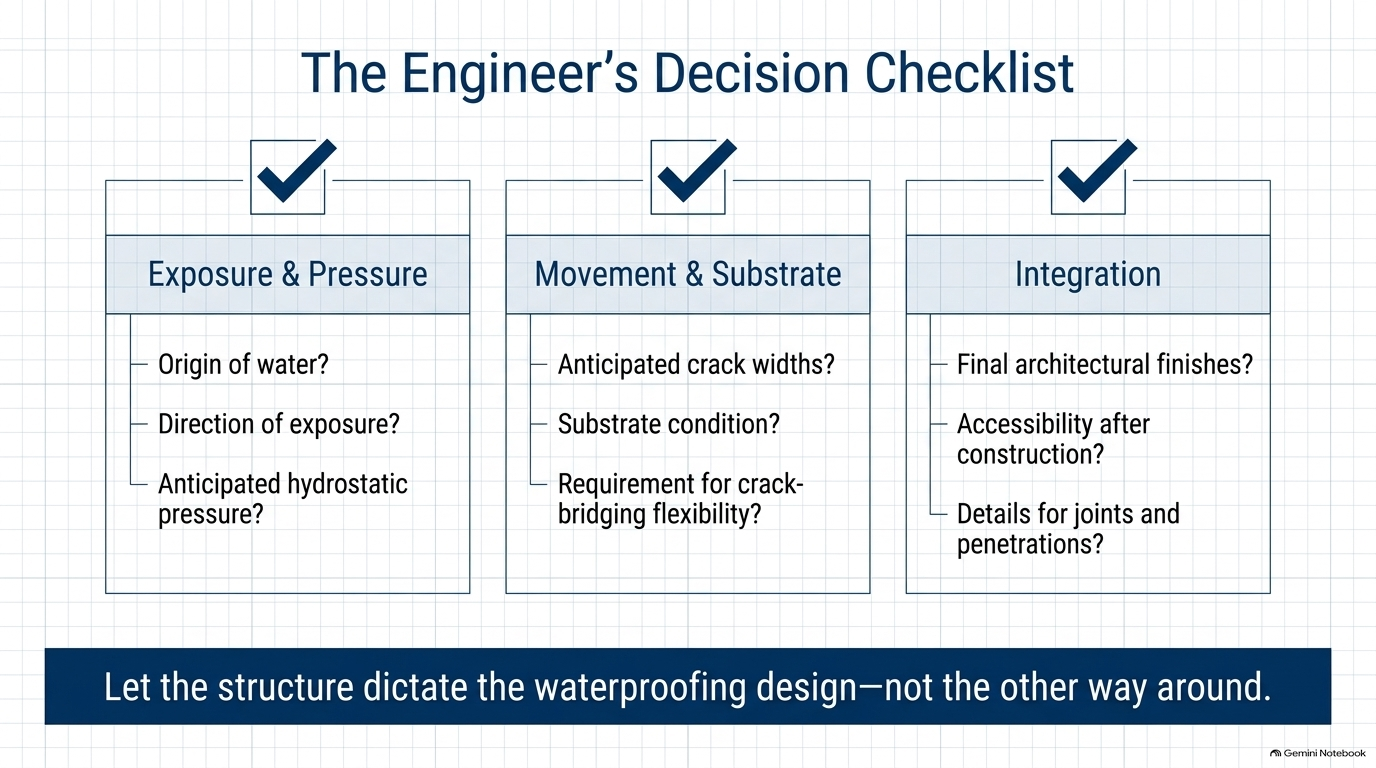
Instead of specifying simply “crystalline waterproofing” or “cementitious waterproofing,” the project team should evaluate the complete performance requirement.
Important considerations include the expected water pressure and direction of exposure, concrete quality and permeability, anticipated crack widths and movement, construction and expansion joints, penetrations, substrate condition, accessibility after construction, compatibility with finishes, exposure environment, installation sequence, repairability, curing requirements, and available independent performance evidence.
For crystalline systems, evaluate documented evidence supporting the proposed crystalline mechanism and claimed performance.
For cementitious systems, evaluate bond, waterproofing performance, flexibility or crack bridging where required, application thickness, substrate compatibility, and environmental exposure.
In both cases, evaluate the complete waterproofing system, not merely the product applied over the largest surface area.
Frequently Asked Questions
Is crystalline waterproofing a cementitious waterproofing?
It can be.
Some surface-applied crystalline waterproofing products are cementitious coatings. The distinction lies primarily in their intended mechanism: crystalline treatments contain reactive constituents designed to develop insoluble formations within the concrete pore structure.
What is the main difference between crystalline and conventional cementitious waterproofing?
The primary difference is the waterproofing mechanism.
Which is better for bathrooms?
It depends on the complete floor and wall assembly.
Flexible cementitious waterproofing is commonly specified beneath tiles in wet areas because suitable products can provide a continuous waterproof layer and some formulations provide crack-bridging capability.
Which is better for basements?
Both technologies can be used in basement waterproofing, depending on the design.
For below-grade concrete exposed to groundwater or hydrostatic pressure, crystalline waterproofing may be considered where reducing water penetration through the concrete matrix is appropriate.
Does crystalline waterproofing replace joint waterproofing?
No.
Construction joints, expansion joints, penetrations, and moving cracks should be evaluated and detailed separately. A crystalline treatment should not be assumed to make movement joints automatically watertight.
Does cementitious waterproofing crack?
Rigid cementitious coatings have limited ability to accommodate substrate movement.
Can crystalline and cementitious waterproofing be used together?
Potentially, yes.
A project may use crystalline concrete protection in one part of the waterproofing strategy and compatible coatings, joint systems, sealants, membranes, drainage, or other treatments where different conditions require them.
How should a waterproofing system be selected?
Start with the structure’s exposure and failure risks rather than the product.
Identify where water originates, expected hydrostatic pressure, likely crack and joint behavior, concrete condition, accessibility, construction sequence, finishes, service environment, and maintenance requirements. Then select and detail systems with verified performance appropriate to those conditions.
Still have questions? Check out our FAQ page or send us a message
Conclusion
The key difference between crystalline waterproofing and conventional cementitious waterproofing is how each system controls water.
Conventional cementitious waterproofing creates a water-resistant layer on the concrete surface. In contrast, crystalline waterproofing uses reactive chemistry to reduce water pathways within the concrete’s pores and capillaries.
However, neither system replaces proper concrete design, crack control, joint treatment, drainage, and good workmanship.
For Philippine construction projects, engineers should select a waterproofing system based on the structure, water exposure, movement, concrete condition, and required performance.
The right waterproofing solution is not simply crystalline vs. cementitious—it is the system that best matches the structure and its exposure conditions.
Ava Concrete Protection provides crystalline waterproofing and concrete protection solutions in the Philippines for new construction, repair, and infrastructure projects.