


by
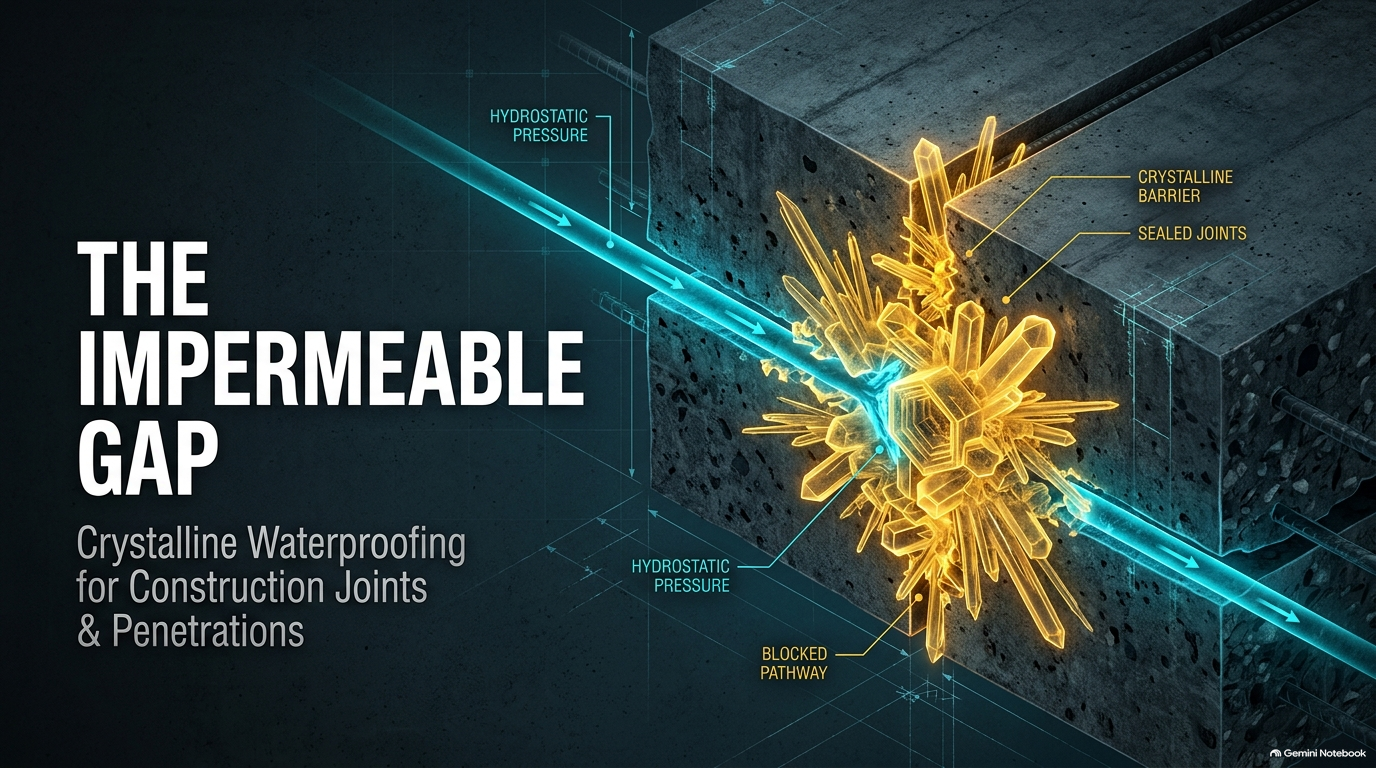
Crystalline waterproofing for construction joints and penetrations helps control water ingress at vulnerable areas of concrete structures. However, joints and penetrations can still create pathways for water.
Construction joints, pipe penetrations, tie holes, sleeves, and wall-to-slab interfaces interrupt the continuity of concrete. Each location needs a specific waterproofing detail.
Crystalline waterproofing can protect the surrounding concrete. It can also support the treatment of certain static joints and penetrations. However, crystalline technology alone cannot address every discontinuity.
Engineers and contractors must consider joint type, movement, hydrostatic exposure, and project requirements. They may also need waterstops, penetration seals, repair materials, or flexible joint systems.
Quick Answer
Crystalline waterproofing for construction joints and penetrations can form part of an effective concrete waterproofing system. However, these vulnerable areas still require specific waterproofing details.
Construction joints and concrete penetrations can create pathways for water. Crystalline coatings and cementitious repair materials can help treat these areas. Depending on the design, water stops, sealants, or mechanical seals may also be required.
The correct waterproofing detail depends on the type of discontinuity and its exposure conditions. Most importantly, engineers must determine whether the joint or penetration will remain static or experience movement.
Why Are Construction Joints and Penetrations Vulnerable to Water Ingress?
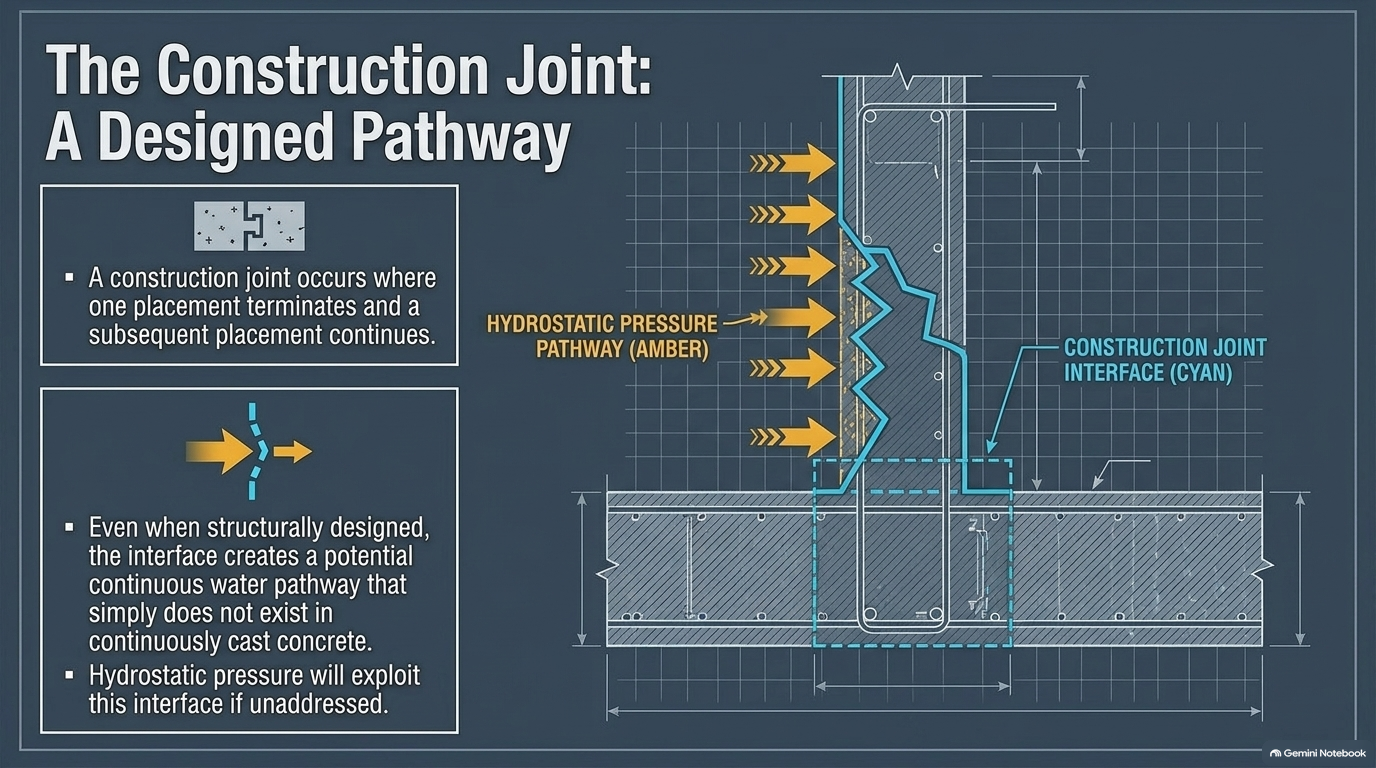
Construction joints and penetrations interrupt the continuity of a concrete element.
A construction joint occurs where one concrete placement terminates and a subsequent placement continues the structure. Although the two placements may form a structurally designed interface, the joint creates a potential pathway that does not exist within continuously cast concrete.
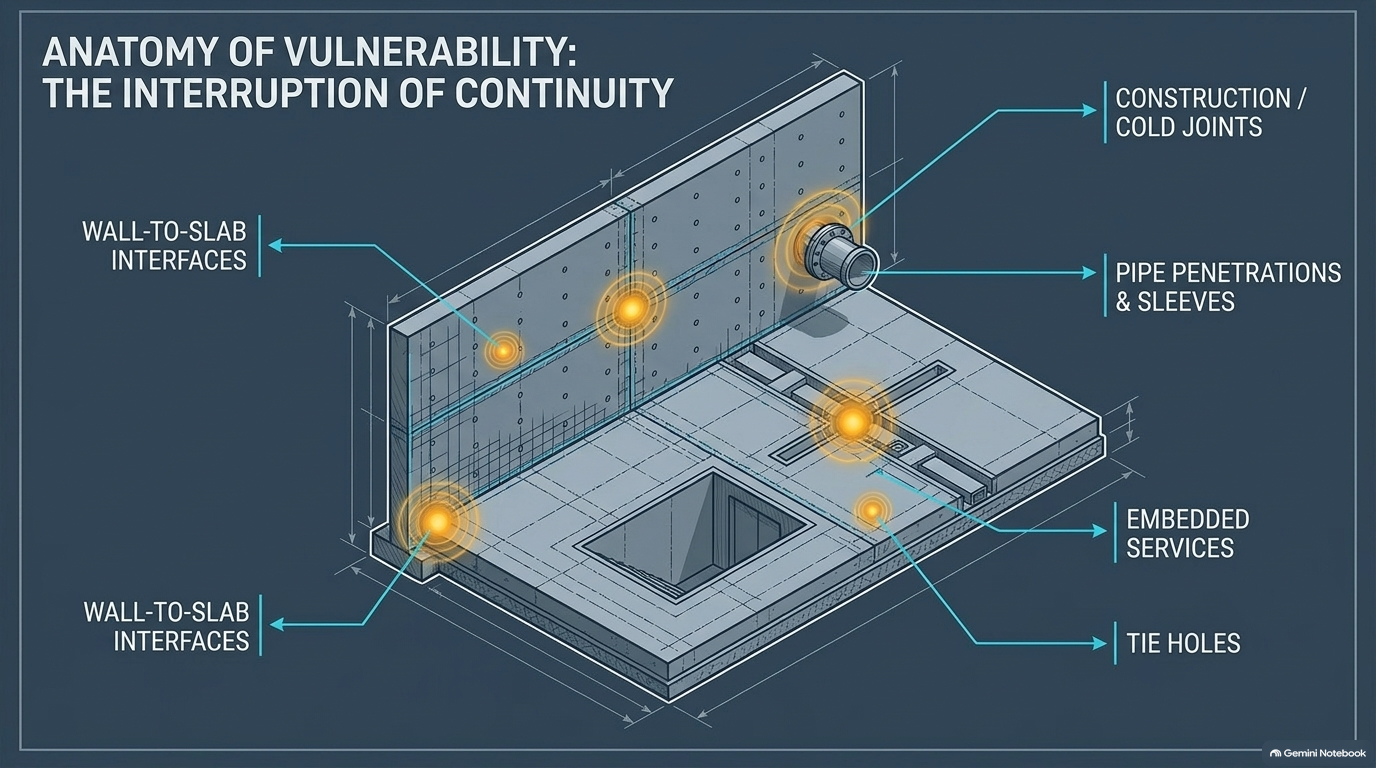
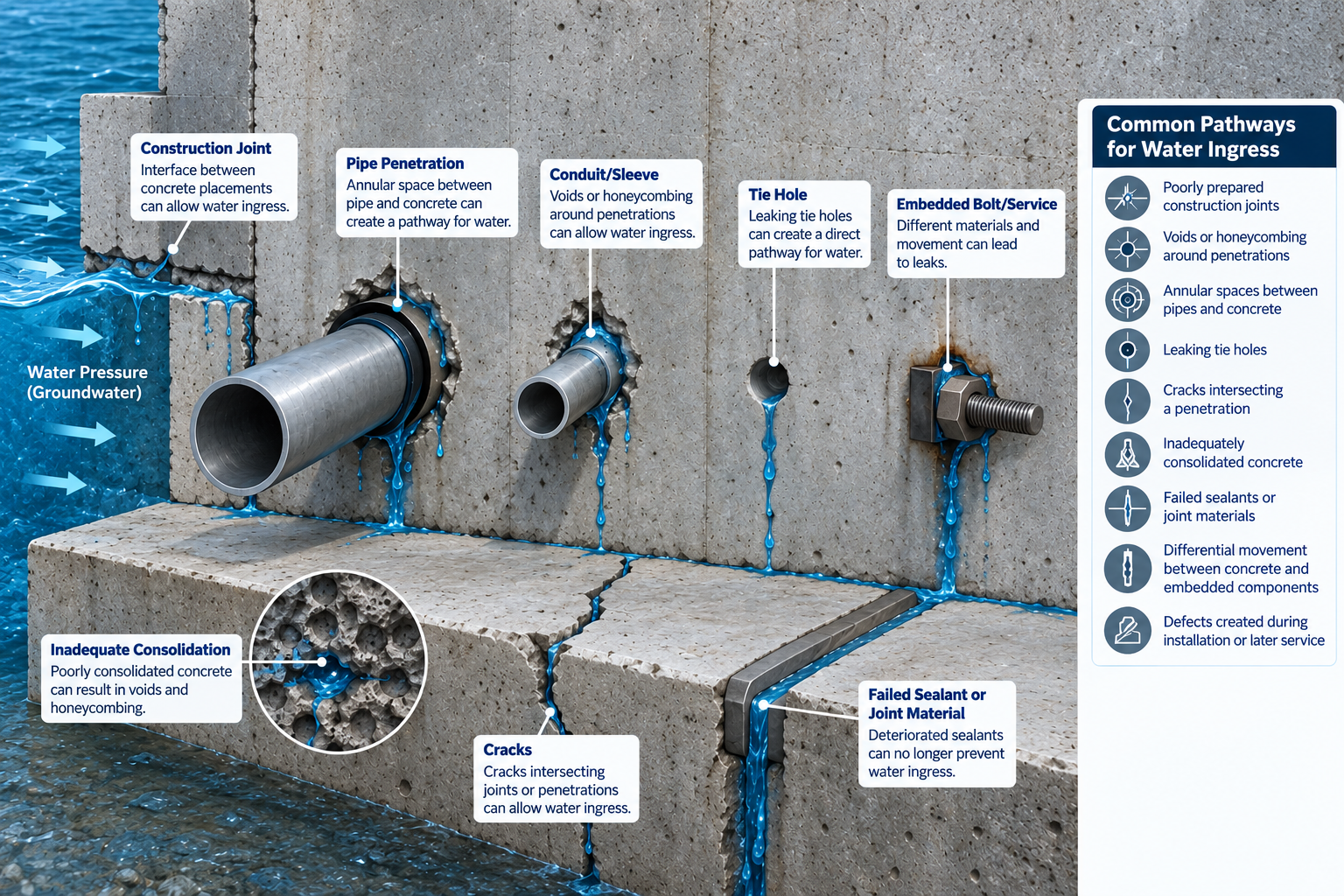
Penetrations create a different discontinuity. Pipes, conduits, sleeves, drains, bolts, and other services pass through the concrete, creating interfaces between different materials.
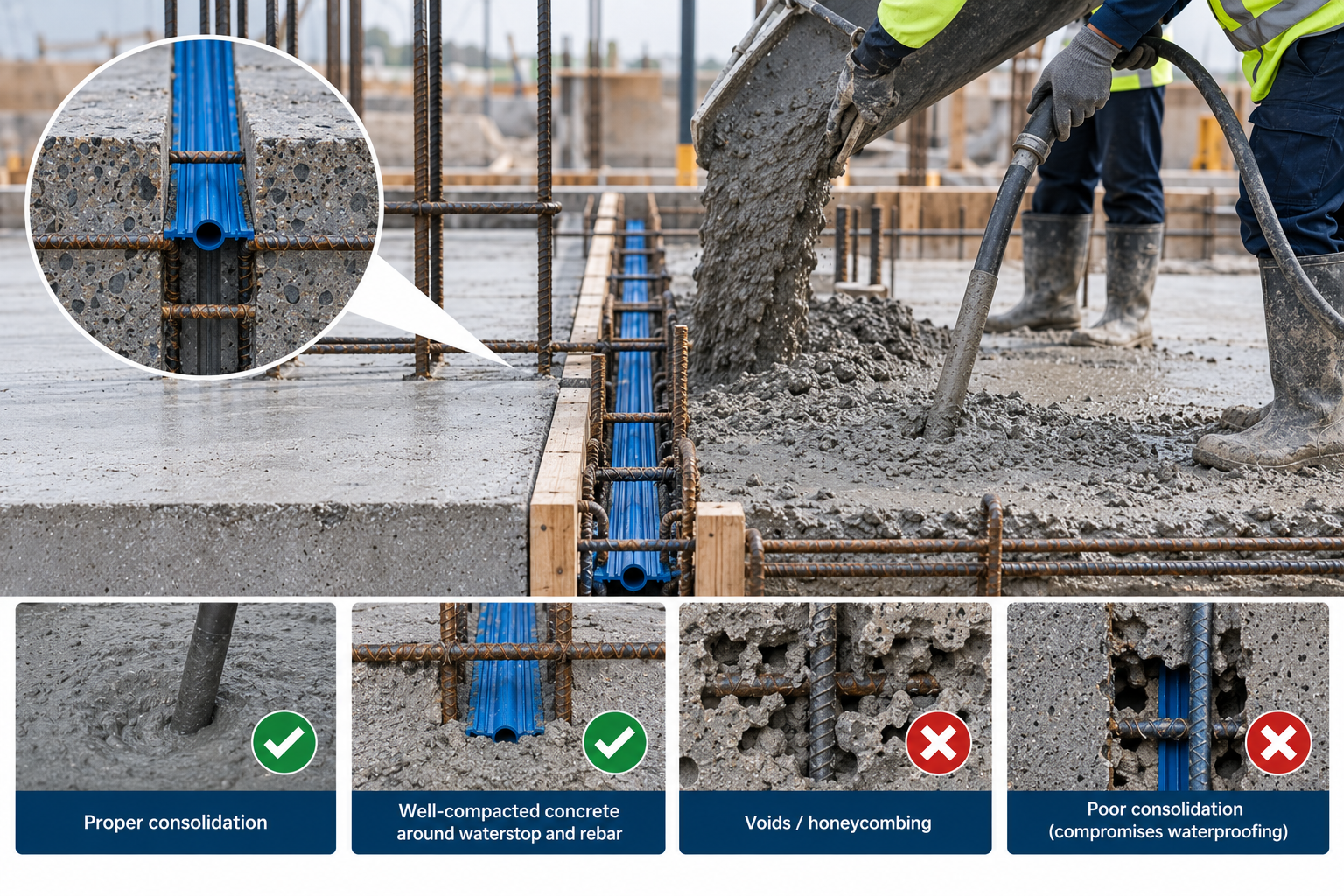
Water may exploit these interfaces when the waterproofing detail, concrete consolidation, sealing, or installation is inadequate.
Potential pathways include:
Poorly Prepared Construction joints
Voids or Honeycombing around Penetrations
Annular Spaces Between Pipes and Concrete
Leaking Tie Holes
Cracks Intersecting a Penetration
Inadequately Consolidated Concrete
Failed Sealants or Joint Materials
Differential Movement Between Concrete and Embedded Components
Defects Created During Installation or Later Service
Poorly Prepared Construction joints
Voids or Honeycombing around Penetrations
Annular Spaces Between Pipes and Concrete
Leaking Tie Holes
Cracks Intersecting a Penetration
Inadequately Consolidated Concrete
Failed Sealants or Joint Materials
Differential Movement Between Concrete and Embedded Components
Defects Created During Installation or Later Service
What Is Crystalline Waterproofing for Construction Joints?
Crystalline waterproofing for construction joints involves using reactive crystalline waterproofing materials as part of the detail where separate concrete placements meet.
The objective is to reduce water migration through the concrete and the joint interface.
However, crystalline treatment should not automatically be interpreted as a replacement for every waterstop or engineered joint system.
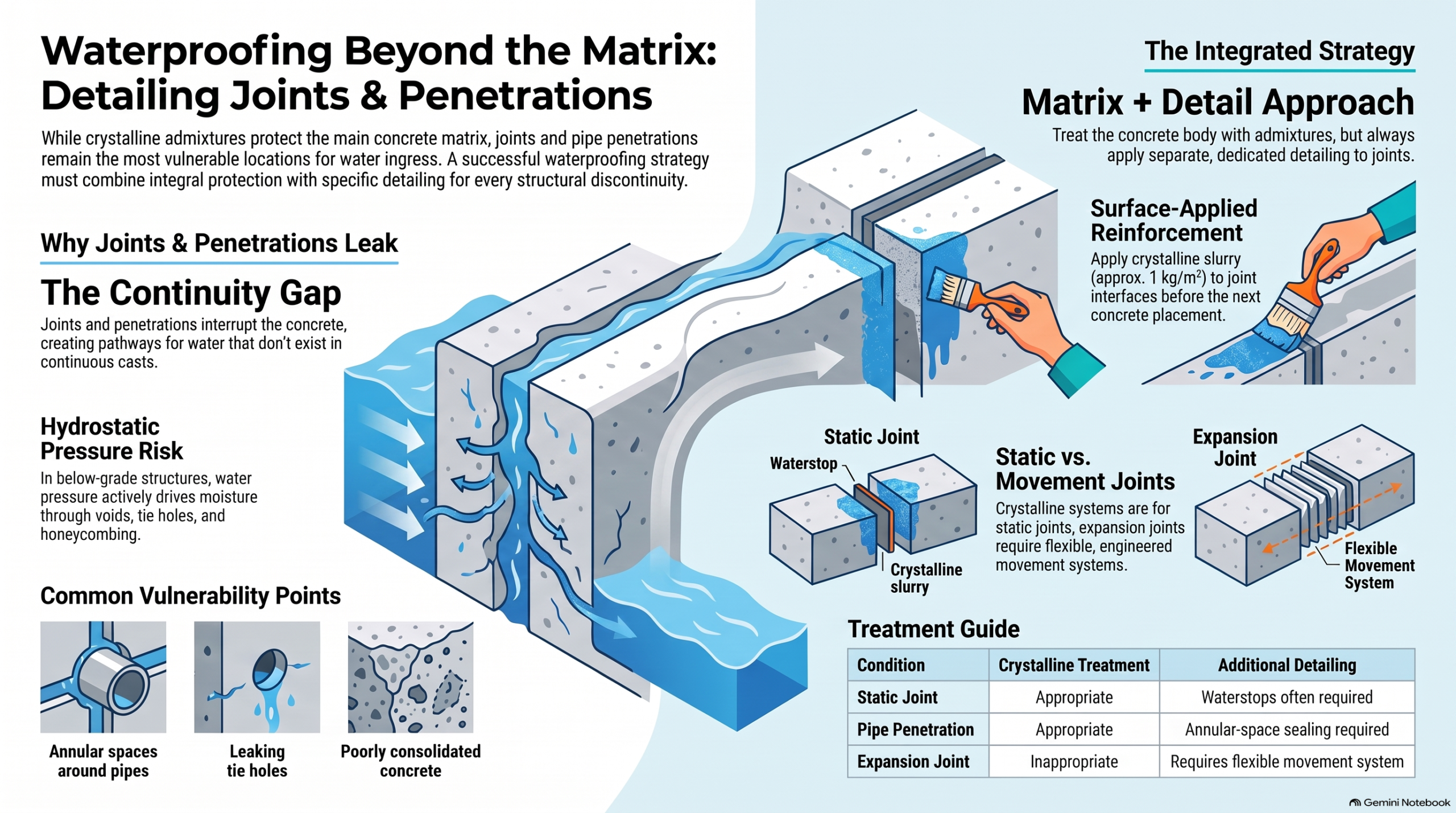
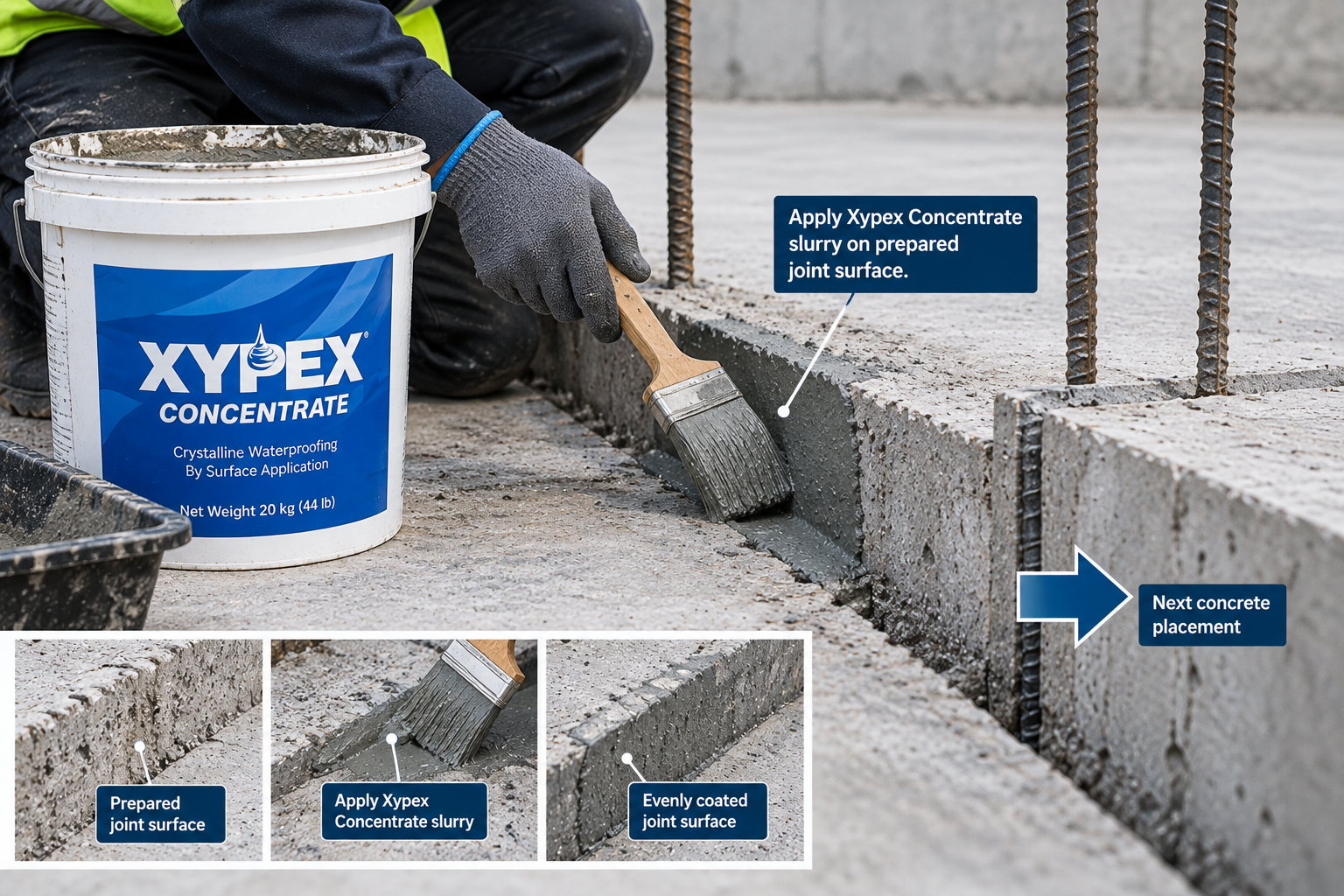
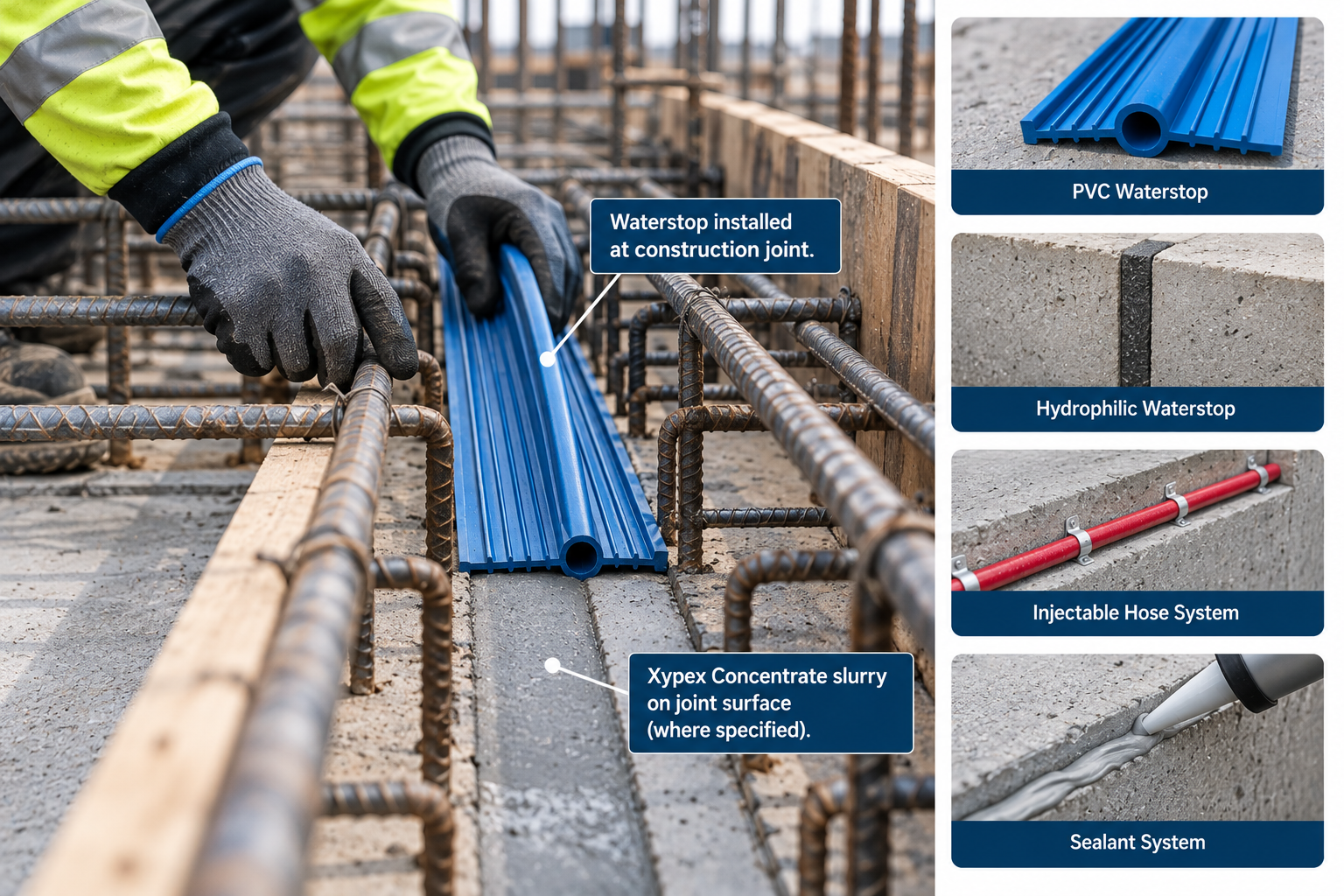
For example, Xypex’s published Admix C-Series specification instructs that Xypex Concentrate slurry be applied to construction and cold-joint surfaces in addition to specified waterstops. The specification states an application rate of approximately 1 kg/m² on the joint surface between concrete pours.
This is an important design principle: integral crystalline waterproofing in the surrounding concrete and dedicated joint waterproofing can perform complementary functions.
How Does Crystalline Waterproofing Work at a Construction Joint?
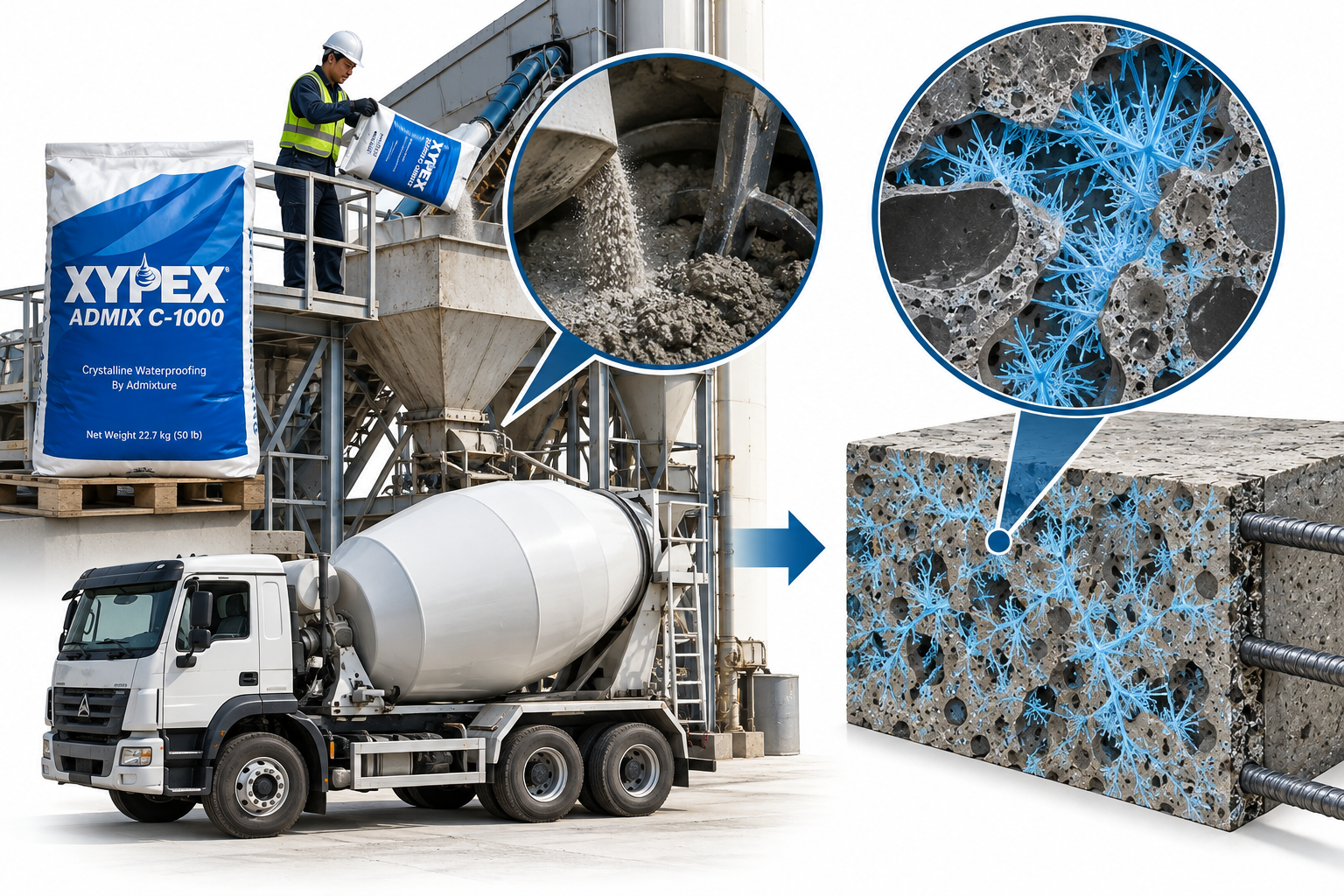
Crystalline waterproofing uses reactive chemistry intended to develop insoluble formations within concrete pores, capillaries, and certain water pathways when the necessary conditions are present.
At a construction joint, however, the interface between separate placements requires additional consideration.
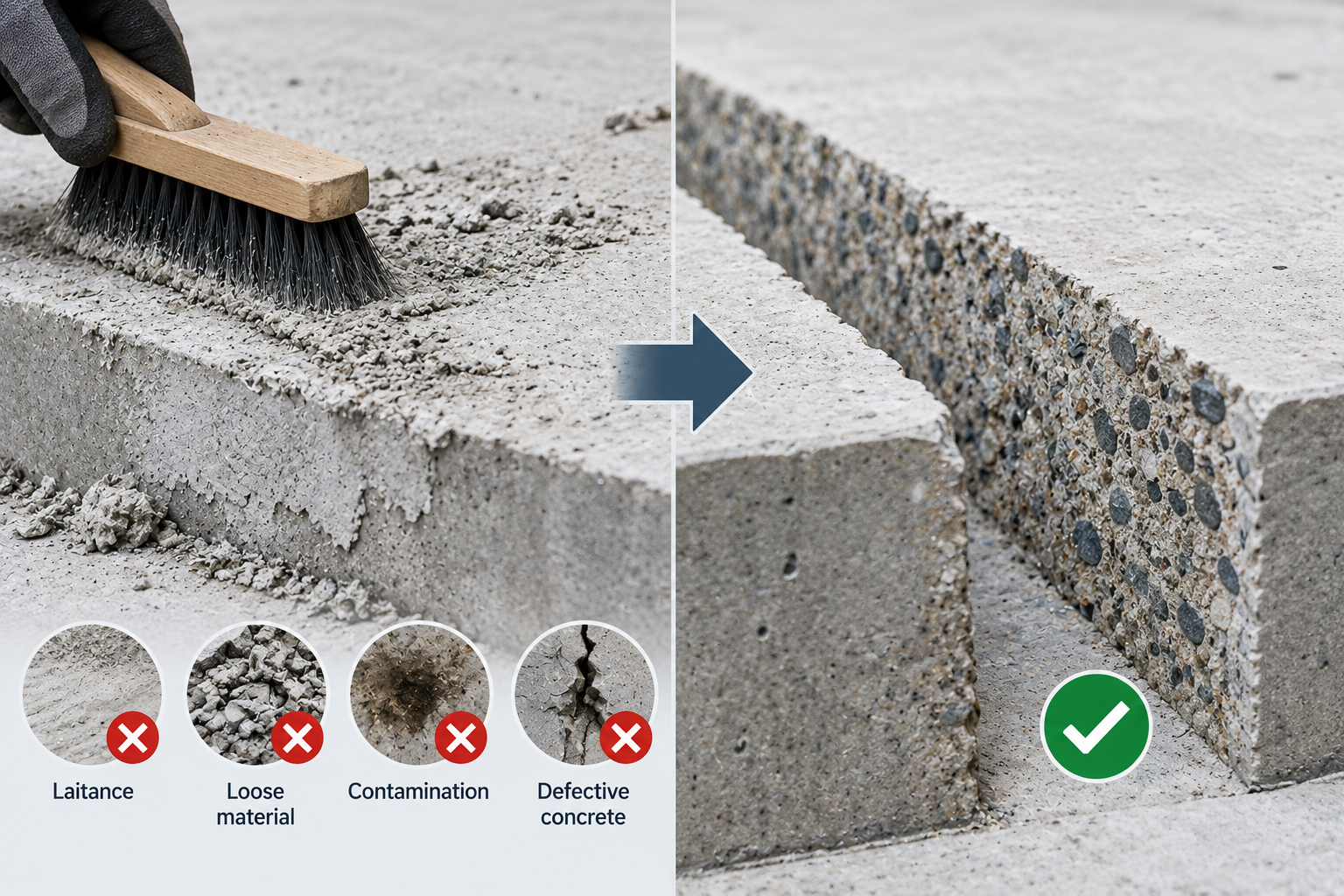
A typical crystalline waterproofing strategy for new construction may therefore involve several layers of protection.
What Is Crystalline Waterproofing Around Pipe Penetrations?
Crystalline waterproofing for pipe penetrations requires specific detailing at the interface between the pipe and concrete. This interface can create a direct pathway for water.
A typical penetration consists of:
Concrete → annular space or interface → pipe or sleeve
The annular space requires proper preparation and waterproofing treatment. This becomes especially important when groundwater or hydrostatic pressure acts against the structure.
Crystalline cementitious repair materials can help waterproof certain static pipe penetrations. Xypex publishes specific repair procedures for pipes passing through concrete walls and slabs. These procedures also address waterproofing of annular spaces.
Xypex identifies Patch’n Plug for sealing around pipe penetrations and controlling certain active water leaks. Other Xypex repair materials may form part of the complete penetration detail.
However, one detail does not suit every penetration. Engineers and contractors must consider the pipe material, penetration configuration, expected movement, hydrostatic pressure, and annular-space dimensions. Project specifications and waterproofing requirements should also guide the final detail.
How Can a Leaking Pipe Penetration Be Repaired?
When active water flows through a pipe penetration, contractors may need a rapid-setting hydraulic repair material first. This helps control the water before completing the permanent waterproofing repair.
Xypex identifies Patch’n Plug as a fast-setting hydraulic cement compound for stopping flowing water. The manufacturer also recommends it for sealing around pipe penetrations and repairing leaking construction joints.
High hydrostatic pressure can make these repairs more difficult. In cases of unusually high water flow, Xypex procedures may require temporary pressure relief during the repair.
This highlights an important principle:
The visible leak is not always the source of the problem.
A successful pipe penetration repair must identify the actual water pathway. Contractors can then prepare and treat the affected area with the appropriate waterproofing system.
Can Crystalline Waterproofing Seal Cracks Around Joints and Penetrations?
Certain crystalline waterproofing systems can help seal static cracks under specified conditions.
For example, Xypex states that its crystalline technology can seal static hairline cracks up to 0.5 mm. This capability can help reduce water pathways within treated concrete.
However, the 0.5 mm crack-sealing capability is specific to Xypex. It should not apply as a general claim for all crystalline waterproofing products.
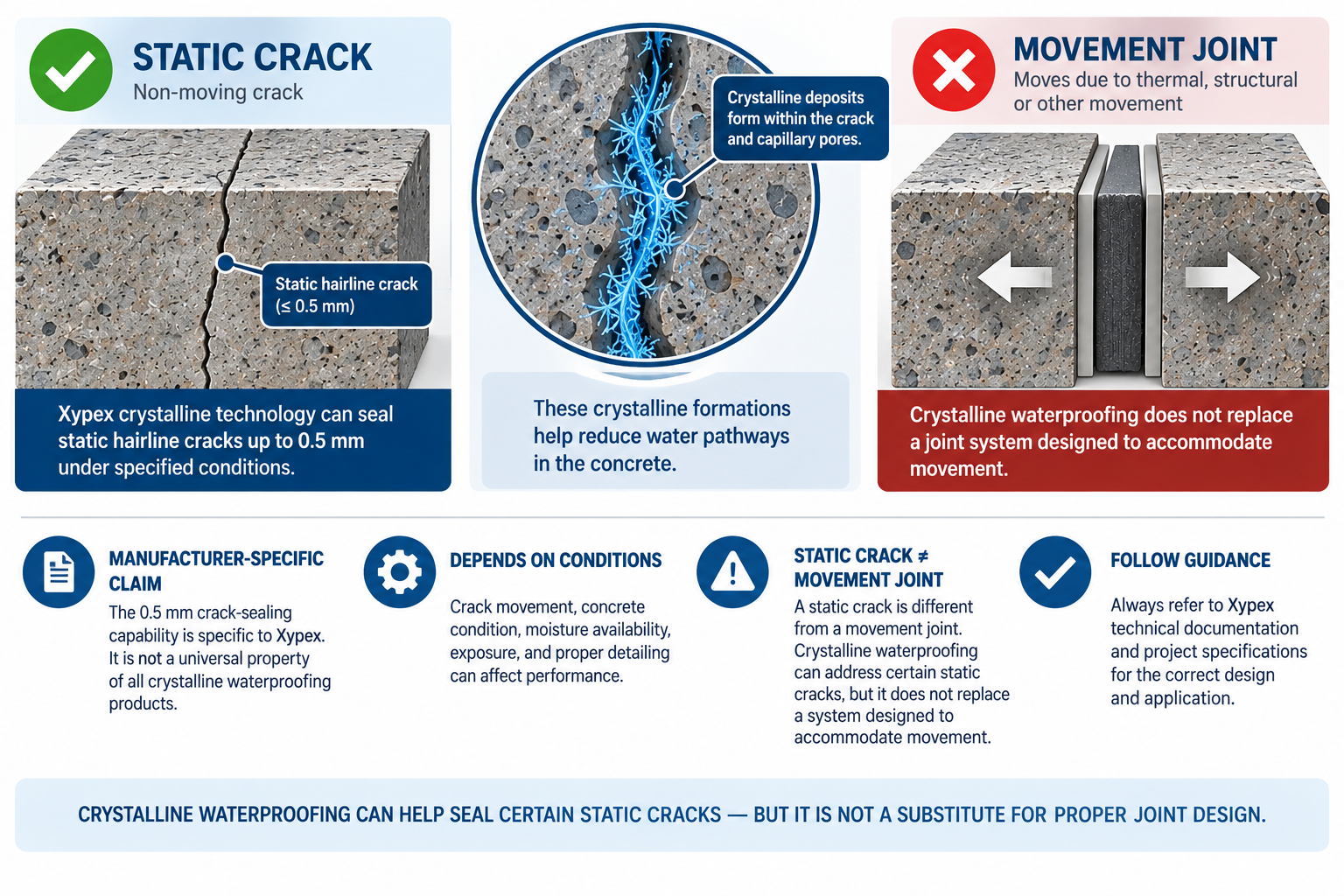
Crack movement also plays an important role. Concrete condition, moisture, exposure, and proper detailing can affect waterproofing performance.
Most importantly, engineers must distinguish between a static crack and a movement joint. Crystalline waterproofing can address certain static cracks, but it does not replace a system designed to accommodate movement.
Static Joints vs Movement Joints: Why the Difference Matters
One of the most important decisions in waterproofing construction joints and penetrations is determining whether movement is expected.
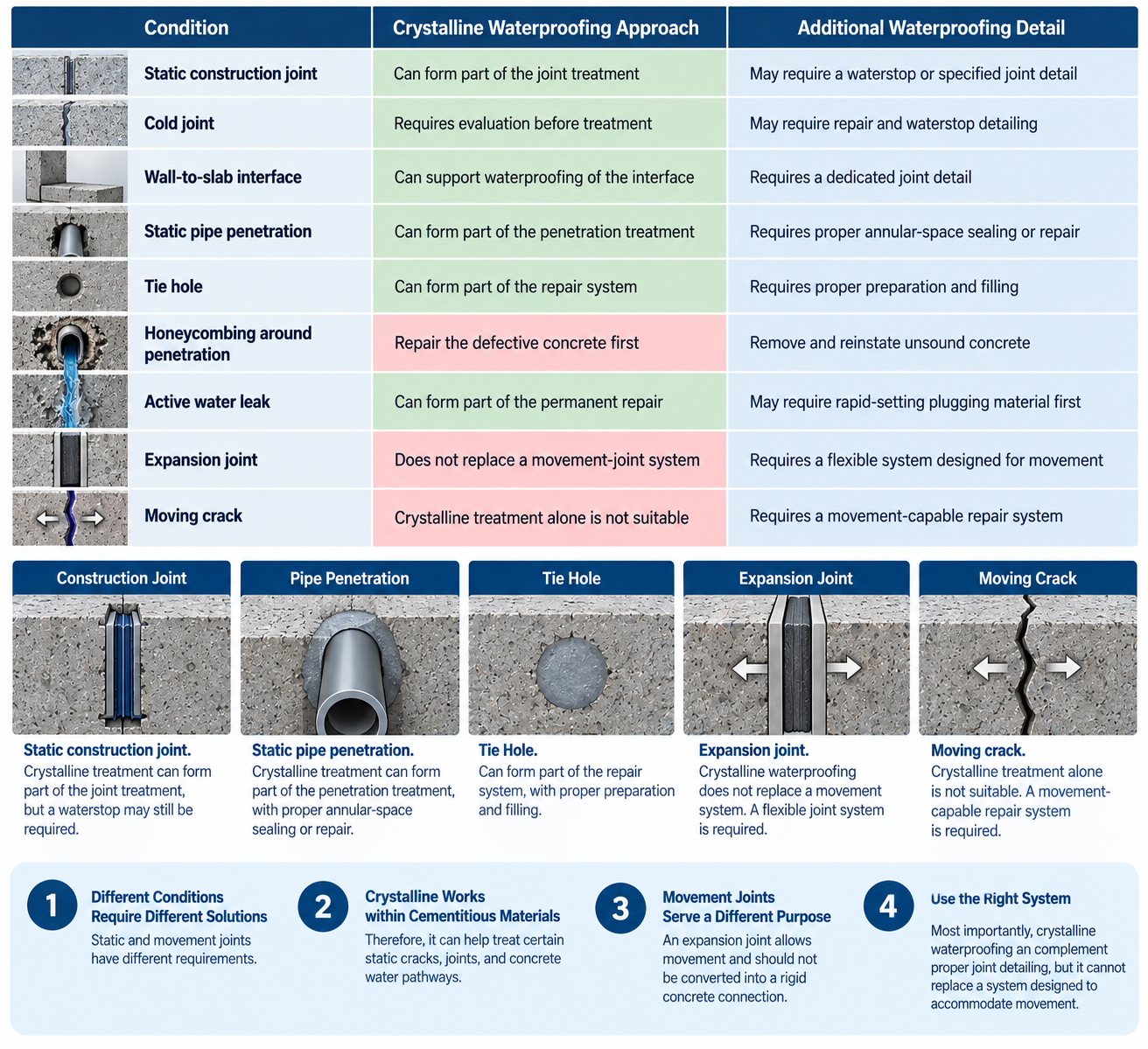
The distinction between static joints and movement joints plays an important role in waterproofing design.
Crystalline waterproofing works within cementitious materials. Therefore, it can help treat certain static cracks, joints, and concrete water pathways. An expansion joint, however, serves a different purpose. It allows parts of the structure to move without creating unintended stress.
As a result, engineers should not convert a movement joint into a rigid concrete connection. Instead, they should use a joint system that can accommodate the expected movement.
Most importantly, crystalline waterproofing can complement proper joint detailing. However, it cannot replace a system designed to accommodate movement.
Why Does This Matter in Philippine Concrete Construction?
Construction joints and penetrations deserve particular attention in Philippine structures because many concrete elements are exposed to significant moisture.
Examples include:
- basements exposed to groundwater
- retaining walls
- elevator pits
- water tanks
- sewage and water-treatment structures
- swimming pools
- tunnels and underground structures
- podium and roof slabs
- foundations
- marine and coastal structures
- infrastructure exposed to prolonged rainfall
During periods of heavy rainfall or elevated groundwater, hydrostatic pressure can expose weaknesses that may have remained unnoticed under dry conditions.
However, Philippine climate alone does not determine waterproofing performance.
Concrete quality, mixture design, joint preparation, consolidation, curing, detailing, workmanship, drainage, and maintenance remain fundamental.
Construction Joints in Xypex Admix Concrete
When Xypex Admix C-Series is incorporated into new concrete, the crystalline waterproofing technology becomes distributed through the treated concrete.
That does not mean construction joints should simply be ignored.
Xypex publishes separate schematic details for several joint configurations, including:
- traffic-bearing slab construction joints
- non-traffic-bearing slab and wall joints
- wall-to-slab construction joints
- slab-to-wall joints intended to keep water out
- slab-to-wall joints intended to retain water
This is useful evidence that even within an integral crystalline waterproofing system, joint configuration remains an independent design consideration.
A robust specification should therefore address both:
the waterproofing of the concrete matrix + the waterproofing/detailing of discontinuities.
What About Wall-to-Slab Joints?
Wall-to-slab interfaces are particularly important because they combine a concrete placement interface with a change in geometry.
Typical examples occur in:
- basements
- retaining walls
- water tanks
- elevator pits
- foundations
- below-grade structures
The interface should be evaluated for construction sequence, expected water pressure, reinforcement congestion, waterstop installation, concrete consolidation, and accessibility.
For existing leaking wall-to-slab joints, the repair methodology may require opening and preparing the joint, controlling active leakage, installing cementitious repair material, and applying the specified crystalline treatment.
The exact dimensions and product sequence should follow an approved project-specific method statement rather than being assumed from a generic detail.
What Does the Evidence Show?
Manufacturer documentation provides evidence for several crystalline waterproofing applications at construction joints and penetrations.
For example, Xypex identifies Concentrate Dry-Pac for sealing strips at construction joints. The manufacturer also specifies it for repairing cracks, faulty construction joints, and honeycombed concrete.
In addition, Xypex identifies Patch’n Plug for several concrete waterproofing repairs, including:
- repairing leaking construction joints
- sealing around pipe penetrations
- repairing tie holes and concrete defects
- controlling active water flow
Moreover, Xypex publishes installation procedures for specific joint and penetration conditions. These include construction-joint repairs, slab interfaces, pipe penetrations, annular spaces, tie holes, and defective concrete.
Therefore, these documents support the intended applications of Xypex crystalline waterproofing and repair products.
However, every project presents different conditions. Joint movement, hydrostatic pressure, concrete condition, penetration type, and exposure can all influence the required detail.
For this reason, engineers and contractors should not apply one generic Xypex detail to every construction joint or penetration. Instead, they should follow the project specifications, approved details, and current manufacturer guidance.
How Does Crystalline Joint Treatment Compare With Other Systems?
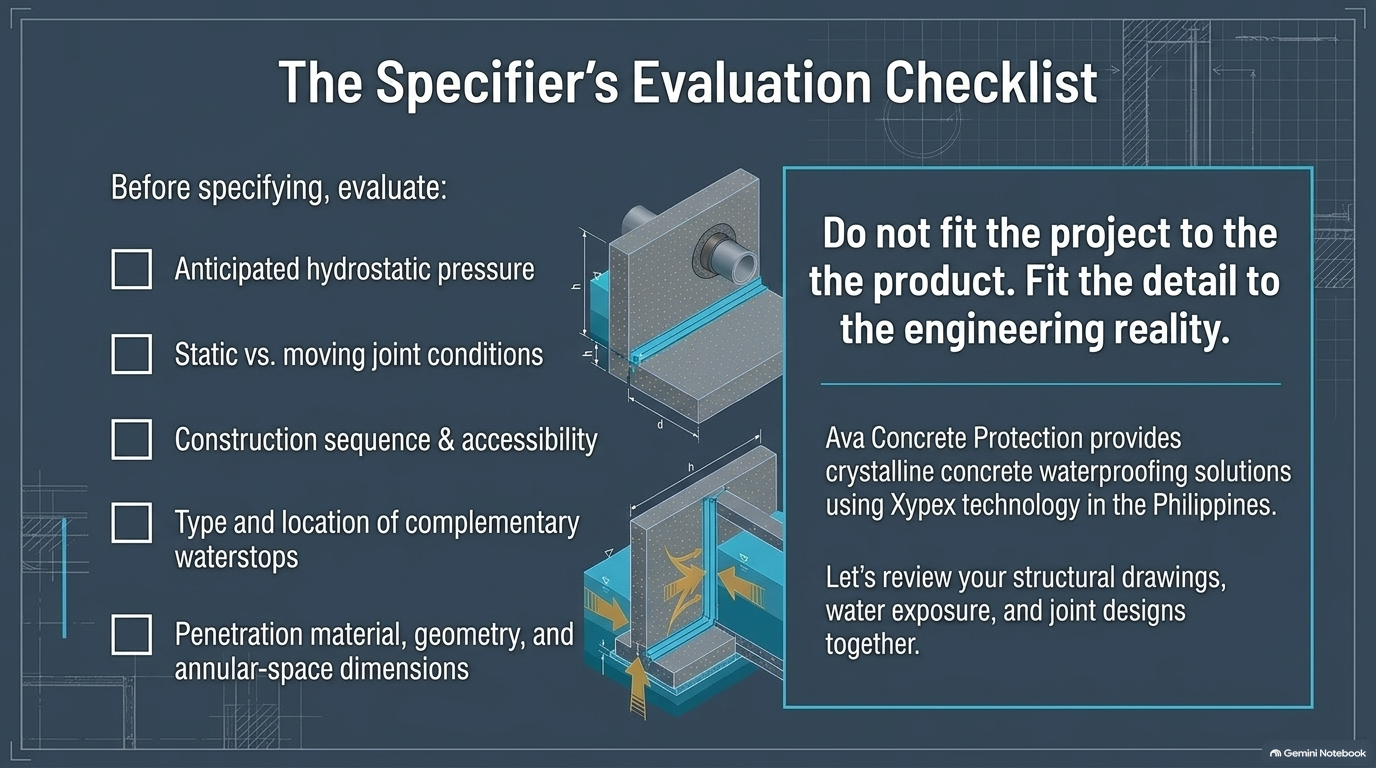
Before selecting crystalline waterproofing for construction joints and penetrations, project teams should evaluate:
- whether the structure retains water or excludes groundwater
- anticipated hydrostatic pressure
- whether the joint is static or moving
- construction sequence
- concrete mixture and expected cracking
- type and location of waterstops
- penetration material and geometry
- annular-space dimensions
- accessibility before and after concrete placement
- concrete consolidation around penetrations and waterstops
- repairability after construction
- compatibility between waterproofing components
- manufacturer installation requirements
- applicable project specifications, drawings, and engineering requirements
This approach is more reliable than selecting a waterproofing product first and attempting to make every project detail fit the product.
Frequently Asked Questions
Can Xypex Admix waterproof a construction joint by itself?
Not necessarily. Xypex Admix waterproofs the concrete matrix, while a construction joint creates a discontinuity between separate concrete placements.
Therefore, construction joints still require specific waterproofing details. Xypex specifications include Xypex Concentrate treatment at construction and cold joints in addition to specified waterstops.
Can Xypex be used around pipe penetrations?
Yes. Xypex provides products and procedures for certain pipe penetration waterproofing and repair applications.
For example, Xypex identifies Patch’n Plug for sealing around pipe penetrations. Xypex also provides procedures for pipes through walls and slabs, including treatment of annular spaces.
Can crystalline waterproofing replace a waterstop?
Not as a general rule. Crystalline waterproofing and waterstops perform different functions within a concrete waterproofing system.
Crystalline technology can complement construction joint waterproofing. However, engineers should not treat it as a universal replacement for waterstops. The project design and specifications should determine whether a waterstop is required.
Can crystalline waterproofing be used on an expansion joint?
Crystalline cementitious treatment should not be treated as a substitute for an engineered movement-joint system.
Expansion joints are intentionally designed to move and generally require flexible systems capable of accommodating that movement.
What if water is actively leaking through a construction joint?
The source and pathway should first be identified.
A rapid-setting hydraulic plugging material may be required to control active water before the permanent repair is completed. Xypex Patch’n Plug is specifically intended for this type of application.
Can Xypex repair honeycombing around a penetration?
Crystalline waterproofing may form part of the repair, but defective concrete must first be properly addressed.
Loose or unsound material should not simply be coated over. The repair methodology should restore the defective area and then provide the required waterproofing treatment.
Does the 0.5 mm self-healing claim apply to construction joints?
Not automatically.
Xypex states that certain crystalline treatments can seal static hairline cracks up to 0.5 mm under appropriate conditions. A construction joint is a designed interface rather than simply a hairline crack, so dedicated joint detailing remains necessary.
Should joints be considered separately when specifying integral crystalline waterproofing?
Yes.
A complete waterproofing specification should distinguish between waterproofing of the concrete matrix and waterproofing of discontinuities such as joints, penetrations, tie holes, cracks, and embedded services.
Still have questions? Check out our FAQ page or send us a message
Conclusion
Crystalline waterproofing for construction joints and penetrations works best as part of an integrated concrete waterproofing strategy rather than as justification for ignoring joints and penetrations.
Integral crystalline admixtures can provide waterproofing protection throughout treated concrete. Surface-applied crystalline materials and cementitious repair products can then be incorporated into specific construction-joint and penetration details where technically appropriate.
However, waterstops, flexible joint systems, penetration seals, drainage, repair materials, or other complementary technologies may still be necessary.