


by
Cracks in concrete can create pathways for water ingress. This is especially important in structures exposed to groundwater, heavy rainfall, stored water, or hydrostatic pressure.
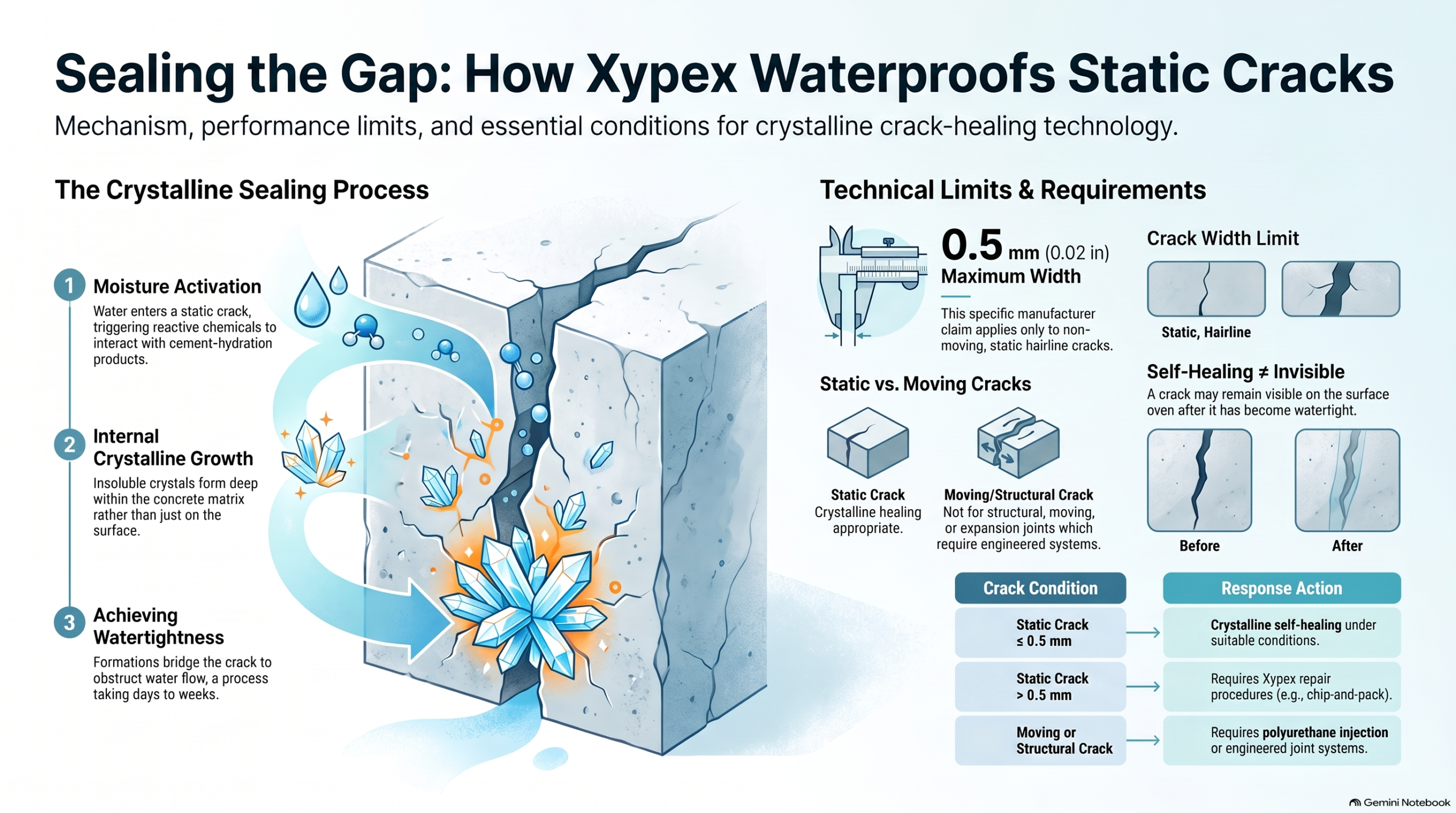
Xypex crack healing can help address certain static cracks through crystalline technology. Unlike a surface barrier alone, the technology works within the concrete.
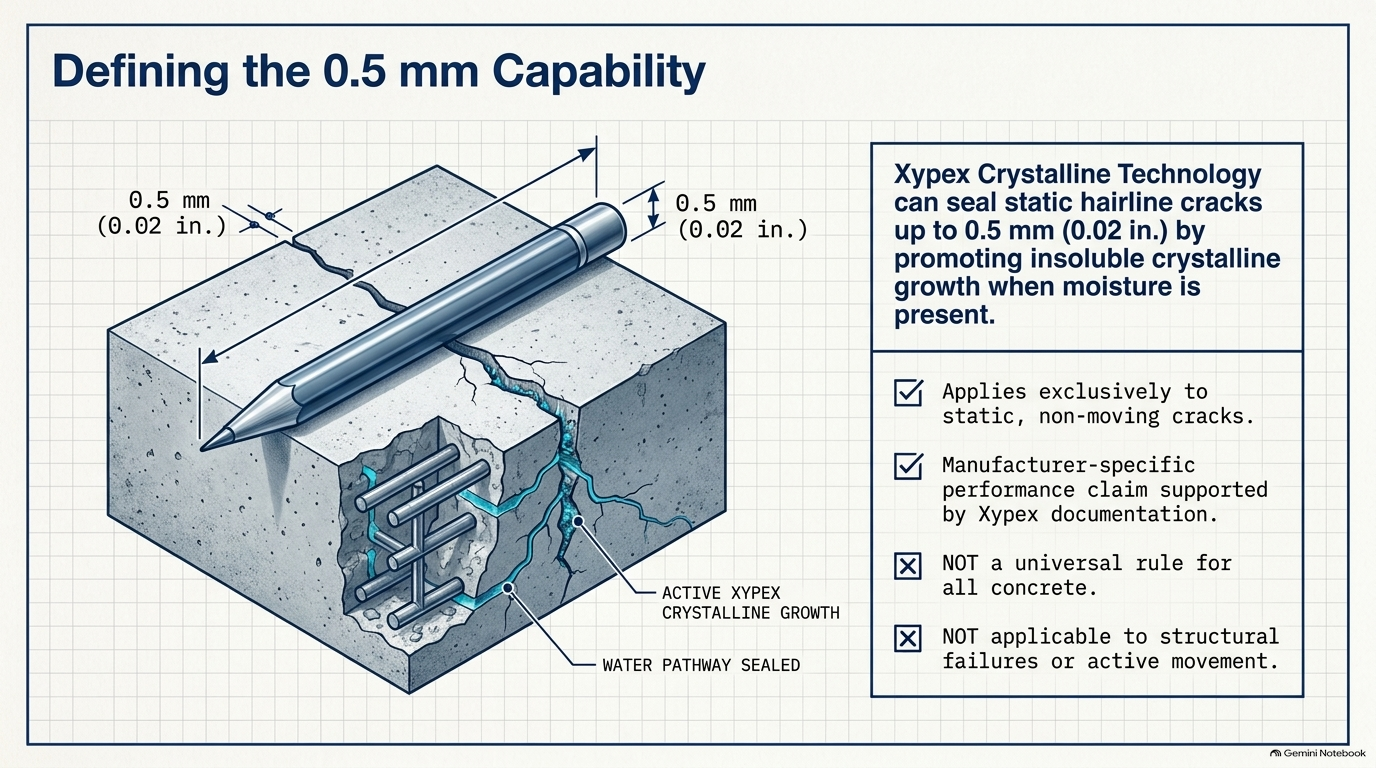
According to Xypex Chemical Corporation, Xypex Crystalline Technology can seal static hairline cracks up to 0.5 mm (0.02 in.) under suitable conditions. Moisture supports crystalline activity within the concrete. As crystalline formations develop, they can obstruct pores, capillaries, and certain water pathways.
This process can help restrict water passing through suitable static cracks.
However, engineers should not assess a concrete crack by width alone. They should first determine whether the crack is static or moving. They should also identify its cause and assess its structural significance. Active water leakage is another important consideration.
The 0.5 mm crack-healing capability is specific to Xypex Crystalline Technology. Therefore, engineers should not apply this performance claim to every crystalline waterproofing product.
The distinction between static and moving cracks is particularly important. Xypex’s crack-healing claim concerns static or non-moving cracks under appropriate conditions. Moving cracks may require a different repair approach.
Structural cracks also require proper engineering assessment. Likewise, expansion joints need systems designed to accommodate movement.
For Philippine concrete structures, Xypex crack healing can form part of a broader waterproofing and concrete-protection strategy. This can be particularly relevant where concrete faces frequent moisture or water ingress.
However, crystalline technology does not eliminate the fundamentals of watertight concrete construction. Proper concrete design, crack control, joint detailing, penetration treatment, curing, and workmanship remain essential.
Quick Answer: Can Xypex Seal Static Cracks Up to 0.5 mm?
Yes. According to Xypex, its crystalline technology can seal static hairline cracks up to 0.5 mm (0.02 in.) under suitable conditions.
When moisture enters the concrete, it supports crystalline activity within pores, capillaries, and certain cracks. The resulting crystalline formations can restrict pathways through which water travels.
However, the 0.5 mm figure is not a universal crack-repair limit. It is a Xypex-specific performance claim for static or non-moving cracks.
Cracks that continue to move require further evaluation. The same applies to cracks that indicate structural distress or exceed the applicable limits. If a crack does not become watertight, engineers should determine the appropriate repair method.
Moving cracks and expansion joints may also require systems specifically designed to accommodate movement.
What Does “Self-Healing” Mean in Xypex-Treated Concrete?
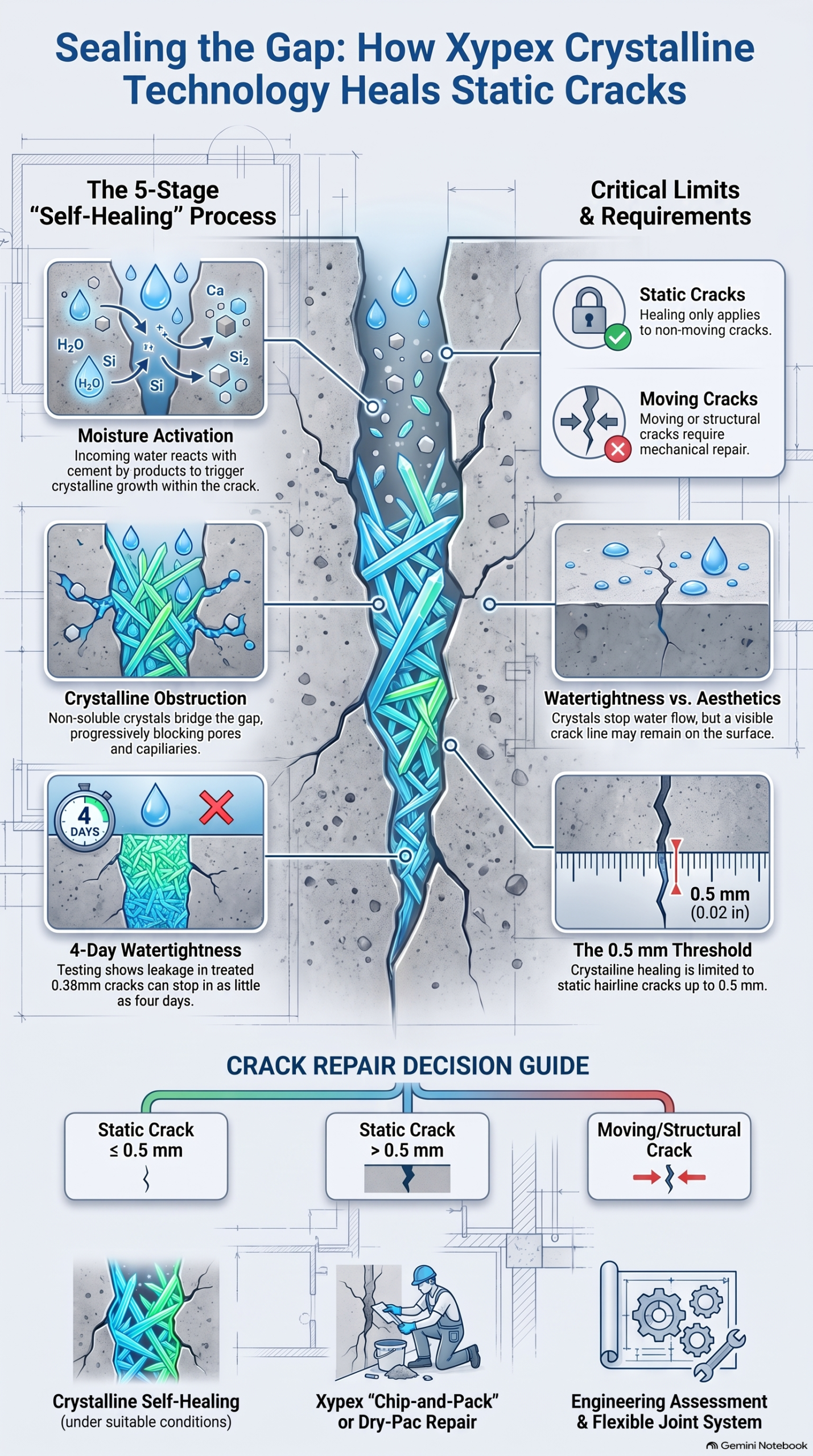
In this context, self-healing refers to the ability of Xypex-treated concrete to develop crystalline formations within certain static cracks when the necessary conditions are present.
Concrete naturally contains pores, capillaries, microcracks, and other voids through which moisture can travel.
Xypex describes its technology as using reactive constituents that interact with water and products of cement hydration to form a non-soluble crystalline structure within these pathways.
When a suitable static crack forms and moisture enters it, the presence of water can support further crystalline activity.
This is why Xypex describes its technology as capable of reactivation when moisture becomes present.
The practical objective is not necessarily to make the crack visually disappear. Instead, the important waterproofing outcome is reducing or stopping water passage through the crack.
That distinction is important.
A visible crack line can remain at the concrete surface even when crystalline development has substantially reduced the crack’s ability to transmit water.
How Does Xypex Seal Static Cracks?
A Static Crack Forms in the Concrete
Moisture Enters the Crack
Crystalline Reactions Occur Within the Concrete
Crystalline Formations Develop Within the Crack
Water Flow Through the Crack Can Be Reduced or Stopped
A Static Crack Forms in the Concrete
A Static Crack Forms in the Concrete
Moisture Enters the Crack
Crystalline Reactions Occur Within the Concrete
Crystalline Formations Develop Within the Crack
Water Flow Through the Crack Can Be Reduced or Stopped
Concrete can develop cracks for many reasons, including drying shrinkage, thermal effects, restrained movement, loading, construction conditions, and other mechanisms.
The presence of a crack does not by itself establish whether Xypex’s crack-healing capability applies.
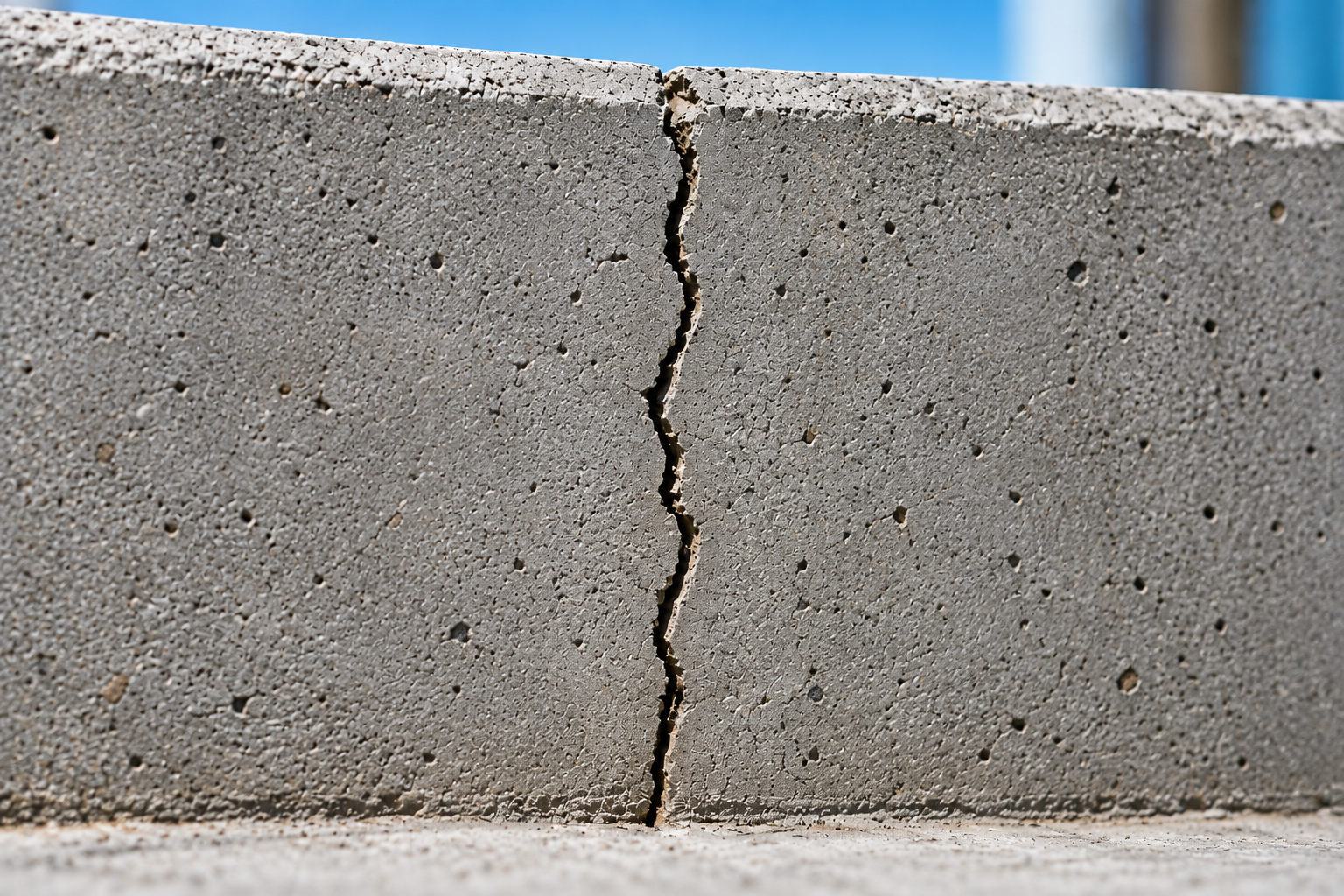
Water is an important part of the crystalline process.
When moisture reaches the crack and surrounding concrete, conditions may allow the reactive constituents associated with Xypex technology to continue participating in crystalline development.
This moisture-responsive behavior is particularly relevant to concrete exposed to intermittent or continuous water.
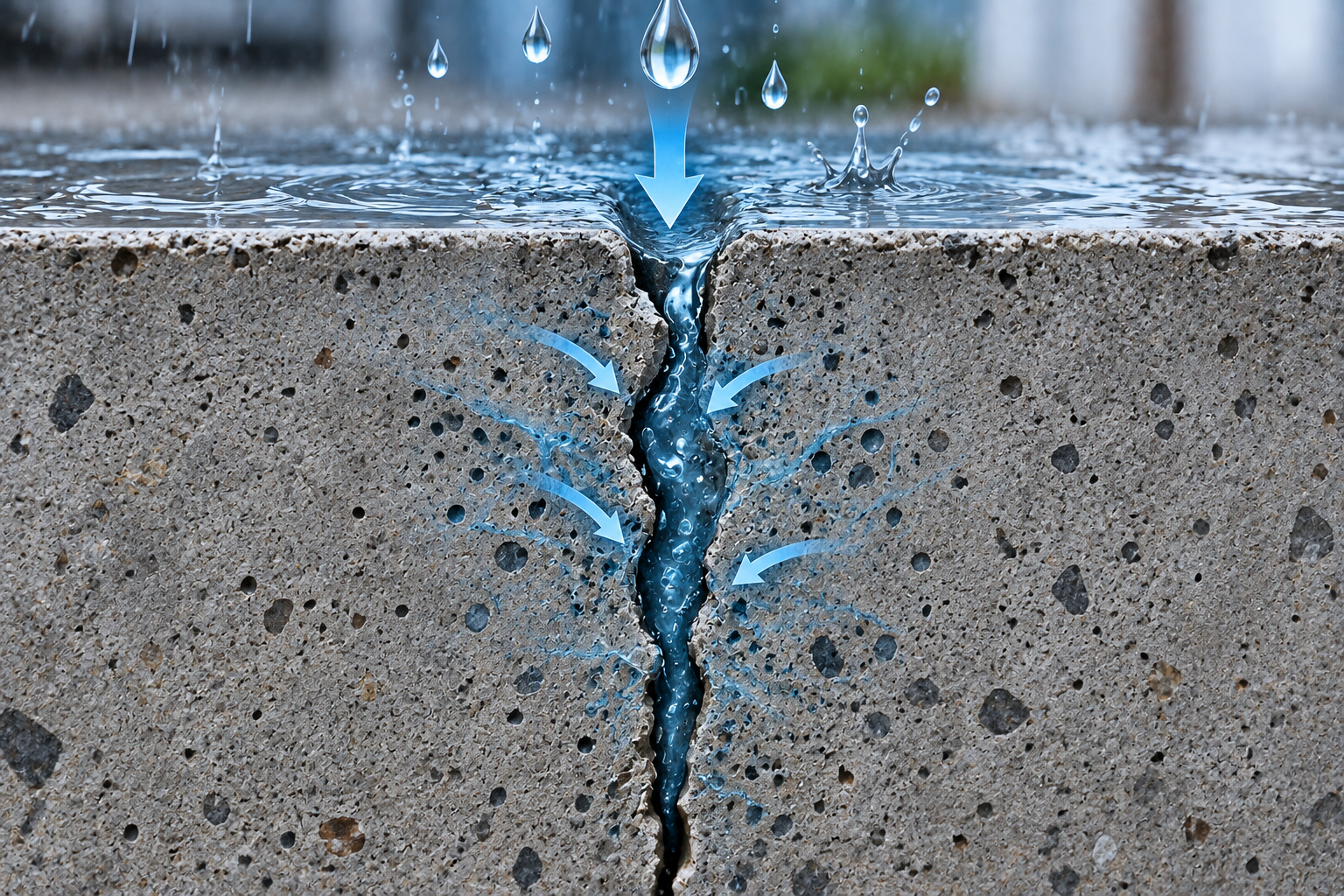
As crystalline formations develop, they can progressively obstruct water pathways associated with a suitable static crack.
Xypex’s technical note states that its crystals will bridge most non-moving cracks up to 0.5 mm (0.02 in.).
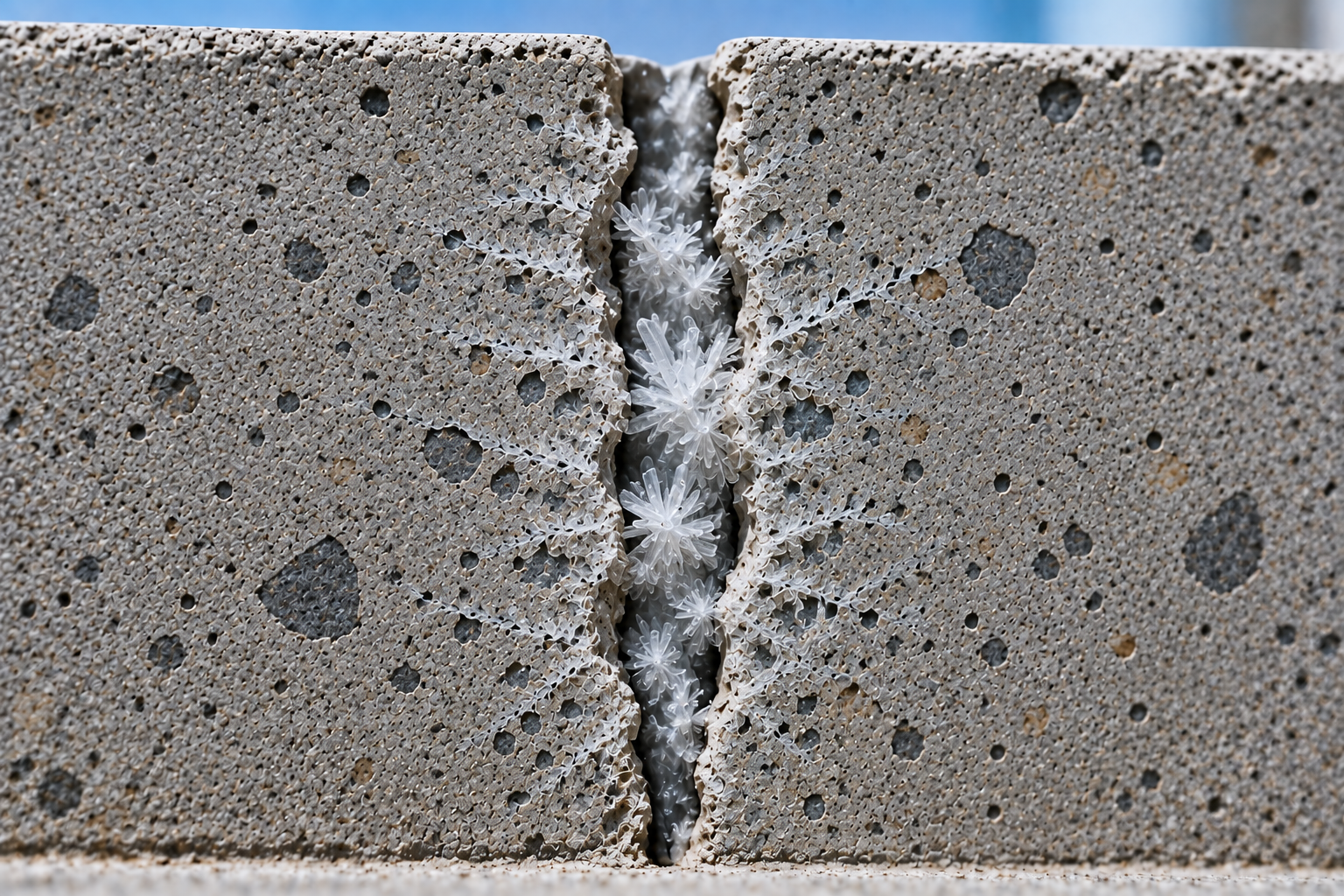
Xypex describes its proprietary chemicals as reacting with water and cement-hydration products to form a non-soluble crystalline structure within concrete’s pores, capillaries, and other voids.
Rather than relying exclusively on a film adhered to the exterior surface, this waterproofing mechanism occurs within the concrete matrix.
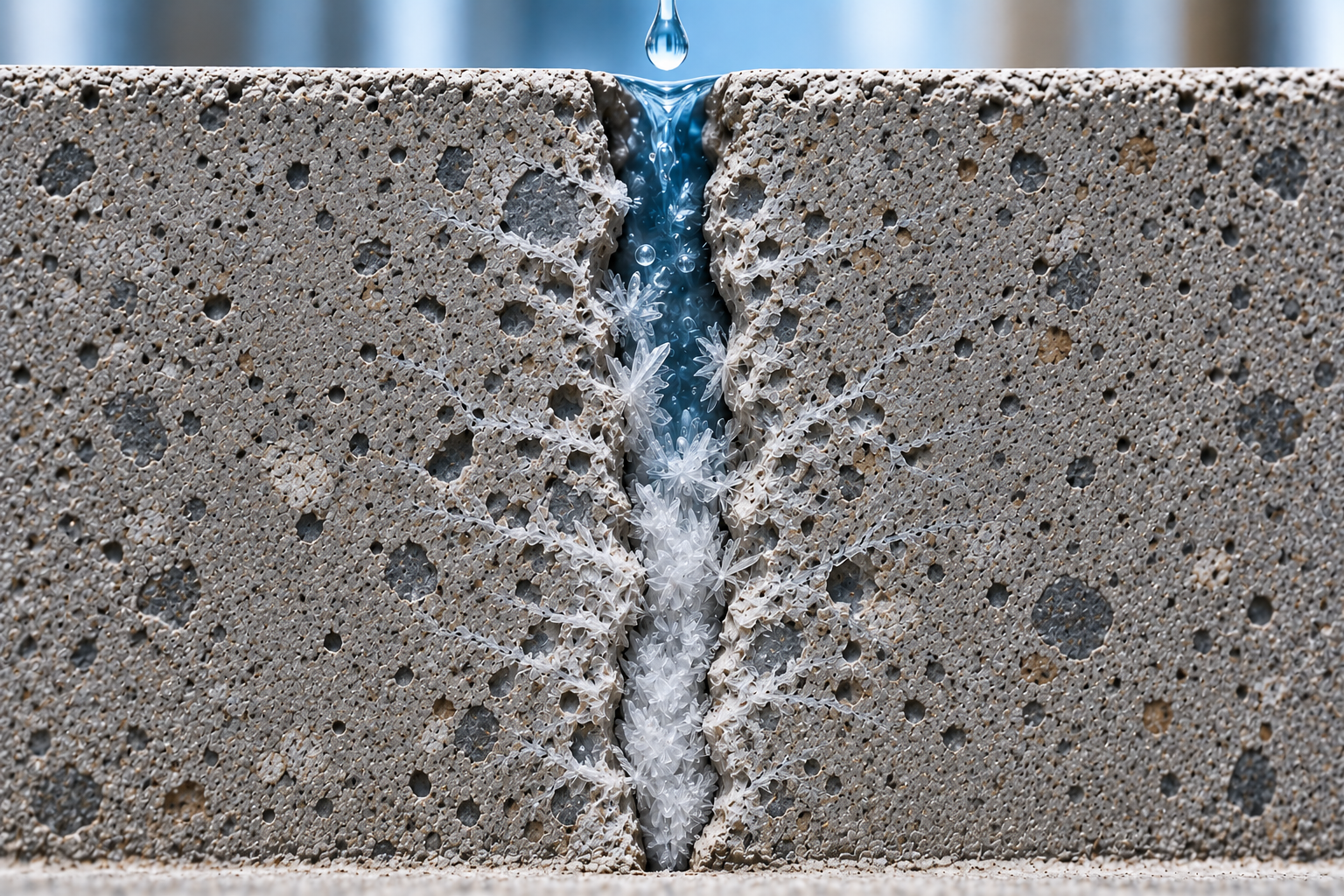
As crystalline formations develop through the crack, the pathway available for water transmission becomes increasingly restricted.
The engineering objective is therefore watertightness, not cosmetic disappearance of the crack.
The time required can also vary. Xypex’s C-Series specification states that crack healing may take several days to weeks depending on job-site and ambient conditions. Cracks that do not heal within the allowable project timeframe should be repaired.
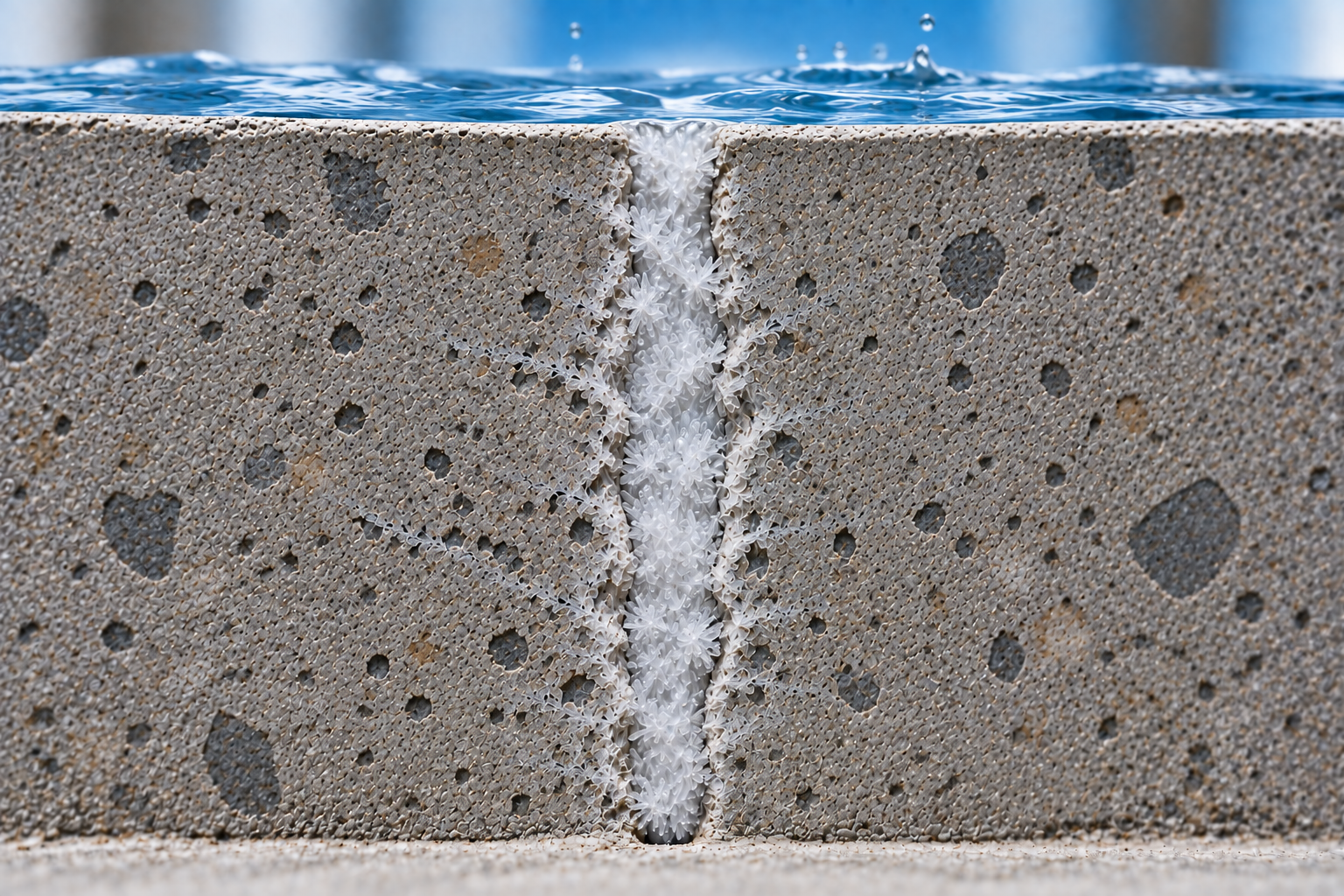
What Does the Evidence Show About Xypex Crack Healing?
The 0.5 mm figure should be connected to documented Xypex testing rather than treated as a generic property of crystalline waterproofing.
One crack-healing test described by Xypex involved concrete slabs containing Xypex Admix C-1000 NF and untreated control slabs.
According to the manufacturer’s published account, cracks were deliberately introduced into the concrete and water was ponded above them. Xypex reports that leaking through the treated panels stopped after four days, while the untreated control specimens continued leaking through the test period. Scanning electron microscopy was also used to examine crystalline development.
Another Xypex technical publication describes treated panels with an average crack width of approximately 0.38 mm in which leakage stopped after four days, compared with untreated control specimens that continued leaking beyond the test period.
These observations provide supporting evidence for the manufacturer’s crack-healing claim.
However, they should not be interpreted as proof that every crack of a given width will seal within four days.
Concrete composition, crack geometry, moisture availability, temperature, age, exposure conditions, and other project variables can affect actual behavior.
Why Is the 0.5 mm Crack-Healing Capability Important?
The significance of crack healing becomes clearer when considering how water moves through reinforced concrete.
A crack can provide a preferential pathway for moisture and dissolved substances.
In structures exposed to groundwater, retained water, rainfall, or aggressive environments, controlling those pathways is an important part of waterproofing and durability design.
For example, crack-healing capability can be particularly relevant in:
- basements and below-grade structures
- water tanks and reservoirs
- tunnels and underground infrastructure
- sewage and water-treatment structures
- foundations
- parking structures
- precast concrete
- bridge and infrastructure concrete
- other concrete exposed to persistent moisture
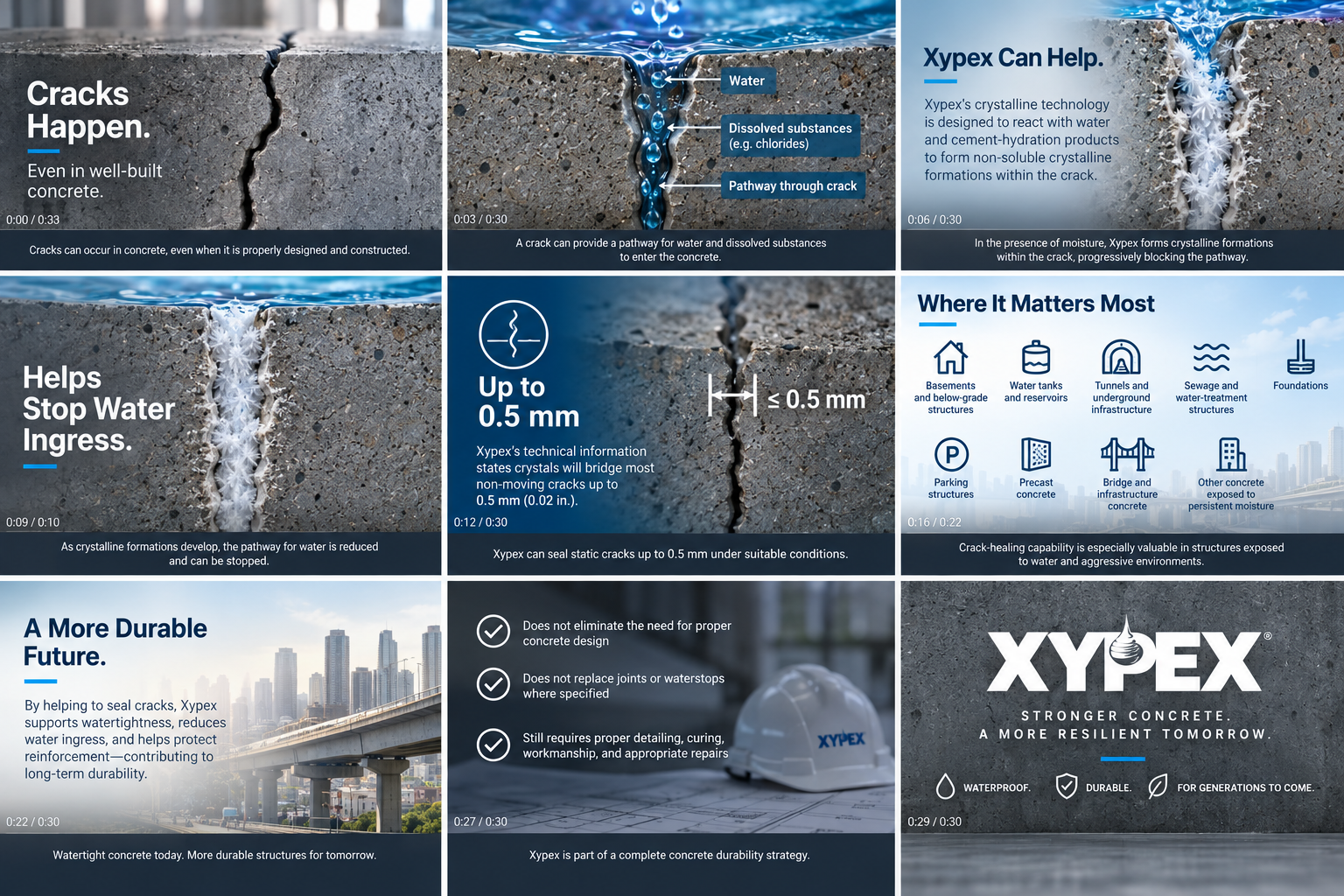
Xypex lists many of these applications for its Admix C-Series.
The benefit is especially relevant where waterproofing has been incorporated into the concrete through an integral crystalline admixture.
Instead of relying solely on maintaining the continuity of an external barrier, the concrete itself contains the crystalline waterproofing treatment.
However, this does not eliminate the need for proper concrete design, crack control, joints, waterstops where specified, penetration detailing, curing, workmanship, or appropriate repair
Why Does This Matter in Philippine Concrete Construction?
Philippine concrete structures can be exposed to substantial moisture.
Heavy rainfall, high humidity, groundwater, water-retaining applications, coastal exposure, and below-grade construction can all create conditions in which controlling water penetration becomes important.
A waterproofing strategy that can respond to certain small static cracks can therefore provide a useful additional mechanism for maintaining watertightness.
But the Philippine environment does not change the fundamental engineering limitation:
Xypex’s 0.5 mm crack-healing capability applies to static cracks not cracks that are continuing to move.
This distinction becomes particularly important for large infrastructure, elevated structures, tunnels, basements, water-retaining structures, and precast construction where joints and movement can be significant design considerations.
Static Cracks vs Moving Cracks: What Is the Difference?
Crack condition
Xypex crystalline approach
Xypex’s C-Series specification provides additional guidance for cracks and concrete defects. It calls for appropriate repair procedures when cracks exceed the applicable crack-healing criteria.
Moving cracks require a different approach. Depending on the condition, the repair may require polyurethane injection or another suitable system. Engineers should select the repair method based on the crack’s movement and project requirements.
Therefore, engineers should not use the 0.5 mm figure as a reason to ignore cracks in concrete. Crack width is only one part of the assessment.
Before relying on Xypex crack healing, determine whether the crack is truly static. Engineers should also consider its cause, movement, leakage, structural significance, and exposure conditions.
The goal is not simply to close a visible crack. The goal is to select a waterproofing or repair approach that maintains watertightness and long-term concrete durability.
Can Xypex Repair Cracks Larger Than 0.5 mm?
Potentially, but this becomes a repair procedure rather than simply relying on autonomous crystalline crack healing.
Xypex’s technical note states that non-moving cracks larger than 0.5 mm can be treated using appropriate Xypex crack-repair procedures. The document describes a chip-and-pack approach for certain cracks greater than 0.5 mm but less than 3 mm.
Xypex Concentrate can also be mixed in Dry-Pac form for repairing cracks, faulty construction joints, and honeycombed concrete.
The distinction is therefore:
≤0.5 mm static crack
Crystalline self-healing may be relied upon where appropriate under the manufacturer’s requirements.
Larger static crack
Inspect and repair according to the appropriate procedure rather than simply waiting for spontaneous healing.
Moving or structural crack
Determine the cause and use a repair or joint solution appropriate to the movement and structural condition.
Does Xypex Make Concrete Crack-Proof?
No. Xypex crack healing does not prevent concrete from cracking.
Concrete can crack for many reasons. These include shrinkage, thermal movement, structural loading, restraint, and construction conditions. Concrete mix design, reinforcement, curing, joint design, and workmanship can also affect cracking.
Instead, Xypex crack healing focuses on restoring watertightness in certain static cracks after they form. According to Xypex, its crystalline technology can seal suitable static cracks up to 0.5 mm under appropriate conditions.
Therefore, Xypex should not be described as making concrete “crack-proof.” Engineers must still use proper concrete design and crack-control measures.
Good construction practices also remain essential. These include proper reinforcement, joint detailing, concrete placement, curing, and workmanship.
This distinction is important when specifying Xypex crystalline waterproofing. It also matters when considering Xypex as an alternative to conventional waterproofing systems.
The goal of Xypex crack healing is not to stop concrete from ever cracking. Instead, it can help reduce water ingress through suitable static cracks and support long-term watertightness.
Does Xypex Crack Healing Make the Crack Disappear?
Not necessarily. Xypex crack healing focuses on watertightness rather than the cosmetic disappearance of a concrete crack.
A static crack may remain visible at the concrete surface after crystalline development occurs. However, the formations within the crack can help restrict water pathways and reduce water ingress.
Therefore, the more important performance question is:
Has the crack become watertight?
This is more relevant to waterproofing performance than simply asking:
Can the crack still be seen?
A visible crack does not automatically mean that water can still pass through it. Likewise, a watertight crack may still require additional repair for other reasons.
For example, a project may require a smooth architectural finish or structural restoration. Exposed reinforcement may also require treatment and protection. In these cases, additional concrete repair may still be necessary.
Therefore, engineers should evaluate Xypex crack healing based on the required waterproofing performance. Cosmetic appearance, structural condition, and other project requirements should be assessed separately.
How Long Does Xypex Take to Seal a Static Crack?
There is no universal Xypex crack-healing time for every static crack. According to Xypex specifications, healing can take several days to weeks. The actual time depends on site and ambient conditions.
Where practical, actively leaking cracks and joints may receive time to self-heal. Moisture supports the crystalline process within the concrete. However, actual performance can vary between projects.
Published Xypex demonstrations have reported leakage stopping after four days in specific treated test panels. However, engineers should not treat this result as a guaranteed four-day healing period.
Several factors can affect Xypex crack healing. These include crack characteristics, concrete condition, moisture availability, temperature, and exposure conditions.
Therefore, project teams should monitor the crack for watertightness rather than rely on a fixed number of days. They should also consider the project’s waterproofing requirements and construction schedule.
If a static crack does not become watertight within the allowable timeframe, further evaluation may be necessary. The crack may also require an appropriate repair procedure.
What Happens If the Crack Does Not Self-Heal?
If Xypex crack healing does not stop the water leakage, the crack requires further evaluation. Project teams should not simply assume that crystalline activity will eventually make the crack watertight.
Xypex’s C-Series specification provides guidance for this condition. Static cracks or joints that do not heal within the allowable timeframe should receive the appropriate Xypex repair procedure.
First, determine whether the crack is truly static. A crack that continues to move may require a different repair approach.
Continued water leakage can have several possible causes. These may include crack movement, crack geometry, insufficient healing time, or unfavorable site conditions. Another concrete defect may also contribute to the leakage.
Therefore, engineers should evaluate the crack condition, movement, water leakage, and site conditions before selecting a repair method.
The goal of Xypex crack healing is to restore watertightness in suitable static cracks. If the crack does not become watertight within the acceptable timeframe, further investigation and appropriate concrete repair may be necessary.
Can Xypex Replace Waterstops at Construction Joints?
No, Xypex should not automatically replace waterstops at construction joints. Crack healing and joint waterproofing perform different functions in watertight concrete design.
A construction joint creates an intentional discontinuity between concrete placements. Therefore, engineers must consider the joint separately from cracks that develop within the concrete.
Xypex crack healing can help seal certain static cracks under suitable conditions. However, this capability does not automatically eliminate the need for a waterstop or another specified joint-waterproofing system.
If the project design requires a waterstop, engineers should follow that requirement. Any proposed change should undergo proper technical review before removing or modifying the specified joint treatment.
This distinction becomes even more important at expansion and movement joints. These joints must accommodate expected movement. Crystalline crack healing alone does not perform that function.
In simple terms:
Crystalline waterproofing helps protect the concrete matrix. Waterstops and engineered joint systems help control water at designated joints.
Therefore, engineers should evaluate Xypex crystalline waterproofing and waterstops as parts of the overall waterproofing design. They should not assume that one automatically replaces the other.
The final joint detail should consider movement, water pressure, construction sequence, concrete design, and project specifications. Proper joint detailing remains essential for long-term watertightness.
What Should Engineers Evaluate Before Relying on the 0.5 mm Capability?
Before relying on Xypex crack healing as part of a waterproofing design, engineers and specifiers should evaluate:
Whether the crack is genuinely static
Measured crack width
Cause of cracking
Evidence of continuing movement
Structural significance
Active water flow or hydrostatic exposure
Concrete condition and quality
Joint and penetration detailing
Applicable Xypex product and dosage
Curing and moisture conditions
Allowable time for crack healing
Project watertightness criteria
Crack width should therefore be treated as one evaluation criterion, not the only criterion.
Frequently Asked Questions
Can Xypex seal cracks up to 0.5 mm?
Yes. According to Xypex Chemical Corporation, Xypex Crystalline Technology can seal static hairline cracks up to 0.5 mm (0.02 in.) under suitable conditions.
However, this capability applies to static or non-moving cracks. Engineers should not apply the same claim to moving or structural cracks.
Crack width is also only one consideration. Movement, leakage, structural condition, and exposure should form part of the assessment.
Is the 0.5 mm capability applicable to every crystalline waterproofing product?
No. The 0.5 mm crack-healing capability is specific to Xypex Crystalline Technology based on the manufacturer’s published documentation.
Engineers should not treat 0.5 mm as a universal limit for all crystalline waterproofing products. Each system should be evaluated using its own technical data, test evidence, and manufacturer requirements.
Does Xypex prevent concrete from cracking?
No. Xypex crack healing does not make concrete crack-proof.
Concrete can crack because of shrinkage, thermal movement, restraint, loading, and other factors. Concrete design, reinforcement, curing, joint detailing, and workmanship also influence cracking.
Instead, Xypex crystalline technology can help restore watertightness in certain static cracks after they form.
Can Xypex heal moving cracks?
Xypex crystalline crack healing should not serve as the sole treatment for a moving crack.
Xypex technical documentation distinguishes static cracks from cracks that experience continued or periodic movement. Moving cracks may require a repair system designed to accommodate that movement.
Therefore, engineers should first determine whether a crack is truly static before relying on crystalline crack healing.
What happens if a static crack is wider than 0.5 mm?
A static crack wider than 0.5 mm falls outside the stated Xypex crack-healing capability discussed in this article.
Engineers should evaluate the crack rather than assume it will self-heal. Where appropriate, the crack may require an applicable Xypex repair procedure or another engineered repair system.
The final repair method should consider crack width, movement, leakage, concrete condition, and project requirements.
Does a concrete crack disappear after Xypex crack healing?
Not necessarily. Xypex crack healing focuses on watertightness rather than cosmetic crack removal.
A crack may remain visible at the concrete surface after crystalline development restricts the water pathway. Therefore, visual appearance and waterproofing performance should be evaluated separately.
Additional concrete repair may still be necessary when the project requires structural restoration or a specific architectural finish.
Does Xypex need water for crack healing?
Moisture plays an important role in the Xypex crystalline process.
Xypex describes its technology as using reactions involving water and cement-hydration products. These reactions promote insoluble crystalline formations within pores, capillaries, and certain water pathways in concrete.
This moisture-responsive mechanism helps explain why Xypex crystalline technology can remain relevant in concrete exposed to water or hydrostatic conditions.
How long does Xypex crack healing take?
There is no universal healing time. According to Xypex specifications, crack healing can take several days to weeks, depending on site and ambient conditions.
Published Xypex demonstrations have reported leakage stopping after four days in specific test panels. However, engineers should not treat four days as a guaranteed healing period for every project.
Project teams should monitor the crack for watertightness within the allowable project timeframe.
Should every concrete crack below 0.5 mm simply be left to heal?
No. Crack width alone does not determine whether Xypex crack healing is appropriate.
Engineers should also consider the cause of the crack, movement, leakage, structural significance, location, and exposure conditions.
A crack below 0.5 mm may still require investigation or repair if it continues moving or leaking. The same applies when the crack indicates a structural concern.
Can Xypex replace waterstops at construction joints?
Not as a general rule. Xypex crack healing and waterstops perform different functions.
Crystalline technology can help protect the concrete matrix and address certain static cracks. A waterstop helps control water passage through a designated construction joint.
Where the project design requires a waterstop, engineers should not remove it solely because the concrete contains Xypex. Any proposed change should undergo proper technical and engineering review.
Still have questions? Check out our FAQ page or send us a message
Conclusion
The ability of Xypex Crystalline Technology to seal static cracks up to 0.5 mm is an important characteristic of its approach to concrete waterproofing.
According to Xypex technical documentation, moisture can support crystalline development within the concrete and across suitable non-moving cracks. As these formations develop, they can obstruct the pathways through which water passes.
But the engineering qualification is just as important as the performance claim.
The 0.5 mm capability applies to static cracks. It does not mean that Xypex prevents cracking, repairs structural defects, accommodates expansion-joint movement, or automatically eliminates the need for waterstops and engineered joint systems.
For cracks exceeding the applicable limits, cracks that continue moving, or leakage that does not heal within an acceptable period, further assessment and appropriate repair are required.
For Philippine projects considering Xypex Admix or Xypex repair systems, Ava Concrete Protection can review the concrete application, waterproofing requirements, joints, penetrations, crack conditions, and relevant Xypex technical documentation to help determine the appropriate approach.
The objective should not simply be to specify a waterproofing product.
It should be to design watertight and durable concrete in which the concrete, crystalline waterproofing, crack control, joints, penetrations, repairs, and complementary systems work together.
Request Project Evaluation