


by
Tunnels operate in one of the most demanding environments for reinforced concrete. Depending on their depth, geology, and groundwater conditions, tunnel structures may face continuous exposure to groundwater and hydrostatic pressure. Consequently, engineers must consider effective waterproofing solutions to protect tunnel structures and maintain their long-term durability.
Although water does not need a large visible opening to create problems, even small pathways can allow moisture to penetrate concrete. For instance, concrete naturally contains interconnected pores and capillaries. In addition, construction activities can introduce joints, cracks, tie holes, honeycombing, and other potential pathways for water ingress. Furthermore, sustained hydrostatic pressure can force water through these openings. As a result, leakage may occur, exposing concrete and reinforcing steel to moisture and potentially aggressive dissolved substances.
Xypex Crystalline Waterproofing, however, takes a different approach from conventional surface barriers. Instead of relying solely on a surface-applied membrane, Xypex uses a chemical reaction within the concrete’s pore structure. During this process, active chemicals react with moisture and cement hydration by-products to form insoluble crystalline structures within concrete pores and capillaries. Consequently, these formations help reduce pathways through which pressurized water can penetrate. Moreover, this technology provides integral waterproofing protection within the concrete itself.
For tunnel applications, this distinction becomes particularly important because contractors often lose access to concrete surfaces after excavation, backfilling, and permanent construction works. Therefore, engineers can incorporate crystalline waterproofing into a properly designed tunnel waterproofing system to help improve long-term protection against groundwater infiltration.
Quick Answer
Xypex Crystalline Technology reacts with water and products of cement hydration to develop insoluble crystalline formations within pores, capillaries and certain cracks in concrete. By restricting these pathways, the treatment reduces water penetration through the concrete rather than relying only on an external surface barrier. Xypex reports independent permeability testing of treated concrete at pressures up to 1.2 MPa (175 psi), equivalent to approximately 123.4 m (405 ft) of water head.
That test result should not be interpreted as a universal design pressure for every tunnel. Tunnel waterproofing still requires project-specific consideration of the concrete, joints, penetrations, cracks, structural movement, groundwater conditions and construction methodology.
What Is Hydrostatic Pressure in Tunnel Construction?
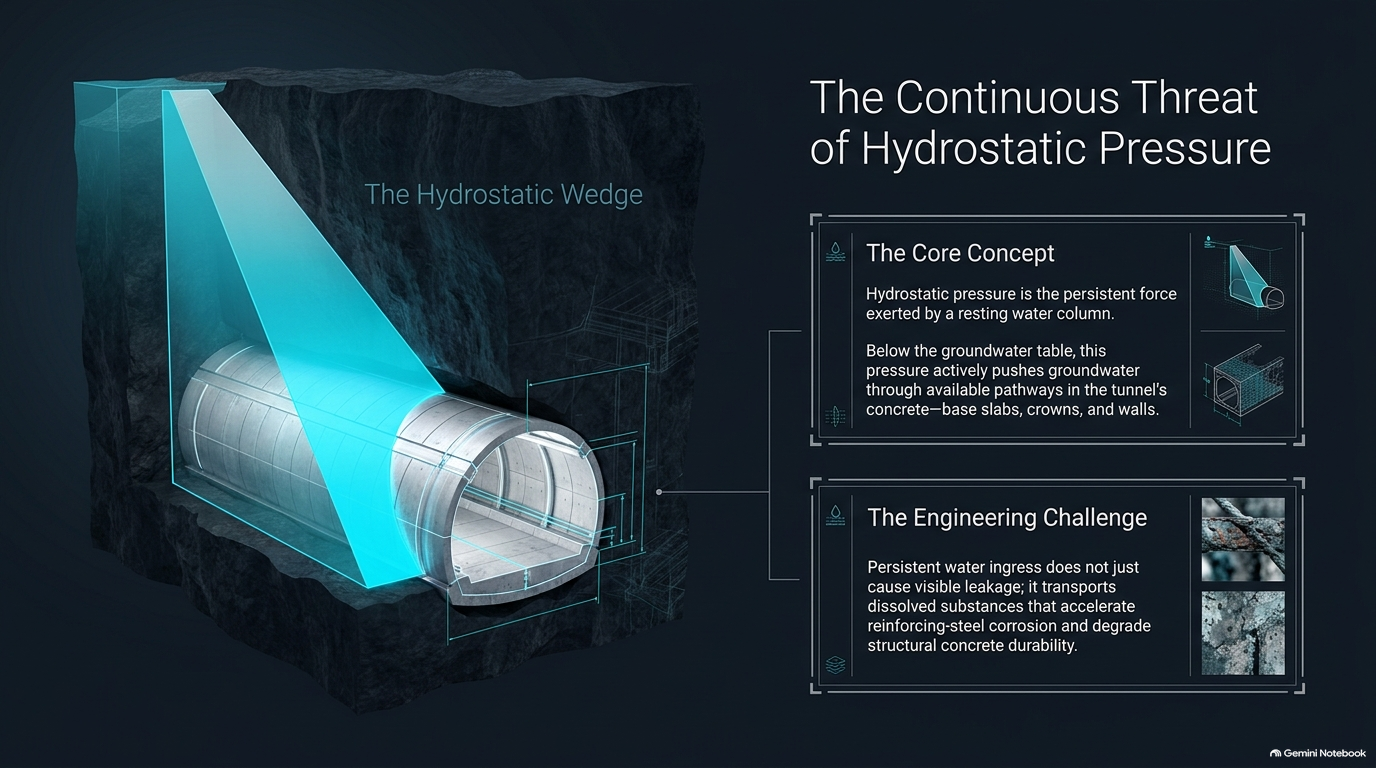
Hydrostatic pressure is the pressure exerted by water at rest as a result of the height of the water column above a given point.
For an underground structure below the groundwater table, the deeper the structure is below that water level, the greater the potential hydrostatic pressure acting against it.
This is important because tunnel waterproofing is not simply about preventing rainwater from entering the structure.
Groundwater may continuously push against tunnel walls, base slabs, crowns and other below-grade concrete components. The pressure can drive water through available pathways in the concrete and through defects or discontinuities.
Xypex identifies hydrostatic pressure, high water tables, concrete permeability, cracks, construction defects and leaking joints among the principal waterproofing challenges encountered in tunnel structures.
Why Is Hydrostatic Pressure a Problem for Concrete Tunnels?
Concrete is durable, but it is not inherently impermeable.
At a microscopic level, hardened concrete contains pores and capillary pathways. Actual construction may also introduce additional routes for water, including:
- Construction and cold joints
- Shrinkage cracks
- Tie holes
- Honeycombing
- Rock pockets
- Penetrations
- Poorly consolidated concrete
Under hydrostatic pressure, groundwater can exploit connected pathways through the concrete.
The engineering concern is not limited to visible leakage. Persistent water ingress can also contribute to the transport of substances that may affect concrete durability or reinforcing-steel corrosion, depending on the groundwater chemistry and exposure conditions.
For tunnels, these problems can be particularly difficult because access to the exterior face of the structure may be restricted after construction.
How Does Xypex Crystalline Waterproofing Work?
According to Xypex’s technical explanation, its active chemicals use moisture and chemical diffusion to move through concrete pores and capillaries. They react with water and products associated with cement hydration to develop a non-soluble crystalline structure within the concrete. Xypex global
1. Water enters the concrete’s pore structure
Concrete naturally contains pores and capillary pathways. Hydrostatic pressure increases the driving force for this water movement.
2. Xypex reacts within the concrete
In the presence of moisture, Xypex’s reactive constituents interact with cement hydration products and other constituents within the concrete matrix. This initiates the crystalline reaction.
3. Insoluble crystalline formations develop
The resulting crystalline formations occupy pores, capillary tracts and certain water pathways. Instead of placing only a barrier between the water and concrete, the objective is therefore to make the concrete itself more resistant to water penetration. This internal mechanism is central to Xypex’s claimed performance under hydrostatic pressure. Xypex global
How Can Xypex Be Incorporated Into New Tunnel Concrete?
For new construction, Xypex Admix C-Series can be introduced into the concrete during batching.
The crystalline technology therefore becomes incorporated throughout the treated concrete rather than being applied only to an accessible external face.
Xypex identifies its technology for cut-and-cover, bored, immersed-tube and other tunnel construction methods, including cast concrete, precast concrete and shotcrete applications. Xypex global
Product selection, dosage, batching procedure and concrete compatibility should nevertheless follow the project specification and current manufacturer technical requirements.
What Does a Real Tunnel Project Show?
Tunnel 45 — Alexandria, Egypt
A useful manufacturer-documented example is Tunnel 45 in Alexandria, Egypt.
According to Xypex, the tunnel is located near the Mediterranean and faced challenging groundwater conditions involving chemical exposure and high hydrostatic pressure.
The project documentation identifies the Engineering Center at the Faculty of Engineering, Alexandria University as consultant and Al-Gharabli for Integrated Engineering Works Company as contractor. Xypex global
This project is useful because it demonstrates the intended application of integral crystalline waterproofing in an actual tunnel exposed to groundwater conditions.

Xypex Crystalline Waterproofing vs Tunnel Membranes
| Consideration | Xypex integral crystalline approach | Membrane approach |
| Primary waterproofing location | Within concrete pore structure | Surface/interface around concrete |
| Surface adhesion dependency | Not the primary mechanism | Usually important |
| Damage during later construction | Internal mechanism reduces dependence on exposed surface | Membrane may require protection depending on system |
| Hydrostatic-pressure performance | Must be supported by appropriate testing | Depends on membrane/system specification |
| Joints | Separate detailing may still be required | Separate joint detailing normally required |
| Moving cracks | Requires specific treatment/design | Performance depends on membrane movement capability |
| Exterior access | Integral treatment remains within concrete | Repair may be difficult if membrane becomes inaccessible |
| Application | Can be incorporated during batching for Admix | Separate installation operation normally required |
| Suitability | Project-specific | Project-specific |
Frequently Asked Questions
Can Xypex withstand hydrostatic pressure?
Yes. Xypex Crystalline Waterproofing helps concrete resist hydrostatic pressure. Independent laboratory tests reported by Xypex reached 1.2 MPa (175 psi), equivalent to approximately 123.4 meters of water head. However, actual performance depends on project conditions and engineering design.
Can Xypex waterproof the negative side of tunnels?
Yes. Xypex forms crystals within concrete pores and capillaries, helping resist water penetration from either direction. Therefore, engineers can consider it for negative-side tunnel waterproofing, depending on product suitability and concrete conditions.
Can Xypex replace tunnel waterproofing membranes?
In some cases, yes. Xypex tunnel waterproofing may provide an alternative to traditional membranes. However, engineers must evaluate groundwater pressure, structural requirements, construction joints, and project specifications before approving a substitution.
Does Xypex eliminate the need for waterstops?
No. Construction joints and movement joints still require appropriate waterproofing details. Therefore, engineers should combine Xypex crystalline technology with suitable waterstops and joint protection systems.
Can Xypex repair leaking tunnels?
Yes. Xypex offers repair products such as Xypex Concentrate and Xypex Patch’n Plug to address suitable concrete leaks. However, contractors must first identify the leakage source and select the appropriate repair method.
Does Xypex prevent concrete cracking?
No. Xypex does not prevent structural or movement-related cracks. However, its crystalline technology can help seal suitable static hairline cracks up to 0.5 mm under appropriate conditions.
Why choose integral waterproofing for tunnels?
Integral waterproofing protects concrete from within. Unlike external membranes, Xypex crystalline technology works inside the concrete structure. Consequently, it offers an advantage in tunnels where external surfaces become difficult to access after construction.
Still have questions? Check out our FAQ page or send us a message
Conclusion
Xypex Tunnel Waterproofing helps protect concrete against hydrostatic pressure by forming insoluble crystals within pores and capillaries. As a result, it reduces water penetration and improves long-term concrete durability.
Furthermore, laboratory tests and tunnel projects demonstrate the practical applications of Xypex crystalline technology. However, effective tunnel waterproofing also requires proper joint protection, concrete quality, and construction detailing.
For subway tunnels and underground infrastructure in the Philippines, AVA Concrete Protection provides technical consultation and Xypex waterproofing solutions based on project requirements.
Contact AVA Concrete Protection to discuss your tunnel waterproofing needs.